

This story was written in partnership between RANGE and FāVS News, a nonprofit newsroom covering faith and values in the Inland Northwest. Learn more about FāVS’s work here.
I’ve been preached at a lot in my career as a journalist who covers Christian nationalism. The Christians I’ve encountered have laid hands on me — which in Christianese means to pray while touching me — and told me the Lord is calling me. They say they long for the day I profess Christ as my king.
But I’d never been preached about until I came into the orbit of pastor of The Pursuit, Russell Johnson. He didn’t seem to want me in the fold at all.
“We have security at all the campuses … just because of the world that we're in, the region we're in, the political climate we're in,” Johnson warned his congregation. The pastor spoke in a Southern drawl that he'd somehow cultivated growing up in Seattle. At The Pursuit during that Palm Sunday sermon, Johnson wore a black T-shirt that read “HOLLYWOOD” under a blazer with a Gucci tag on the sleeve, an angled fringe haircut and large-framed glasses.
The Pursuit, a chain of west-side megachurches that has just expanded to Spokane, recently bought and moved into the property of the beautiful old Lutheran church in Browne’s Addition. The church’s planting has caused a stir in the neighborhood; as the locals sense, it is one of the biggest Pacific Northwest organizing hubs in the Christian supremacist movements trying to establish Jesus, rather than voters, as the highest authority in American government. (Read more from expert Kate Burns about this movement and Johnson’s place in it here.)
Since Johnson founded The Pursuit in 2014 in a barn, it has grown to four locations across Washington state, the headquarters in Snohomish and satellite locations in Seattle, Kirkland and here in Spokane. Johnson travels between them in a private helicopter.
He believes Christians are the victims of the culture wars, as he said on Palm Sunday, describing a sermon he’d recently delivered at the Spokane location.
“I notice a guy trying to get on the stage. Security stops him, and then he tries to get on stage again, a second time, and security stops him. And by the third time that he's trying to get on stage, finally, security helps escort him to the exit and tells him that he can't come back.”
That guy? He was referring to me.
But that isn't what happened — it’s not even close.
Not charging the stage
Two Sundays before, I was at the church’s first “Revival Nights” event taking photos and recording audio, like I normally do when I’m reporting on far-right churches, but this time I was told that the congregation found it distracting. That’s fair: most of the other folks at the church were quietly sitting in their seats while I hunted in the periphery for a good photo angle.
What I did not do was try to get on stage. Not even once. Imagine my surprise when I heard Johnson, in a live-stream of the Palm Sunday service, tell his congregation that not only did I try to storm the pulpit three times, but that I was drunk.
For the record: This was a mix of exaggerations and falsehoods. So I’d like to clear up his narrative. I’d had some wine earlier in the day that Sunday, which was probably in bad taste, but I was not drunk.
For the record: I tried to interview him after the event — would love to sit down with him over a coffee — but sharing a stage with him is right up there with unanesthetized dental work as the last thing I want.
For the record: I left politely the first time I was asked — and I have a text thread with Travis, the security guard who escorted me out, to prove it.
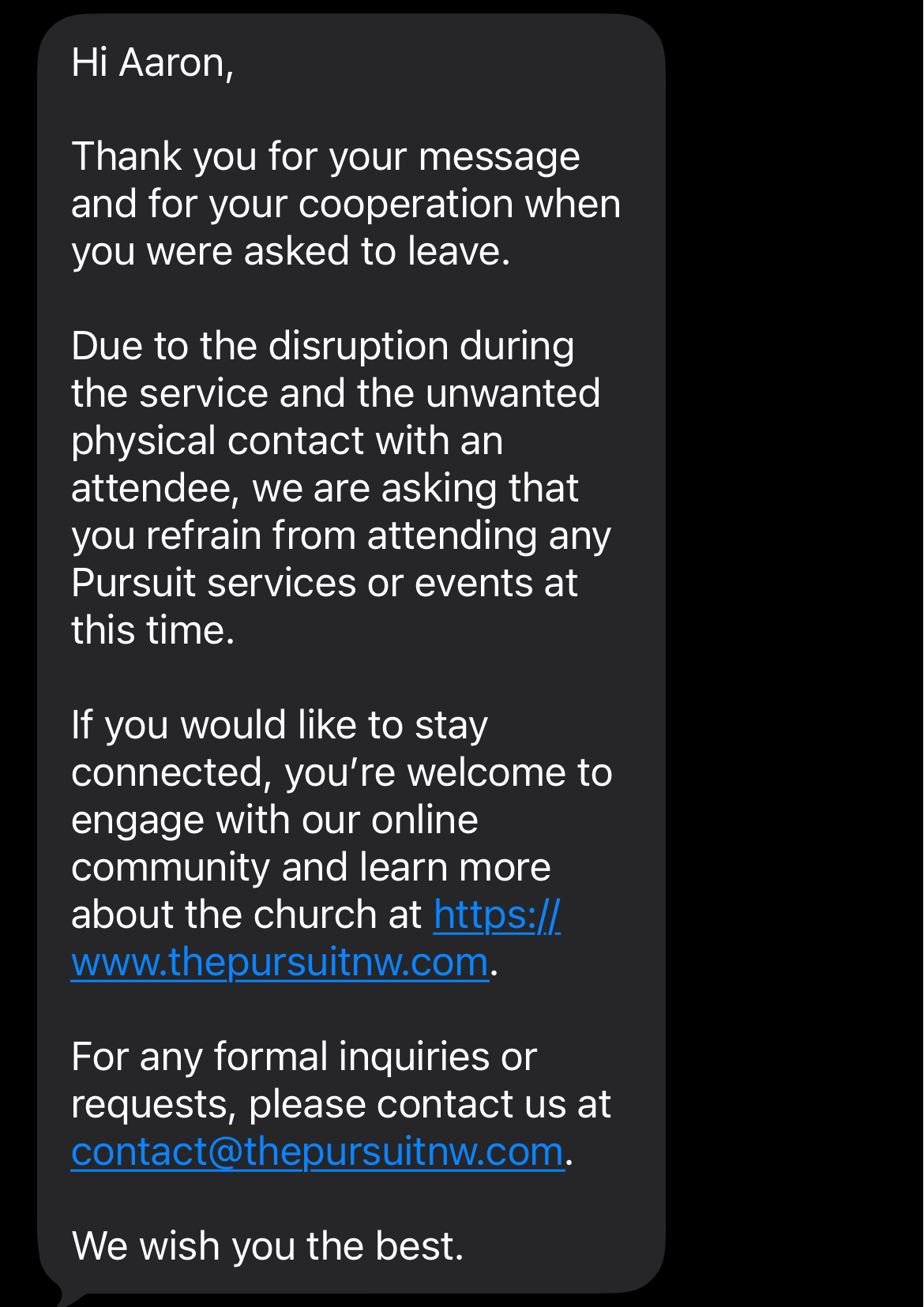
But Johnson was not satisfied with his blown-up story about me being escorted out. He needed to give me an agenda.
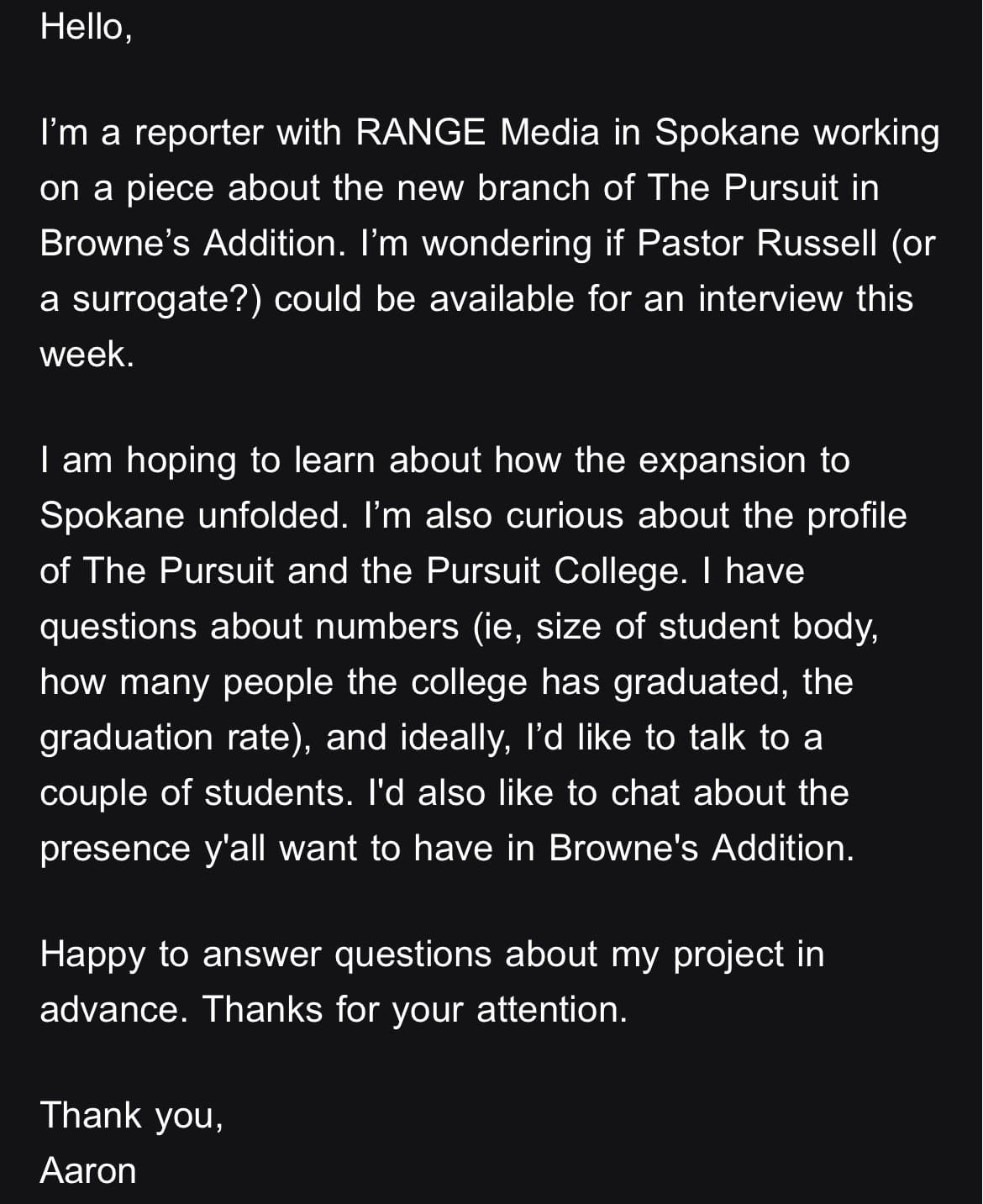
“And so then I wake up the next day,” Johnson continued in his sermon, “I got an email in my inbox from this reporter: ‘Would you like to sit down for an interview? We're writing a hit piece anyways. We'll give you a chance to respond, and we want to hear both sides but we're letting you know the article is going to come out, and you better sit down with us right away and give us your side of the story.’”
For the record: it generally doesn’t much serve a reporter to tell someone they are trying to interview that they want to write a hit piece. For the record, sigh, I did not do that, either.
The Johnson method
This is not the first time Johnson has spun a run-in with a Spokane-connected reporter into a public controversy. Nate Sanford, a former Inlander reporter who’s now at Cascade PBS and KNKX, was investigating AI usage when Johnson posted to Twitter audio of a voicemail containing hateful language toward Christians under the comment “Another satisfied customer.” Most of the replies reveled that Johnson had landed YET ANOTHER blow in the constant spiritual war playing out on Twitter and Instagram. (When Johnson is not preaching, slicing into a filet mignon at Ascend in Bellevue, scoping out the next multimillion-dollar property to purchase for his church, playing Call of Duty, or “trying to finish my PhD,” he is fighting demons on social media.) But a reply far down in the thread seemed to notice the flat and mechanical quality of the audio. “Bill Billerson” said “This is fake.”
Sanford emailed Johnson to ask about it. One day — and 20 of Johnson’s tweets — later, Johnson posted a screenshot of Sanford’s email including Sanford's email address and cell phone number under the message “you don’t hate the media enough.”
“People said some mean things on Twitter and it was a little annoying for a few days, but it was, you know, whatever,” Sanford told me. “But, you know, he definitely has a habit of posting reporters' emails on Twitter.”
Fighting the natives
Obviously, neither mine nor Sanford’s behavior was Johnson’s point. But the specter of a drunken, stage-stealing, reputation-assassin reporter infiltrating a holy space is a handy foil for a pastor who wants to tell his congregation that he won’t back down from the dark secular forces of a godless neighborhood like Browne’s Addition.
If there is any sin that infects the neighborhood, it is NIMBYism. The community has complained repeatedly to the city of Spokane about The Pursuit: floodlights keep people up at night, The Pursuit lacked a permit to operate an assembly, construction crews were breaking down walls before building permits were approved.
Fifteen residents noted in interviews that the church was hosting more congregants than the fire code allows, that they’d ripped up a beloved community garden, that churchgoers were blocking driveways and fire hydrants with their cars, that Johnson has a history of going into queer neighborhoods and staging confrontations with protesters, that unknown security personnel were patrolling the grounds with long guns and in Kevlar, menacing passersby.
The city has asked The Pursuit to comply with the rules, and a city official told me the church is cooperating.
But the neighbors’ concerns don’t seem to matter to Johnson — he’s on a more important, divinely-inspired mission.
“The reason why we planted a church in Spokane is because the Lord was in need of it,” Johnson said.
So, a reporter getting kicked out of a church or asking him a question about a tweet positions him as God’s good warrior. And here’s the bigger playbook that he’s already used in other PNW cities: start a visible controversy in an otherwise sleepy neighborhood known for its friendliness to queer and other marginalized groups, demonize anyone who doesn’t want him there, declare that the neighborhood belongs to Christ, and that he’s fighting God’s holy war against secularism.
When Johnson helped anti-trans Portland pastor Jenny Donnelly and the Spokane dominionist Matt Shea organize the Seattle stop of a national tour to oppose gender-affirming care, he and Shea told media outlets that counterprotesters had lobbed “urine-filled balloons” at the Christians. There is no evidence to support that assertion. The exaggerating or fabricating of threats to the church is a well-trod path that Christian nationalist figures bring to Spokane every few months. You can taste its flavor in Sean Feucht’s long relationship with the city.
The Pursuit’s evolution is chronicled in the highly-produced hagiographical documentary it made about itself in 2024 called “The Kids from the Barn” here. Watching it will give you a window into Johnson’s rhetorical flair. And you can read more about how Johnson is leaning into that pattern in Emry Dinman’s exhaustive and excellent profile of The Pursuit in The Spokesman here.
Who brought it here?
The Pursuit’s sudden appearance in Browne’s Addition, at its core, is deeply connected to far-right and Christian nationalist movements, which I’ve been writing about for years. And that’s why, even though Johnson marked me a blemished goat and disinvited me from the fold, I can still tell you a bit more about how they got here.
The Pursuit’s journey to Spokane starts with three Eastern Washington men who were part of Johnson’s organizing circles: Gabe Blomgren, Titus Hug and Gavan Spies. They are connected through the dominionist soldier-politician-turned-apostle Matt Shea’s church On Fire Ministries, which Blomgren and Hug helped found as elders, and of which Spies is at least a some-time attendee.
Blomgren, with whom I have a friendly reporting relationship and is being groomed as Pursuit Spokane’s worship pastor, did an on-the-record interview with me several weeks ago about The Pursuit. I disagree with him about important issues like queer rights and reproductive healthcare, but he’s been kind to me and generous with his time. I’ve always enjoyed our conversations.
I asked him if queer people could go to The Pursuit. He said, “Yes, all are welcome, but there’s a real distinction between attendees and members. Anyone seeking active membership has to agree with the church’s view on biblical teachings.” Anyone can attend a service at most churches. But to become a member means to enter a formal agreement with the church, and one of the provisions is to sign onto its doctrine and commit to its rules. The Pursuit interprets scripture to say that queerness is sinful.
“I don’t think someone who disagrees with the church’s doctrine would feel at home as a long-term member,” Blomgren said. Still he encouraged people to “come and see for themselves.”
The three wise men
Blomgren, who has previously worked as a mail carrier, did a years-long stint as a member of Covenant Christian Church in Spokane. That church operated a related ministry called The Church At Planned Parenthood, which staged what they called “worship services at the gates of Hell.” These abortion protests in front of the Spokane Planned Parenthood, at which Blomgren was present, netted the ministry about $1 million worth of legal costs over harassment allegations.
In 2020, Shea, who has no formal training as a pastor, was hired to lead Covenant Church. In 2021, Shea left with a good chunk of the Covenant congregation from which he founded On Fire, and Blomgren became Shea’s worship pastor.
Blomgren left On Fire more than a year ago, as did his friend Titus Hug. Hug runs a prominent construction company in Spokane and a Christian mission in Kenya. Blomgren and Hug, both in need of a new place of worship, soon started talking about planting a church. (Hug did not respond to a request for comment on this story.)
Enter Gavan Spies, a former strategic director for Turning Point USA’s faith initiative and some-time attendee of On Fire. The three men decided they should start a church together, Blomgren told me. But it’s a lot easier to plant a church when you have infrastructure and money, which they, through their past work with churches affiliated with The Pursuit, knew Johnson had.
“Titus called him, and Russell [Johnson] was like, ‘Yeah, I feel called to Spokane,” Blomgren said. “Once I had heard that, I said to myself, ‘I would much rather take a bunch of people and fight together, work together, rather than trying to recreate something or start something.” He’d seen Johnson speak at an event in Arizona and said the common ground he felt with the pastor was refreshing. “You know, I think Christianity is so fractionalized. … It's so broken.”
He thought The Pursuit could pull Spokane Christians together. He recalls Hug’s and Johnson’s phone call was either in the late summer or the early fall of 2025. By January 29 of this year, The Pursuit had bought Browne’s Addition’s All Saints Lutheran Church for $2 million.
All Saints pastor Rev. Alan Eschenbacher told me in an email he had no choice but to sell the church and send the proceeds to All Saints’ partners in the Evangelical Lutheran Church in America. “Attendance was dwindling for 15 plus years, and offerings were greatly reduced,” he said. That coupled with increasing overhead created an unsustainable situation. The Pursuit, by contrast, seems to have lots of money — on April 19, it announced nearly $50 million in purchases of Seattle real estate.
Not tilling the soil
The three men got busy renovating the church, and Spies, who Blomgren said was the campus director of the Browne’s location, wanted the community garden out — one of the saddest of the complaints about the church I heard from neighbors who had planted there for years.
Not long after the purchase, Christine White, 80, who’s lived across the street from the church for two decades and maintained a plot in the community garden All Saints had established for the neighborhood, got an email. It was from the community garden’s manager, who told her the new owner of the church did not want to keep the garden — it was private property, after all, and the folks who had plants there needed to get out. White was prepared to do this when she got the email, but she wanted to talk to the purchaser first. She figured she had a little time to work out her extraction from the garden and wanted to negotiate with a representative from The Pursuit.
She said she walked across the street the next day, and her plot, home to about $500 worth of plants, had been “scalped.” (White was one of two Browne’s residents I interviewed willing to go fully on the record. The other 13 feared reprisals from their new neighbors and would not let me use their names.)
California dreamin’
So far, The Pursuit hasn’t established an official leader for the Spokane congregation. Instead, they’ve been bringing in a rotating cast of high-profile celebrity pastors and worship leaders who are at the center of the New Apostolic Reformation, which is the most influential realm of Christian support for President Donald Trump’s war on the Islamic Republic of Iran. (The Sunday after Trump began his attacks, Johnson delivered a sermon implying Trump was helping to bring about the end times.)
When I talked to Blomgren, he didn’t know when the Spokane branch would get a dedicated pastor.
“I'm not that high up the food chain,” he said.
Many of the folks Johnson brings in hail from the notoriously liberal state of California.
On April 19, the church told its congregation it was hiring celebrity pastors Jay Koopman and Ross Johnston onto the church staff, but the announcement didn’t say which of The Pursuit’s campuses they would work at. Both have preached at the Spokane location. Koopman is the former frontman for Sean Feucht. Johnston — who has said he was oppressed by an “orphan spirit” because his mother, a gay woman, had been artificially inseminated to conceive him — founded the organization California Will be Saved.
In our last conversation, Blomgren articulated the ultimate goal of The Pursuit Spokane: “Spokane will be saved.” I asked him what that meant. He described a very different end goal from Russell Johnson’s idea of planting the good church the Lord needed in Spokane. It was a vision in which every person in Spokane has the resources to live a dignified life. And, crucially, how it’s the church’s job to do that work.
“Jesus was able to somehow distribute to 5,000 people food for the whole entire group,” Blomgren said. “And he didn't bring that much food. It was a miracle. It will be up to God and the church to steward what we already have, giving it to the people. It's through the action of the church in the city.”
As for the community garden, there’s a chance someone might make a new one. On April 21, Spokane Parks & Recreation officials set up sticker boards near a playground in Coeur d’Alene Park, across the street from The Pursuit. The board displayed mockups of potential new features and asked passersby to place a sticker on the ones they wanted most. One feature was a community garden, and one of the officials said that was a direct response to The Pursuit getting rid of the All Saints garden. That feature had four stickers; some of the playground features had eight.


