

Early in the morning on the seventh day of the trial of the Spokane 3, Justice Forral rested their case without taking the stand. It was a somewhat unexpected move, as their co-defendants also charged federally with conspiracy for their roles in the June 11 anti-ICE protest – Bajun Mavalwalla II and Jac Archer — had testified in their own defense on Tuesday.
So just minutes after walking into the courtroom, the jury was sent out as the lawyers hurriedly organized the exhibit book for the jury to review. It was a tedious process, with attorneys arguing over how evidence should be labelled in the books. For example, should a video of Forral holding a metal stick be labelled “Forral with a club” or “Forral with a steering wheel lock.”
There was an anxious, charged energy to the air. Friends and families of the defendants mingled about, swapping little facts about the case or worries. After about an hour, the jury was brought in and Judge Rebecca Pennell read them their jury instructions. She read out the details of the charge and key definitions of things like “force,” “threat” and “intimidation,” — necessary components of a conspiracy.
These instructions included hard-fought clauses from the defense, like a reminder that “merely tensing up or merely resisting does not constitute force.” They also included an “aiding and abetting” clause, which means that even if the jury does not believe defendants committed conspiracy, they can be held accountable for helping members of the conspiracy.
At 10:35 am, assistant US attorney Lisa Cartier-Giroux began the closing arguments for the federal prosecution.
In an unusual move, her boss Pete Serrano, the US Attorney in charge of WA’s Eastern District, was at the proceedings, watching from a seat in the back of the room between court security officers. He was the focus of an earlier motion from the defense to dismiss the case, arguing the district does not have a “lawfully appointed” attorney since Serrano has never been confirmed by the Senate.
Federal closing argument
In her closing arguments, Cartier-Giroux spoke intentionally and methodically. Using a PowerPoint presentation as a visual aid, she painted a careful picture of federal agents under siege, a local police force who were slow to respond — possibly at the direction of Spokane’s mayor, who was in contact with one of the alleged co-conspirators — and a sophisticated conspiracy of protesters working to trap ICE agents in the building and force them to release detained asylum-seekers.
When people think of conspiracies, they think of movies like Oceans 11, she said: people sitting in a basement, plotting, specifically inviting other conspirators, and then enacting their plan. Because the events of June 11 happened so quickly, that didn’t happen, but it was still a conspiracy nonetheless, Cartier-Giroux argued.
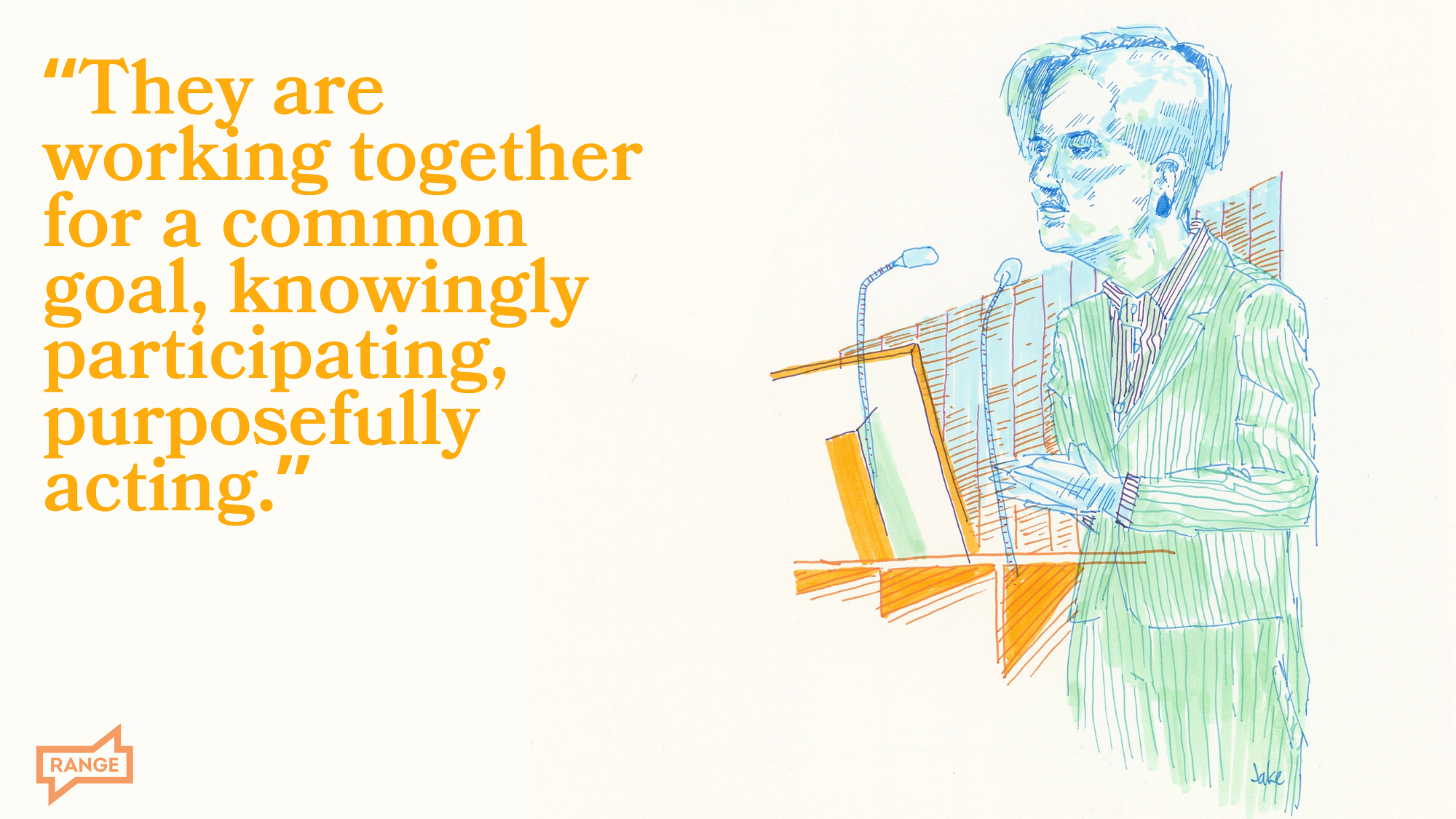
“They are working together for a common goal, knowingly participating, purposefully acting,” she said.
The agreement was one of shared actions and purpose — even if that wasn’t spoken between people, even if there’s no evidence like agreements or communication between defendants prior to the protest, she said.
She laid out what she sees as each defendant’s acts for the conspiracy. Forral barricaded gates and let air out of the white bus’s tires, she said. They agitated the crowd and said things like “come here, this is the door,” and “block the exits.” By getting a bike lock out of their car and banging it on a pylon, they were threatening local law enforcement officers, and by extension, the federal law enforcement officers inside, she argued.
For Mavalwalla, the case was primarily that he stood in front of the south gate of the ICE facility and linked arms with other protesters to form a human chain across the gate as ICE agents pushed and shoved them, throwing some to the ground. Cartier-Giroux quoted Mavalwalla on video saying things like, “The police aren’t coming to help you, it’s against state law,” and “block every exit.” Then, later, after local law enforcement responded, Mavalwalla can be seen handing out COVID-19 masks to protesters in front of the Border Patrol van — evidence of “shared intent,” she said.
Archer was one of the leaders of the conspiracy, Cartier-Giroux argued. They took down emergency contacts and coordinated a bail fund. They recorded voice memos characterizing blocking the gate as “doing their job” and said things on those recordings like, “We collectively made it so they had to essentially deploy violence in order to kidnap these boys.” They also organized the arm-linking at the south gate, which the federal prosecution has continually characterized as force.
“Archer, Mavalwalla and others push back, pulling away and relocking arms to use the force of their body mass against the officers,” one of Cartier-Giroux’s slides read, as she said, “They’re using it like a rugby scrum, they’re using the body mass. How do you know that? When they do get separated, when they do fall down, they get up, relink arms and go right back to the gate.”
At some moments during her closing statements, she addressed the more controversial moments of the case, like federal agent Jeremy Burlingame’s Twitter account filled with racist, homophobic and transphobic posts.
“You may not like the decisions made by people, you may not like the witnesses, but your job here is not to decide if it could have been better,” Cartier-Giroux said. “You’re not here to punish witnesses you do not like, you’re here to decide if I have proven this case beyond a reasonable doubt.”
With her last five minutes, she asked the jury to consider the charge of conspiracy carefully. Whether protesters actually had a physical agreement or conversation or not, they had the same goal and the same plan, she said.
“The plan was to trap them inside … to trap the officers so they couldn’t do their duty, which was to transport them, to bring them to court in Tacoma,” Cartier-Giroux argued. “That’s not the way things work in this country. Mobs can’t demand police to turn over people. There is a process and for all the clamoring on about due process, that’s exactly what they were going to get, [the protesters] only delayed it.”
Defense closing arguments
At 11:45 am, Forral’s attorney Andrea George began her arguments. She talked for nearly an hour, using up about two-thirds of the defense’s allocated time. For much of the argument, George spoke softly, sometimes slowly, presenting from a PowerPoint of her own.
“It is imperative that you look at this statute as to what they have to agree to, not the end purpose of preventing ICE from having these people, but a conspiracy or agreement to prevent by force, intimidation or threat, or an agreement to injure either the person or property of a United States officer,” she said. “If you don’t have that, then you don’t have this crime.”
Forral’s case is simple, she said. Forral wasn’t on the bail list. They didn’t write their emergency contact down. They weren’t linking arms with protesters at the south gate. There wasn’t a conspiracy, but if there was, Forral clearly wasn’t a part of it.
George highlighted what she characterized as violence at the south gate, violence at the hands of federal officers — officers who testified that they had no concrete plan, but nonetheless acted together.
She pointed this out specifically, making the point that protesters could have similar behavior without a plan or an agreement between them, which is necessary for conspiracy.
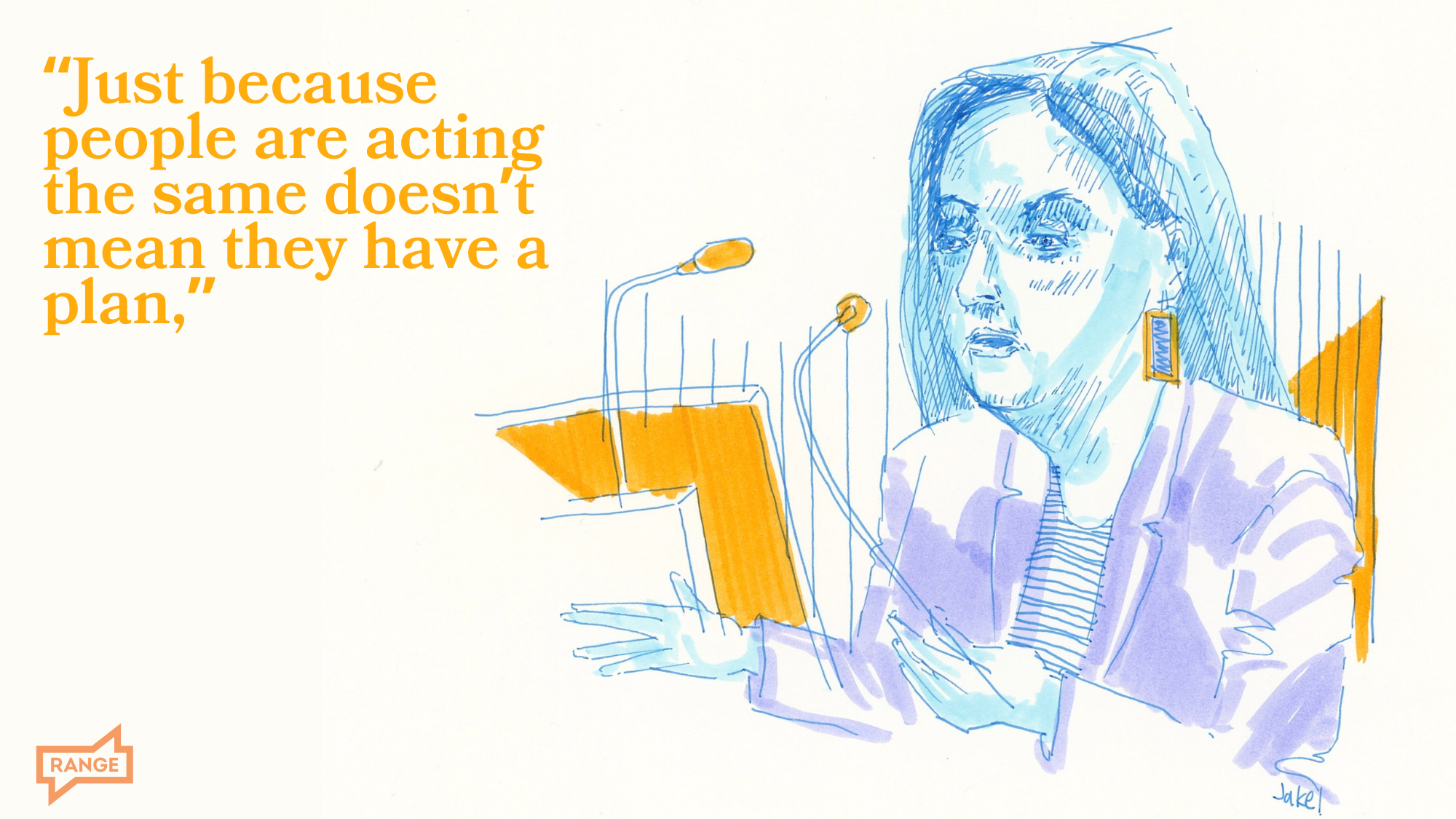
“Just because people are acting the same doesn’t mean they have a plan,” George said.
There was a bombshell moment in George’s argument, too. Before the trial began, there had been a debate between George and federal prosecutors as to what constitutes federal property. Pennell ruled that even if something was a federal agent’s personal property, it could be considered relevant under conspiracy if they were using it to discharge their duties. However, Pennell did not explicitly rule on contractor property.
During her arguments, George contended that even if jurors thought Forral’s actions of parking their car in front of the white bus at the ICE facility and fiddling with the tire (she said there was no proof they actually let any air out) was impeding under the conspiracy charge, that white bus didn’t belong to the federal government. Instead, she said, it was owned and operated by contractors, making it irrelevant to the conspiracy deliberations.
This was met with an abrupt objection from prosecutors, but Pennell ruled in George’s favor.
And when it came to the hours of body cam footage the jury was shown of Forral interacting with local law enforcement, none of that was relevant, George argued, because those aren’t federal officers either.
Being angry with the cops is not a federal conspiracy, she said.
“People acted independently that day. The government takes independent moments … and stitches them together into agreement,” she said. “People were there for very different reasons, this was not a conspiracy. Find Justice Forral not guilty.”
Aine Ahmed on behalf of Mavalwalla was much shorter, taking just 23 minutes.
“You had individuals at this protest that damaged property, no doubt about it. My client, Mr. Mavalwalla played no part in that, he didn’t encourage that,” Ahmed said. “In terms of conspiracy, I could know you were robbing a bank. I could stand outside and clap for ya. That doesn’t make me a co-conspirator.”
Mavalwalla didn’t know anybody at the protest, Ahmed argued, and couldn’t have knowingly entered into an agreement with any of them. If Mavalwalla seemed to be acting similarly to other protesters, that just spoke to shared values.
Ahmed spoke casually, with good ole’ Southern charm in his voice, as he described a federal case relying on thin evidence and techniques like pausing video at a point where defendants looked bad and leaving it on the screen for minutes for the jury to see.
“Innuendoes and suppositions and conjecture is not evidence,” Ahmed said. “One of the things that really had an impression on me during the government’s case — they stopped the video of the confrontation at the south base with Mr. Mavalwalla’s face on the video and he looked diabolical … That’s just a bush league technique when you don’t have evidence.”
Ahmed described Homeland Security Investigation (HSI) agent John LaForte as “Napoleonic” and looking for a fight. Federal witnesses like Burlingame and Spokane County Sheriff’s Deputy Brittan Morgan who called protesters “fucking cunts,” as “knuckleheads” who bring their biases to the stand.
He also stressed that Mavalwalla never used, or intended to use, force against federal agents, regardless of footage of him linking arms with protesters or “spinning around like an airplane” (Mavalwalla’s words) in front of local law enforcement.
“Merely tensing up or merely resisting does not, by itself, constitute force.” Ahmed said, reading from the jury instructions. “Bingo, right there … Mr. Mavalwalla is one of less than 1% of the American population that is a combat veteran. He is a master. If he wanted to use force, that would not have been like that.”
During a moment when it appears Mavalwalla could potentially be elbowing an agent, that was because agents shoved him, like they were doing with other protesters, Ahmed said. “It was an act of thuggery is what it was, and they’re not fighting back. They’re not.”
“The government in this case has failed to prove this case, this charge, beyond a reasonable doubt and while I only represent Mr. Mavalwalla in this case, I would submit that the words ‘not guilty’ should be echoed in this court over and over again,” Ahmed finished.
Carl Oreskovich, soft-spoken and so tall he was told to use a hand microphone, took the floor at 1:03 pm on behalf of Archer.
Oreskovich stressed that Archer was not on trial for any other offenses besides conspiracy. Not trespassing, not failure to disperse — conspiracy.
When Archer prepared to attend the protest, when they took anything that could be construed as a weapon out of their bag, when they called their parents and sent the post around to other organizers, they only intended to do what was in Stuckart’s post: sit in front of the bus. Oreskovich continually hammered the point that Archer was only interested in nonviolent civil disobedience, no force, threat or intimidation that would be required for conspiracy.
Archer arrived, saw disorganization, and attempted to organize the crowd so it would stay peaceful and nonviolent, Oreskovich argued. They weren’t a mastermind, but an experienced organizer who wanted to keep people safe.
“The government wants to ascribe some nefarious purpose to Jac Archer walking around with the clipboard,” Oreskovich said. “It ignores your common sense, it ignores your reason.”
Unlike some of the other defendants, Archer did form an agreement at the protest, he added, but it wasn’t an agreement as defined under conspiracy. It was to risk arrest: nonviolently.
“Jac Archer tells people ‘Hey if you cannot take a punch without throwing a punch, do not get in this line,’” Oreskovich said. “Jac Archer does not want force, Jac Archer does not want violence, Jac Archer is trying to organize people to not act violently.”
Oreskovich also touched on the federal characterizations of protesters linking arms as using force.
“ICE officers come in and try and describe it for you, try and put some labels on it and act like these people were acting forcefully,” he said. “They say it was a ‘tush push’ or a ‘rugby scrum’ for those of you who are sports fans, this was no ‘tush push’ or ‘rugby scrum,’ don’t be fooled by that.”
It wouldn’t be the first time the government tried to fool the jury, he said, bringing up Burlingame.
“You don’t think Officer Burlingame tried to fool you? You don’t think he’s trying to fool you again with his answers?” Oreskovich said. Burlingame said he didn’t have social media but, “all of a sudden when the defense finds out about them, bingo: erased … he doesn’t want you to know he’s biased. Biased against Black people. Biased against nonbinary people. Don’t be fooled by the government’s description of things.”
Oreskovich closed by asking the jury to beware of “the hammer,” — the government’s short rebuttal that defense won’t get to respond to, imploring them to use their common sense and reason. He also bemoaned the jury’s loss of innocence, in a way.
“It’s sad in some respects. We’ve heard things in a courtroom that were heartbreaking. Heartbreaking to watch hidden hatred, hidden racism,” he finished. “You don’t have to go too far to understand why Jac Archer is a passionate person who fights against racism and hatred.”
Rebuttal and what’s next
The other prosecutor, Rebecca Perez, followed defense closing statements with a 15 minute rebuttal. She spoke fast, and passionately, running through her points in a rapid-fire fashion.
For Burlingame and Morgan, their conduct may have been offensive and “vile,” she said, but jurors could simply watch the video and disregard their testimony. It would still show the same thing, she said.
As to the arguments about needing an actual agreement for conspiracy, the government is considering the communication between protesters that they can see as evidence.
“The communication that does exist … and indicates the agreement. But not only the communication, but the actions.” Perez said. “Mere presence isn’t enough, but certainly the fact that this was a nine hour, seven hour thing: that shows some agreements.”
She highlighted other elements in the jury instructions: not every defendant has to have committed each act to be found guilty. Loud, consistent profanity from the protesters should be considered threats or intimidation — the federal agents testified to being scared.
“This event happened and it was only possible because these defendants worked together with an agreement, with each other and others to impede officers,” Perez said. “You can call it civil disobedience, you can call it whatever you want, giving it a different name doesn’t mean it doesn’t meet the elements.”
Perez closed by saying protesters refusing to get pushed over were “fighting back,” and that the defendants should be found guilty.
The jury was sent out to deliberate around 2 pm and continued until 5 pm when they asked for instructions on going home for the night. Pennell released the jury with strict instructions to not talk about or research the case. The jury will restart deliberations at 9 am on Thursday, but it’s likely they will have a verdict by the end of the day.
After the verdict, defendants will also likely file a third “Rule 29” motion, asking Pennell to acquit the defendants for a lack of evidence against them.


