

The top floor of a blocky Perry District office building was full of praise on a recent Sunday morning. Two Haitian women — one whose jet-black hair spilled over her shoulders, one whose platinum locks were pulled back in a crocheted, eggshell bandana — held microphones at the lectern and led the congregation in longing French and Haitian Creole hymns.
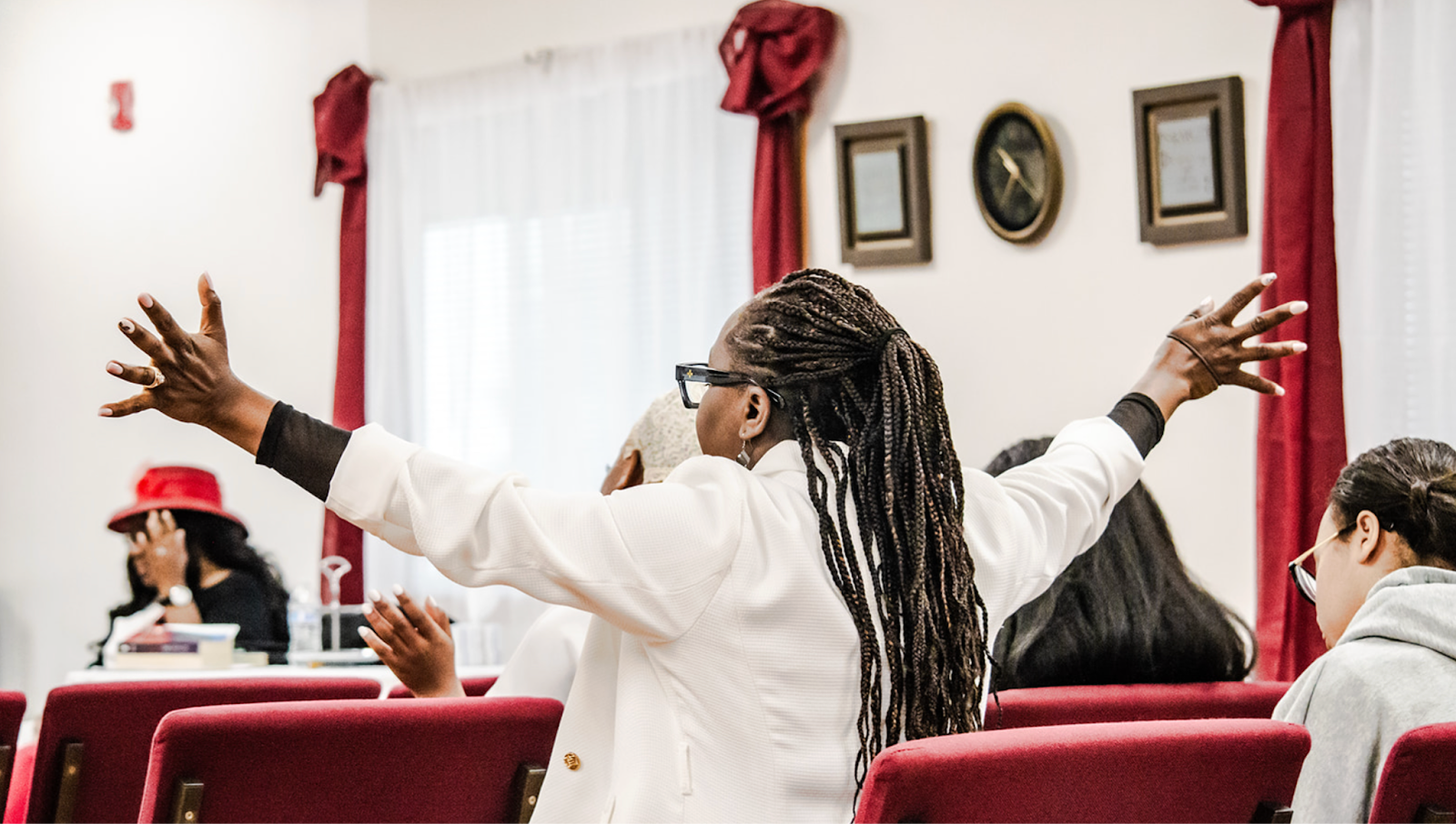
A woman in a white blazer with gold jewelry gleaming swayed with her hands to heaven. A tall man in his 20s in a fresh burgundy suit scrolled on his phone between glances at the sheet music. Several young teenagers fidgeted in the red-upholstered chairs behind their guardians. On a table in the back sat a basket full of Haitian hot sauce a woman had brought in for people to sample.
The woman in the blazer, Guilda Ouelette, gave testimony: her husband had just recovered from a pulmonary embolism. He was not with them, but it seemed he was going to pull through.
The pastor, Luc Jasmin, stepped to the lectern after her: “We’re so happy to hear about Brother Bernard.”
But the room was not full of people. As he preached about Christian blessings, Jasmin looked over a small sea of red upholstery, about 50 empty chairs that, a year ago, would have been filled. The 15 people who were here were the safe ones. While Brother Bernard was convalescing, much of the rest of Jasmin’s congregation was in hiding.
“We lost close to 70% of our congregation” to Trump immigration policies, Jasmin had said in an interview before the service.
Who were the people who might have filled the chairs if not for the second Trump presidency? Young Haitians — people who are at a much earlier stage in their immigration journey than the folks worshipping at Maranatha that Sunday.
Jasmin described them: “You find an 18- or 20-year-old thinking, ‘I just graduated from high school and I can't go to college, and all my hopes, my dreams are gone,’” Jasmin said, reciting the story he’s heard from so many of his country’s people. “So they go through five different countries. They wait a long time in rocks and mountains and deserts. Hundreds die on the way. They have to see somebody dying. All they want is to get to a place where they think they're gonna be safe. In some countries, [traffickers] rape them, they abuse them. Finally they get to the border. They give you a piece of paper and say, ‘You’re going to court in six months.’ So you go there, you could take the paper and you could work.”
They find someone like Pastor Luc, whose family runs a nonprofit that helps Haitian refugees navigate housing and education so they can start building a life.
“And all of a sudden a president comes in and says, ‘Well, stop all that. Everybody that was legal, you’re not worth anything.’”
He was describing the experience of hundreds of thousands of Haitian refugees who came to the US under a special asylum program called Temporary Protected Status (TPS) that allows them to work in the US until things are better in their home country.
Things are not better in Haiti. After a series of natural disasters and political crises, the country’s government has fallen to street violence, and gangs are said to run 80% of the capital city Port au Prince.
Still, Trump wants to send them back — or to the notorious Salvadoran prison CECOT, where many Haitians have been deported under his administration. After spending his campaign elevating racist lies about Haitian immigrants eating their neighbors’ pets in Springfield, Ohio, he issued an executive order ending their TPS status last year. A judge stayed that order February 2, but the community is still in limbo.
Jasmin doesn’t know of any Haitians who’ve been deported from Spokane, which has experienced some targeted immigration actions, though less than some hot spots like Minneapolis or Chicago. But local Haitians are still afraid for their status: the judge’s stay on the Trump order could be overturned, and they could be sent away at any time.
“They're very cautious, even on Sundays,” said Claud Jasmin, Luc’s brother, who came to the US in the aughts and plays the keyboard during services at Maranatha. “I can understand that because I went through being undocumented for some time when I first came here years ago.”
Jasmin founded the Eglise Evangelique Maranatha Church in 2019 after a long career in accounting (he still has his family-run accounting firm) as a multi-lingual respite for refugees fleeing escalating violence in their home countries. It’s become a staging ground to help Haitians who came to Spokane under TPS and are trying to stay under the Trump administration’s radar.
“This is the first time in the story of America that the church is not sacred ground anymore,” Jasmin told RANGE. “The church is a fugitive land. But now even the priests are being beaten.”
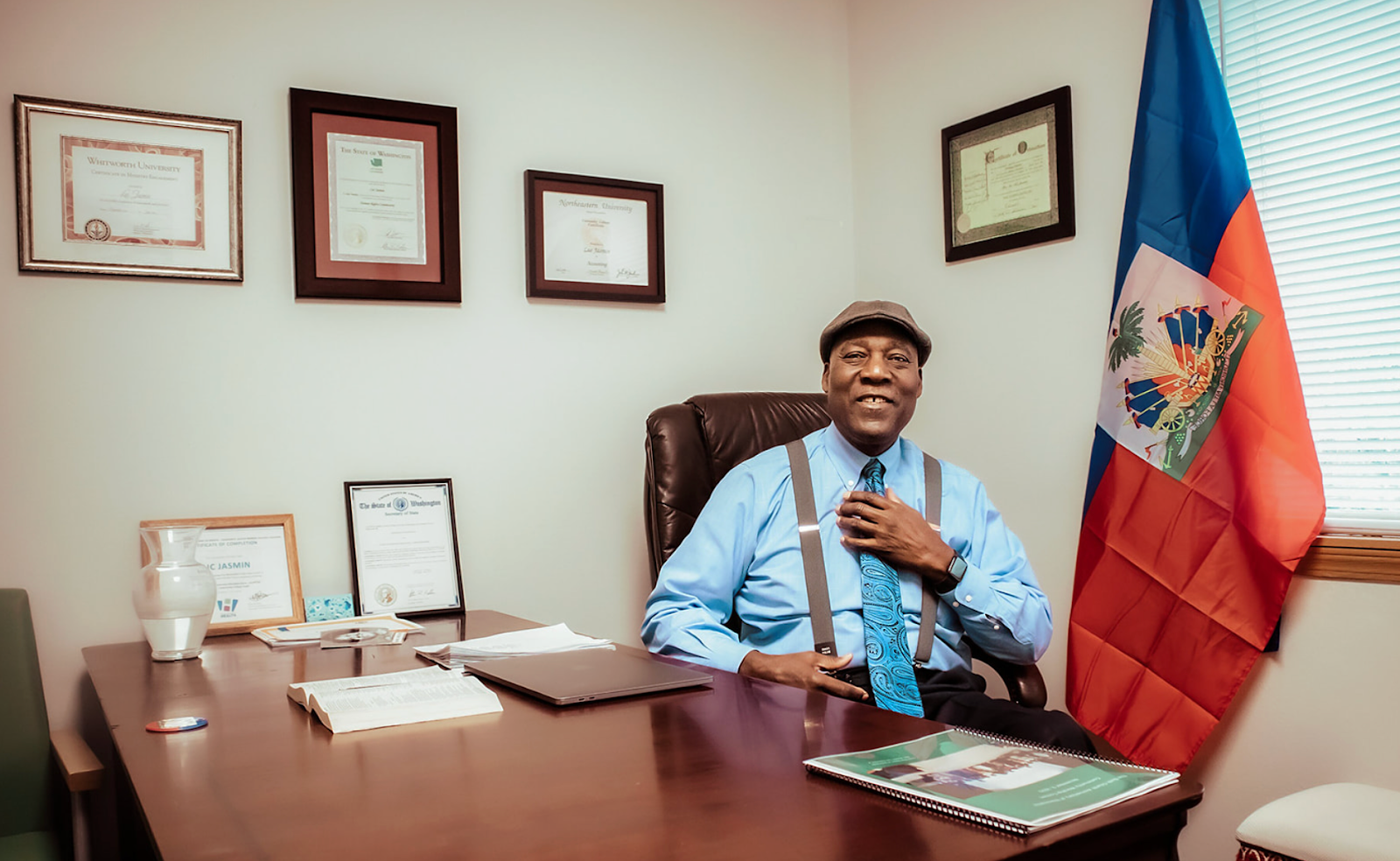
Jasmin is broad-shouldered and towering, and he’s dressed as snazzily as his flock. At the Sunday service, he wore an ironed blue dress shirt, pleated trousers held up by suspenders and a newsboy hat. Sitting under the Haitian flag hanging over his office desk before the sermon, he tented his long fingers and described what was happening in his home country: When his people call family members back home, they hear screaming and gunshots in the background, often from American-made weapons. They cannot safely return there.
He said Trump’s order is designed to push Haitians back out of the country before they can establish themselves because he’s afraid of minorities working hard and gaining status.
“You have elite Haitians right here in the United States in every single position,” he said.
His family is an example of this. The Jasmins have become a household name in Spokane. They run this church, an accounting business and nonprofit that organizes housing for Haitian refugees and this church. Luc Jasmin III, pastor Luc’s son, sits on a slate of local and state governing boards and has run for city council. His brother Claud, who translates the services at Maranatha, had a long career as an organist for churches in Boston before moving to Spokane during the pandemic. He’s also an American citizen.
“The mentality of Trump is not to let these Haitians get to be here five years,” Jasmin said. “Because if you spend five years here, you're gonna have wealth and you're gonna have built a life.”
The back-and-forth nature of their status has been painful for Haitians using TPS in Spokane.
“I don’t know if it will be safe to go to work,” said Sandy, a TPS recipient and nurse whom RANGE is identifying only by first name to protect her safety. She spoke at a fundraiser for TPS recipients at the First Presbyterian Church downtown in early February.
Hundreds of supportive people were there — immigrants and non — creating a safer environment for TPS recipients to show their face in public. Luc Jasmin said he was encouraged by the show of support.
“I'm so happy and so surprised that the community received the Haitians that way,” Jasmin said. “Because you know, before Pastor John decided to do that, the community was down, really down, my brother. Really down. After the video everybody's talking and everybody has hope.”
He wants to create an online presence for Maranatha, and he has shifted his focus more to providing services for people who can’t leave their homes for fear of being nabbed in the street on the way to church, work or the grocery store.
“This is the underground movement we are doing, and I love doing it because we help each other survive,” he said.


