Editor’s note: Before this story published, EWU Provost Lorenzo Smith and President Shari McMahan recommended seven of the nine original programs for discontinuance, including Gender, Women’s & Sexuality Studies, which faculty has recommended for preservation. You can read McMahan’s recommendation here.
At Eastern Washington University, there’s a new metric to determine whether certain kinds of degrees should survive: 10 graduates annually on average for the previous five years. It’s the brainchild of Lorenzo Smith, the provost, who started almost exactly one year ago. Smith has identified nine inadequate programs which are all now being eyed for the chopping block.
The university’s board of trustees will try the metric on for size at its June 25 meeting when it decides which of the nine will be cut.
Faculty in the Gender, Women’s & Sexuality Studies (GWSS) program — one of those nine programs — received letters late last month which essentially said: prepare to lose your jobs.
“This letter serves as advance notice that … your appointment could be subject to separation effective June 15, 2027,” the documents say. Interim GWSS Director Jessi Willis and former Director Judy Rohrer read the notice, which RANGE has reviewed, while they were each at work on May 29.
“When I got the letter I was very disheartened,” Willis told RANGE, emphasizing that their dismay had little to do with their own job but for the gap that will open in local educational opportunities in the humanities for students in Eastern Washington if the degree goes away. “I’m really invested in students learning the things I got to learn when I was a young person.”
GWSS houses classes that look at social issues through feminist and queer lenses.
Smith explained to RANGE last month that he also — in addition to the 10 grads per year metric — evaluates program support in the community, faculty recommendations and feedback from students.
Some programs that don’t meet the threshold are not on the list of nine.
When the trustees make the final call, much of the Eastern community will not be around to see it happen or weigh in. It’s summer, when most students are out of town and many faculty are not teaching. The trustees will make their decision based partly on recommendations from Smith and President Shari McMahan.
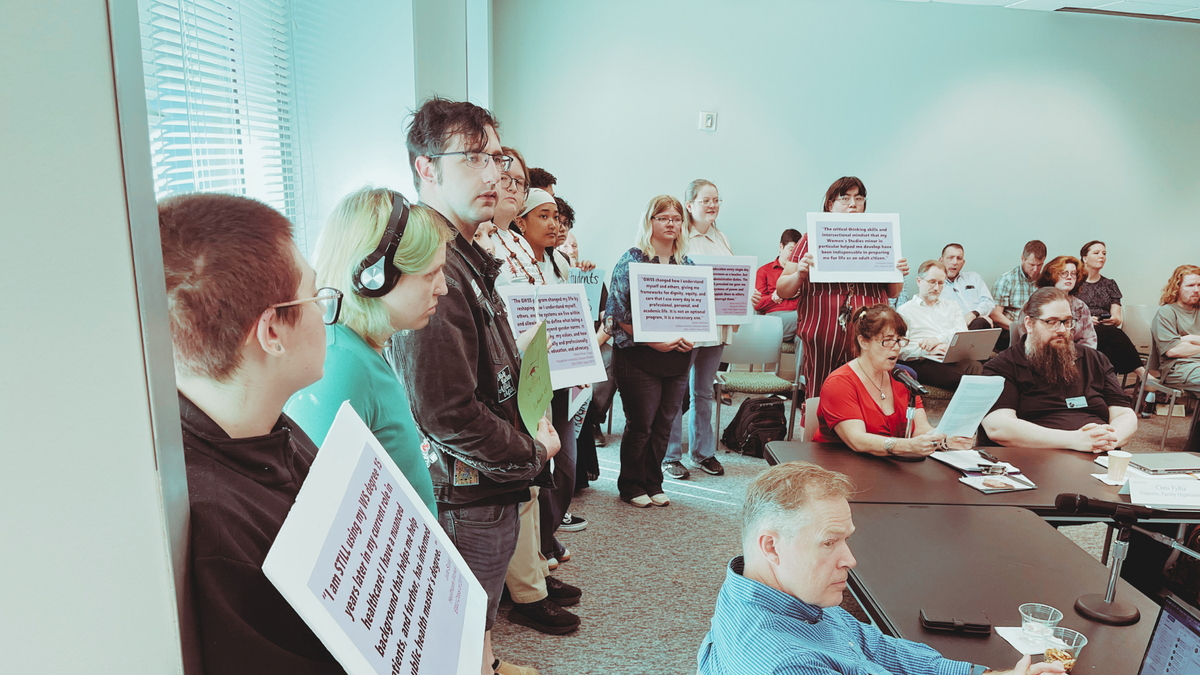
The community weighed in on the proposed cut during faculty government and trustees meetings last month, while class was still in session. Students, community members and faculty showed up by the dozens to the board meeting on May 14 to protest the proposed cuts, and the faculty government later urged the board to preserve the program, along with four others on Smith’s list. Spokane Mayor Lisa Brown, who once worked with GWSS, spoke at an event in February drumming up community support for the program. Nearly 700 people and dozens of community organizations have signed a petition faculty member Rohrer organized urging the board to preserve GWSS.
But recent events don’t inspire confidence in people who care about the program.
Smith did not return a request for comment, but university spokesperson Linn Parish told RANGE in an email that such letters are standard practice when an institution is considering cutting programs not only at Eastern but across academia. It is allowed by the faculty union’s collective bargaining agreement, Parish said.
“The pending program decisions are part of a broader process that identifies and vets programs with low enrollment,” Parish said. “The elimination of any degree program does not equate to the elimination of courses. … It’s part of a long-term strategic growth plan that enables the university to dedicate resources to majors in which there is demand.”
Parish said the university could not comment on specific faculty, and it was not clear whether faculty in other programs on the list of nine got letters similar to Rohrer’s and Willis’.
Smith was careful to say in the letters that they didn’t represent formal notice of termination; rather, they presented an opportunity for faculty to get ready for what, until tomorrow, is only a possibility. And even if the university eliminated the degree entirely, a minor program could persist.
Rohrer’s and Willis’ terminations could become effective next year, the letters say.
Smith told RANGE in May that he did not know what he would recommend regarding the programs.
Tenure, the status some faculty achieve with rank, is designed to protect academic freedom and job security from power structures. In this case, it is no protection. While Rohrer, an associate professor, has tenure, Willis, a senior lecturer and the only faculty member with a PhD in GWSS, does not, despite working at EWU for 16 years.
As Rohrer expressed in a recent letter to the editor in The Spokesman, she thinks the trustees are intent on axing it.
“We are preparing ourselves for the worst,” said Annette Carpenter, who graduated with her GWSS degree just days ago.
People have seen the program’s demise written on the eroding walls of academia for years. When one of its longtime tenured professors, Elizabeth Arveda Kissling, retired in 2021 with emeritus status, the university did not preserve that position. The Women’s and Gender Education Center, which works closely with GWSS and supports many of its students, has gone without a manager for years; Willis volunteers to fill that role. Given that history of attrition, some involved in GWSS believe there is nothing that would convince the board to not cut the program.
“I think that the board, the president and the provost are focused on budgetary cuts, and it is very likely that with that focus in mind, they will cut the program,” Willis told RANGE.
GWSS is one pillar in a suite of diversity degree programs that make the university an asset in Washington state, supporters of the program said.
Eastern has been trying to rebrand itself to compete in a university landscape ravaged by funding cuts, hostile politics and a demographic crisis that poses existential challenges to higher education. For decades, it operated as a regional comprehensive with a mission to serve underrepresented communities close by. It recently rebranded itself as a “polytechnic” dedicated to hands-on training in practical fields rather than theoretical ones like GWSS — or programs like English and Philosophy, which the university collapsed into one program several years ago.
In recent years, the board has also rebuffed recommendations from faculty to invest in some academic programs, including GWSS. At the same time, it has preserved the status of programs like the football team, which, playing in its current conference, costs the university about $10 million a year.
Carpenter said it would be a mistake for Eastern to cut the GWSS program.
“Eastern’s going to really regret losing that because everyone who’s taken a class with Dr. Willis loved it,” they said.
 Aaron Hedge