

It happens like clockwork: a disaster devastates a community. People lose homes. They lose cars, workplaces, loved ones. They need somewhere to turn — and after that, they need a scapegoat. And people in powerful places sometimes suggest there’s a convenient person or thing to blame for the suffering.
It happened this week in Spokane. After the wildfires, people from across the political spectrum — some weighing in from places as far-flung as Washington DC — asserted with no evidence there was more to the wildfires that devastated our county than a wayward man with a match and a hot, dry climate.
“The trees around the properties are fine,” said the YouTuber @HustleBitch in a video he posted on YouTube. “The street signs are untouched. But the cars in the driveways are completely melted, and the homes themselves have just vanished.”
It didn’t seem to make sense to him how one thing could burn when another didn’t. He used this information to insinuate that someone purposefully set fires to clear ground for a data center in Spokane County, a project some of the most powerful politicians and institutions in the area have recently advocated for.
“Who?” he asked. “Who would benefit from this? Well, let me tell you something. A Spokane County Commissioner who was reportedly having secret discussions with a company to build a massive data center in the area.”
He was referring to Commissioner Al French, who’s been in high-level talks with a data center developer that wants to build a facility on the West Plains. But @HustleBitch didn’t prove his case. Instead, he played footage showing people grappling with the crisis.
“We don’t know how it started,” said a woman he’d cribbed video from; she had been filming the smoke from High Drive. “No one’s telling us shit.”
It’s true that powerful lawmakers want a data center in Spokane County. But the villain in the case of the Old Trails wildfire was not motivated by development; he is a troubled arsonist who has admitted to having set the rural areas west of Spokane ablaze. He’d been planning it for weeks, The Spokesman-Review reported. He was abetted by climate change.
But details about the arsonist didn’t start to come out until much of the informational damage was done.
The data center conspiracy theory is not too far afield from a video that former Spokane County GOP chair MJ Bolt shared, suggesting cars melt more readily these days because of chem trails, the conspiracy theory that airplanes are spreading biological or chemical agents.
Big ideas, unproven claims. This kind of stuff is everywhere after a disaster.
Kate Bitz, a program manager with the Western States Center, a nonprofit that advocates for democracy in the Pacific Northwest, told me that such conspiracy theories take our eye off the ball of maintaining a healthy society.
“Conspiracy theories tell us the lie that all-powerful forces are behind the devastation our communities face,” Bitz wrote in an email. “They distract us from focusing on the truth, whether that is the impact of climate change, the danger that a single act can have in fire-prone conditions or the reality that in a democracy we can all organize to have a say in our future.”
We live in a world that throws the victims of natural disasters like the wildfires that ate parts of our community last week to the unreliable whims of insurance companies, lawyers, media — the systems that sustain our way of life but are too often disinterested in actual, individual wellbeing.
This week, anti-LGBTQ+ right-wing groups — like that of the far-right worship pastor Sean Feucht — began to mobilize around the fires. Feucht called for prayer and said he was “planning a response,” though he didn’t offer details. Lewis Arthur, founder of the right-wing militia group Veterans On Patrol, advanced the notion of a data center conspiracy on the social media platform Telegram.
We also saw conspiracy theories crop up when community leaders, like Bolt, spread unsubstantiated theories about the relationship between recent push to bring large data centers into Spokane County and the fires.
There is a lot of angst. That angst — intuitive as it is about power structures — feeds bad actors.
Two years ago, I spent three days with Arthur, whose organization made a name for itself by dismantling watering stations for immigrants near the US border with Mexico. He’d been on the lam in Spokane, running from Arizona authorities, and had spent days falsely asserting that Fairchild Air Force Base pilots were spraying toxic chemicals over Spokane and city leaders were enabling sex traffickers. It was a weird experience. He hugged me after our final interview, but when I published a story saying he’d doxxed the city council, he threatened to come to my workplace with protesters.
He’s now back in town, making the same claims on Telegram as the data center conspiracy theorists.
Arthur, a poor, unhoused man, exerts power through his connections to far-right movements — he showed up at the standoff between militias and the federal government at the Malheur National Wildlife Refuge in 2016 — and by exploiting people’s willingness to believe in things they can’t prove.
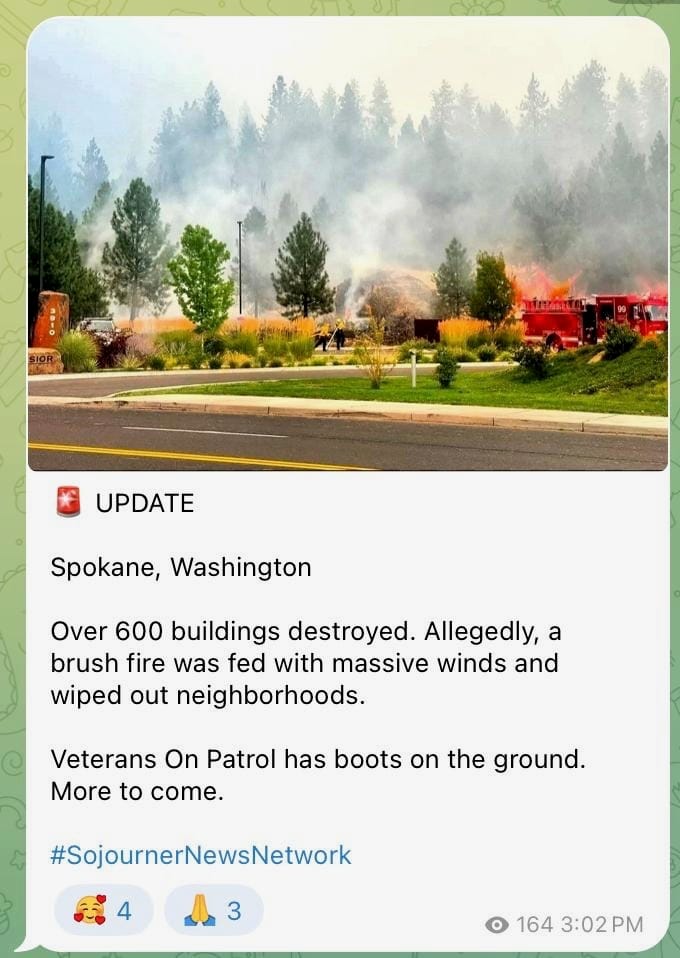
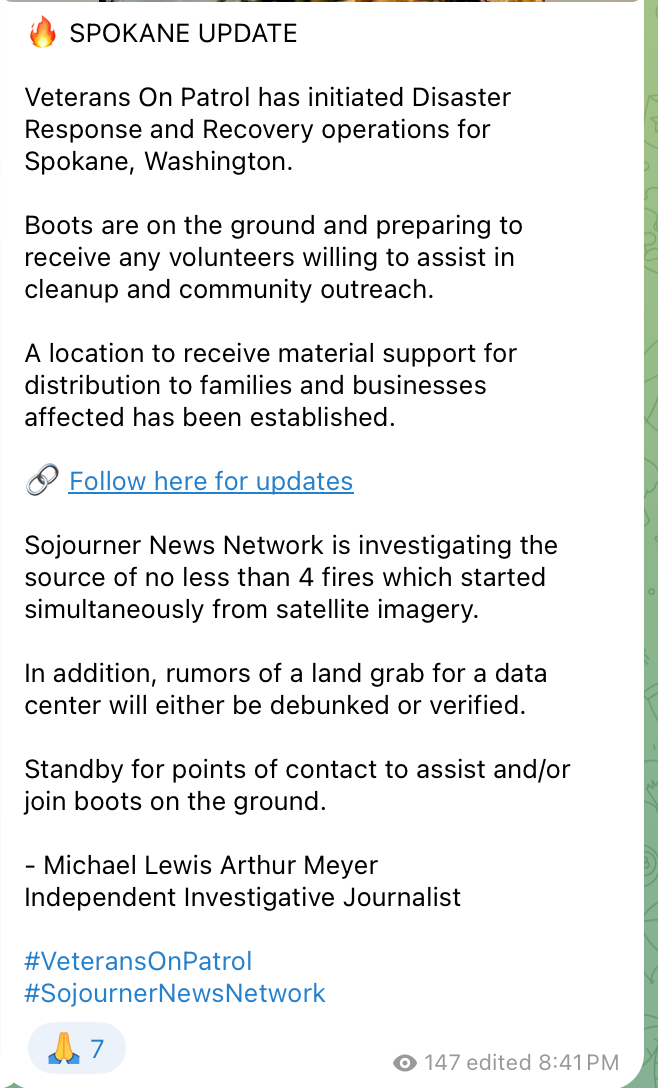
“It dovetails remarkably well with VOP’s goals of mobilizing people around outlandish claims, fundraising to support their own activities and building their audience,” Bitz wrote in her email about the man. She pointed out that this is Arthur’s MO, noting that he did the same with Hurricane Helene, as did Sean Feucht and other groups who want to take the US out of the hands of voters and give it to Jesus Christ.
“Again and again, we see opponents of democracy exploiting disasters and tragedies to spread conspiracy theories,” Bitz wrote to me. “They do this to advance their own goals, whether they are building political power, spreading bigotry, or furthering their personal grift.”
As far as we can tell, a man with a history of violence set the Old Trails fire on purpose. But he is not the only person preying on our community.
“This Spokane fire is insane right now!!” Feucht, who led a worship concert in Spokane almost exactly three years ago at which prayer leaders denounced earlier fires and queer people in the same breath, wrote on social media. Feucht has a thick history in Spokane, and has said he might come back. “Please pray! Maybe it’s time for another worship night there to pray and stand with the community!”
But Bitz expressed hope that Spokane can dispense with the conspiracy theories and come together around the fire.
“Conspiracy theories … tell us that our communities don’t have any power,” Bitz wrote. “What Spokanites are showing as we organize to care for evacuees and first responders is that we do have the power to take action and have each other’s backs.”
The Spokane Complex fires destroyed homes of conservatives and liberals alike. They cleared the ground neither for a data center nor a Christian revival.
The Christian nationalists who want to invade Spokane, like the people advancing data center conspiracies, don’t want to destroy the public sector. They’re just opportunists. The data center opponents seem to have their hearts in the right place — they just don’t want a massive, potentially environmentally toxic facility to be dropped in their backyard.
Though the two groups have different motivations, the conspiracy theories about this fire are all harmful. They distract from the truth of our community response. Let’s tell ourselves a true story.


