
Camp leaders and state officials say the move was disruptive. Some of the information provided by police was incorrect and misleading.
Editor's note: This story has been updated to reflect the approval of a new occupancy permit for the Trent shelter issued on December 7.
Just before 2 p.m. Tuesday afternoon, around 15-20 local law enforcement agents from Spokane Police Department, Spokane County Sheriff’s Department, and Spokane Valley Police Department (a contracted subset of the Sheriff’s Department), entered Camp Hope to hand out fliers directing people to resources and letting them know the camp would be closed.
The atmosphere at the gate to the encampment was tense as police cars gathered a couple blocks away. Service providers and camp staff alerted camp residents that police were coming and urged them to stay in their tents, be calm and not engage with law enforcement. The only indication that law enforcement would be visiting the camp was a quote from Sheriff Ozzie Knezovich in an article by RaeLynn Ricarte in The Center Square published on Monday.
Before they entered the camp, deputies told providers including Julie Garcia, the founder of Jewels Helping Hands (JHH), the main service provider at the camp, that the purpose of the operation was not enforcement but simply to share information about services. The gates to the encampment weren’t opened for law enforcement until Garcia said she got approval from Washington State Department of Transportation, which owns the land, to allow law enforcement on-site.
The information that police handed out — a flier that stated that the camp will be closed, provided resource listings and advised people to seek services at the Trent shelter — contained out-of-date information, and advised people to seek services and shelter at a facility which has been turning people away during this current cold snap. (A reference to the shelter operating above capacity was removed from this paragraph after a new Temporary Occupancy Permit was approved on December 7.)
Garcia said she would have appreciated having more time to prepare residents and keep them calm. “Really, the key to all this is if [the police] talk to us about coming in and touring and bringing things that’s ok with us,” she said. “We just have to be able to explain what’s happening to the folks that are scared.”
“This show of force is totally unnecessary and was meant to elicit a fear response which we are not going to let happen,” said a camp resident who goes by Suka. “We have that information and the information on the pamphlets was inaccurate at best.”
The pamphlet listed an outdated address for Compassionate Addiction Treatment. The current occupants of that building are the Healing Rooms, a conservative Christian organization that also sublets its space to On Fire Ministries, the church Matt Shea founded in 2021 after leaving the Washington State Legislature.
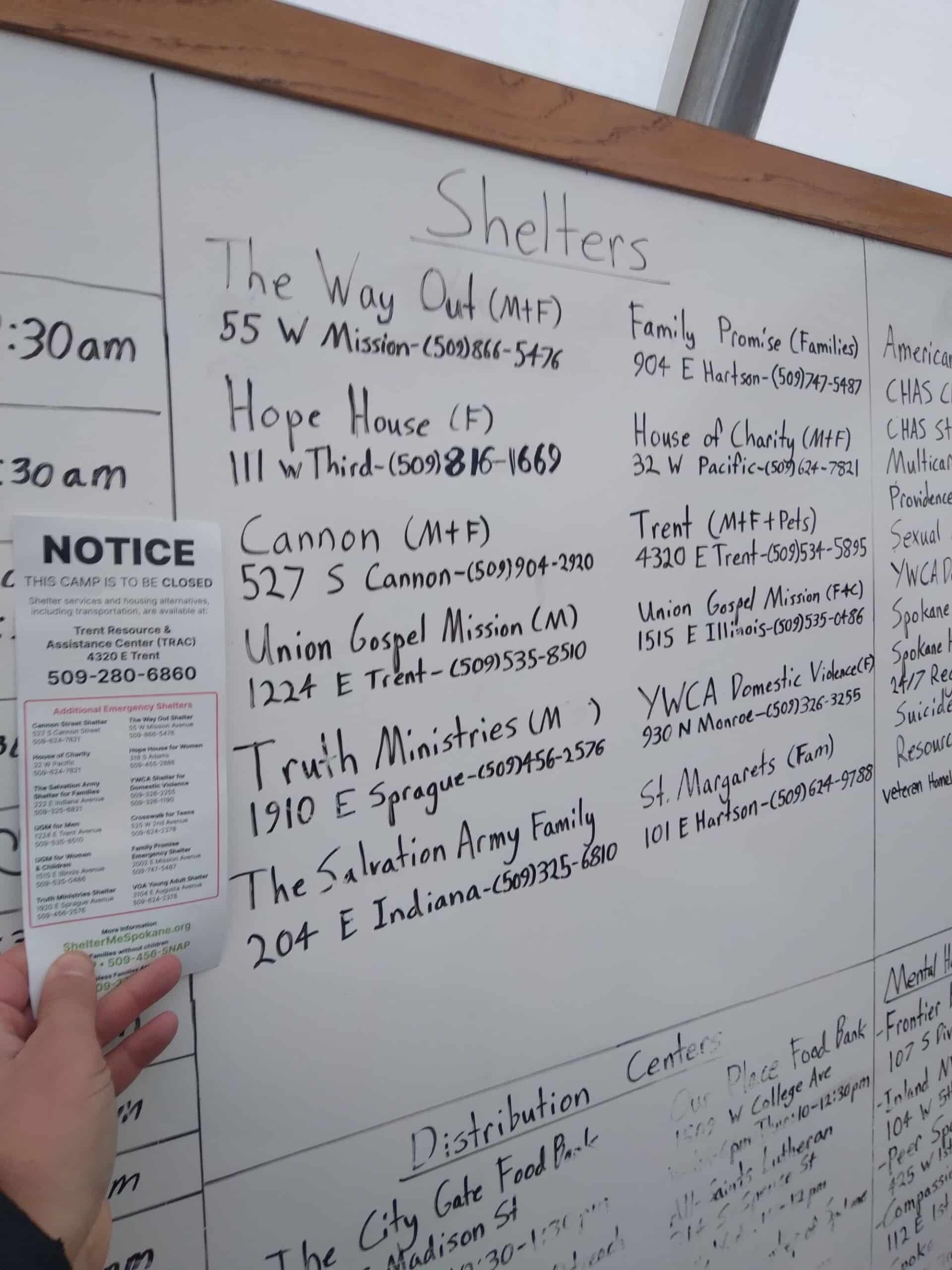
The pamphlet also listed a phone number for sobering services through Spokane Treatment and Recovery Services (STARS) that does not work. STARS has not offered sobering services since September 2021, is not currently offering sobering services and has no plans to begin offering them again at this time, according to interim executive director Joe St. John. STARS does offer withdrawal management services for people experiencing withdrawals from chemical dependency. The Inlander’s Samantha Wohlfeil reported on this reduction in sobering services across the Spokane community over a year ago.
A far more comprehensive and up-to-date list of services has been posted on a whiteboard in the large tent adjacent to the camp for months.
For the most part, residents heeded the advice not to engage with law enforcement. There was no indication that anyone living at the camp came into conflict with police as they handed out fliers. As police fanned out through the encampment, knocking on tents and RVs, camp staff, peer navigators, state employees and eventually additional journalists documented the interactions.
The tensest moments came as law enforcement and service providers gathered after officers were done handing out information throughout the camp. Service providers, including Garcia and JHH staff member Sharyl Brown, raised concerns that the resources being advertised by the flier weren’t regularly available or were insufficient.
“I’m telling you, I call most of these places on a daily basis, they’re not open, they have no openings,” said an exasperated Brown.
Sheriff’s deputy Josh Pratt, who works on Spokane Valley’s homeless outreach team, countered that the Trent shelter was open. The most recent availability at the shelter, posted last night, said that the shelter had 16 beds available and 275 beds total.
“They’ve turned me down. Last week they turned me down,” said Brown, who works with residents to get them connected to services including the Trent shelter and the Catalyst Project, the 100+ person supportive housing facility opening this week with funding from the state’s Rights-of-Way Initiative.
The legal capacity of the Trent shelter has been murky at best. The city administration has repeatedly told RANGE that no one will be turned away by the Salvation Army at Trent and that the shelter has an undefined “flex capacity.” In a meeting of service providers last week, Salvation Army’s Ken Perine said the nonprofit has purchased additional beds and that the shelter is staffing up to accommodate 350 people. Yesterday, Dermott Murphy, the Spokane Building Official who issued the building occupancy certificate for the shelter, told RANGE that the current occupancy limit is 250 people and that occupancy should not be going above that number. (On December 7, Murphy issued a new Temporary Occupancy Permit that allows the shelter to have 375 people, including 350 shelter beds and 25 staff.)
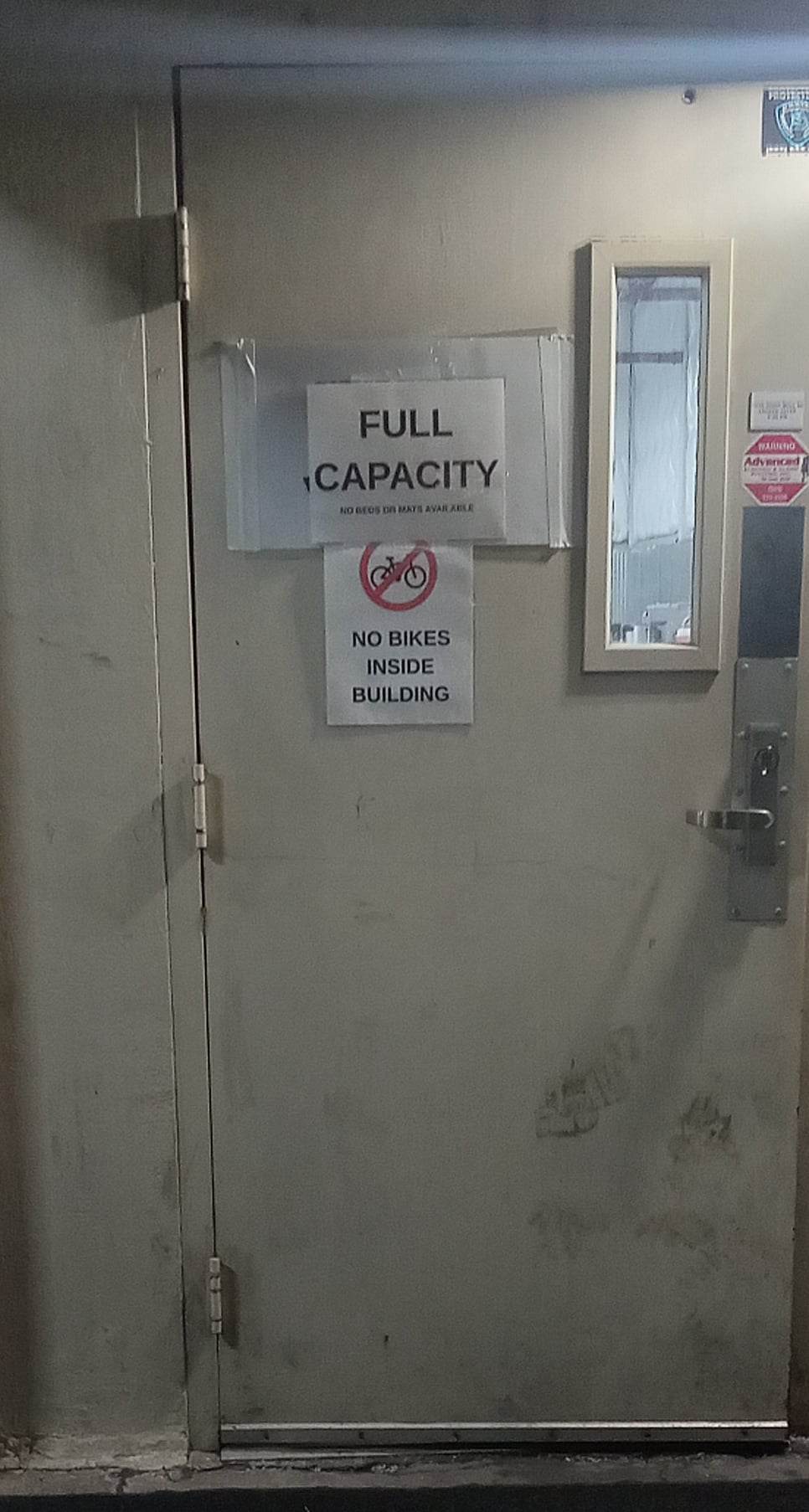
Shelter staff and people staying at Trent have told RANGE that the shelter has reached and exceeded the advertised capacity of 275 people and turned people away. “We try to get them somewhere else, we do our best,” said one Trent staff member whose identity RANGE is protecting because they could lose their livelihood for speaking to the media. “They can say [we won’t turn people away] all they want, but yes, we have to turn people away. We don’t necessarily know where they go.”
Last Friday, a shelter resident sent RANGE the following picture from the facility.
At Camp Hope, resident reactions ranged from shrugs to frustration to general antipathy towards law enforcement.
“I don’t fuck with the police, man,” said a camp resident who gave the name David. “Nobody’s talking to them, man. We have no reason to. I didn’t do anything wrong.”
After officers had left, Suka questioned the timing of the law enforcement action. “Most of us already have a housing option, we’re just waiting for it to open and waiting for us to be placed,” said Suka, who will soon be moving into the Catalyst Project at the former Quality Inn in the West Hills. “Very excited, all kinds of good stuff going on,” she said about moving on from the encampment.
Staff from the Commerce Department and Washington State Department of Transportation, who witnessed the police engagement at the camp, said it was counterproductive. “We take one step forward and two steps back,” said WSDOT spokesman Ryan Overton. “Yesterday was an exciting day with Catalyst and how far we’ve come with the Department of Commerce, Empire Health Foundation and all of our partners, Catholic Charities included. All this is doing is distracting, riling up the campers. It’s disappointing.”
“There could have been a conversation about how to do that engagement,” said Tedd Kelleher, the managing director of the housing assistance unit at the state Department of Commerce, who came from having lunch to witness the police action. “They know our number, they know everyone else’s number, we talk to the city almost every day. It’s ridiculous. Of course it raises everyone’s anxiety, especially the people living here.”
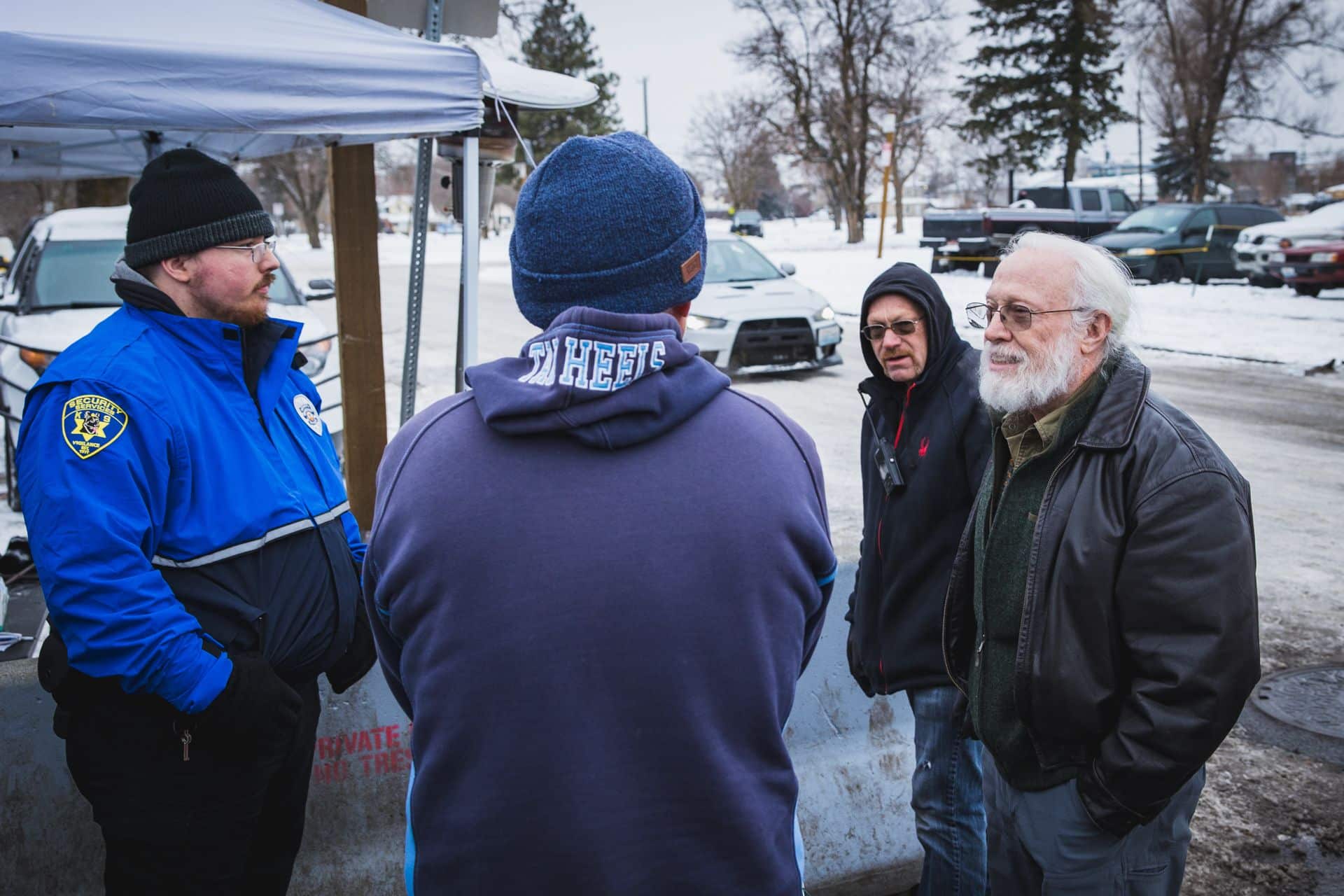
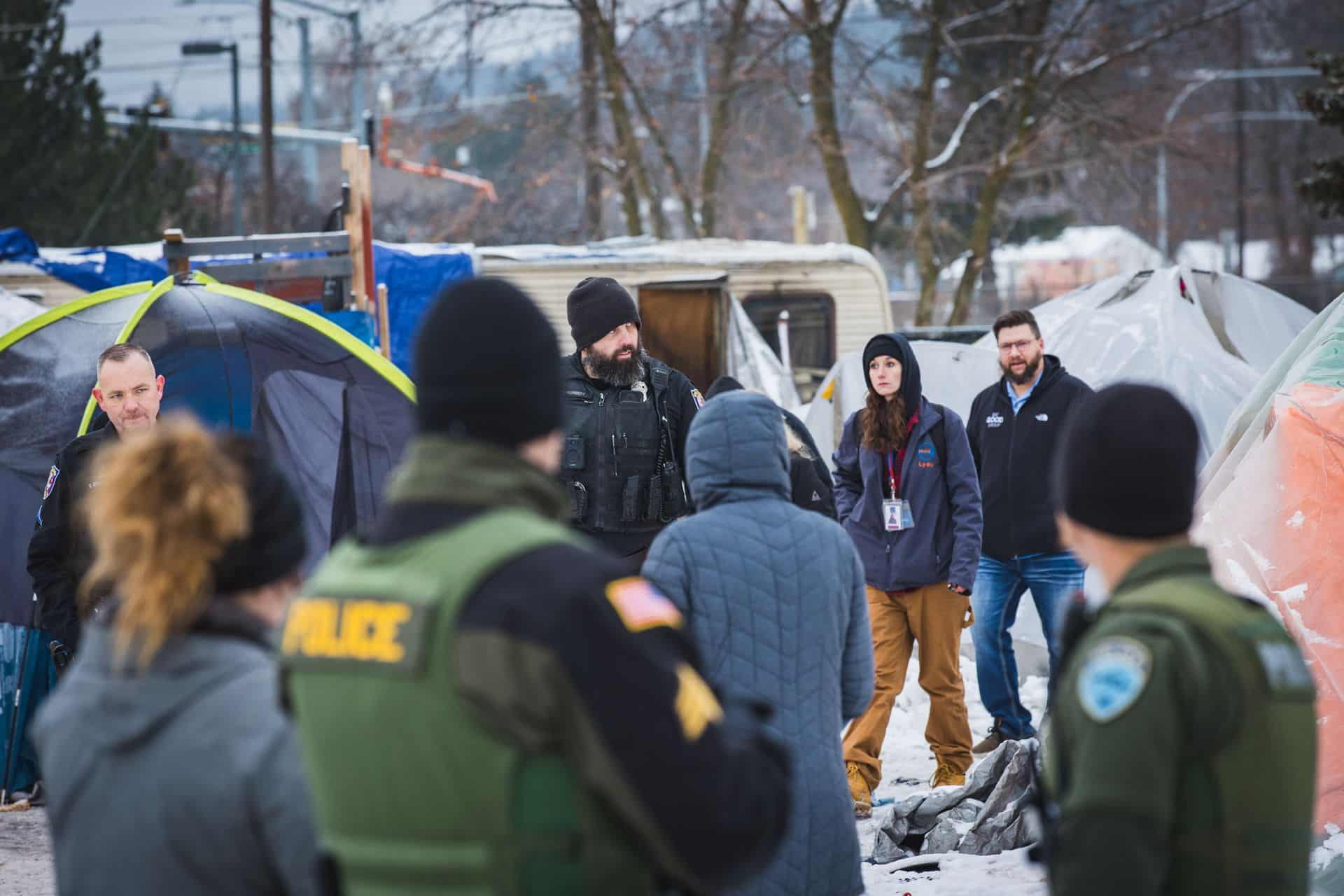



Jeffry Finer, the lawyer for the groups and residents suing the city and county for their response to Camp Hope, said that having that many officers on site to deliver pamphlets could portend a heavy-handed sweep of the encampment. “If this is how the sheriff delivers a letter, you can imagine how he’d conduct a sweep,” Finer said.
None of the deputies on site approached by RANGE were authorized to speak with the media. An email to the Spokane Sheriff’s Department public information officer Mark Gregory has not been answered.
City communications director Brian Coddington told RANGE in an emailed statement: “Members of the Behavioral Health Units at the Spokane Police Department and the Spokane County Sheriff’s Office conducted outreach and engagement to provide information about resources available in the community to those staying at the camp. The teams regularly provide information about resources to community members as part of their duties. Transportation was also available for anyone who needed a ride to access services. Unfortunately, no one took them up on the offer.”
Councilwoman Karen Stratton said the whole effort was a waste of resources. “We can’t get officers in our neighborhoods to respond to crime, but they can get these numbers to go into Camp Hope with so many people with so many needs — that’s wrong.”
“I’ve never felt threatened there. I’ve played with their dogs. I’ve passed out clothes that I brought down,” Stratton said. “This is not about public safety, this is about egos and that makes me really angry.”
Join RANGE and members like Bianca on our mission to empower our community starting at $10/month here.


