

When Spokane Mayor Lisa Brown walked into office two years ago, the city was in deep financial trouble. The pandemic, inflation and generous union contracts had left Spokane staring down a mammoth budget deficit. Two years later, the city of Spokane is still trying to tunnel its way out of the hole.
“This has taken the vast majority of every waking — and sometimes sleeping — moment," City Administrator Alex Scott said at a September 2025 budget meeting. "It's really all budget, all the time.”
But no big cost has taken the city by surprise, he explained, like what’s happened with the cost of jailing people in Spokane.
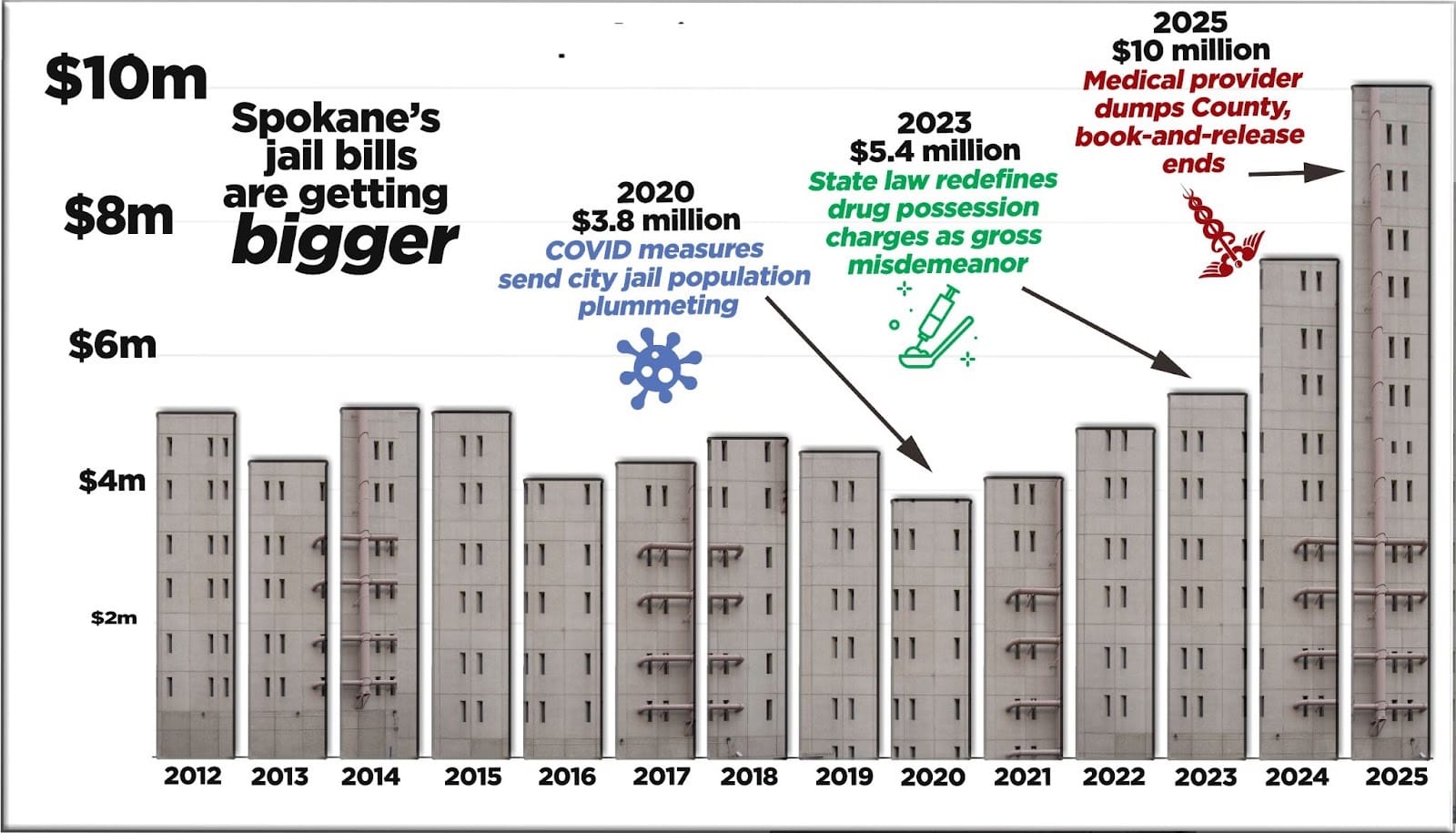
The price tag of housing prisoners for the city of Spokane had more than doubled.
The PowerPoint slides presented at the meeting tallied up the damage: The city’s bills for jailing inmates in Spokane County’s facilities spiked from $4.2 million in 2021 to a projected total of over $9 million in 2025. By the time the final bill for 2025 hit, the number had increased to $10 million: a nearly 140% increase in just four years.
Yet the city doesn’t control the local jails. The county does. Like a wife growing increasingly horrified watching her husband drive, the city has been stuck asking questions and shouting advice from the passenger seat. And that hasn’t necessarily been ideal for their fraught relationship.
“When it comes to jail costs — and you can quote me on this, I don’t care — there’s been a lot of historical distrust,” City Council President Betsy Wilkerson told RANGE. “Because the county runs it, there hasn’t been as much transparency for how the costs are assigned and how they come up with it.”
Over the last seven months, the city conducted its own internal audit of jail spending. The audit results, announced last month, faulted both the city and the county for not consistently collaborating to "proactively manage jail service costs."
Yet the audit did not find any financial wrongdoing and didn’t provide a clear answer to the critical question: Why, exactly, had the price tag for Spokane’s prisoners gone up so sharply?
And as the city was working on the audit, the problem has gotten worse. A lot worse.
LAW OF INFLATION
In his office across from the Spokane County Courthouse, Senior Director of Law and Justice Michael Sparber bristled at the suggestion that the County wasn’t being transparent.
Bald, bearded and speaking with a Woody Harrelson rasp, Sparber motioned to the data visualizations sprawled across a giant TV screen. There are pie charts, histograms, line graphs: stats on jail occupancy levels, criminal charges and local billing agencies since 2021 in the Spokane County Jail downtown and the Geiger Corrections Center in Airway Heights.
“What's this? This is all information they can look at,” Sparber said. “Look at the counts. They can do the math. They can be looking at the same things I'm looking at."
Sparber has spent 37 years working within the Spokane County detention system. He meets with the city staffers quarterly, but said the city didn’t actually interview him as part of their audit. Brown, for her part, said she doesn’t “just pick up the phone and chat with Mike about stuff like that.”
But RANGE did what the mayor didn’t — met with Sparber directly to press him on why the city’s jail costs are so out of control.
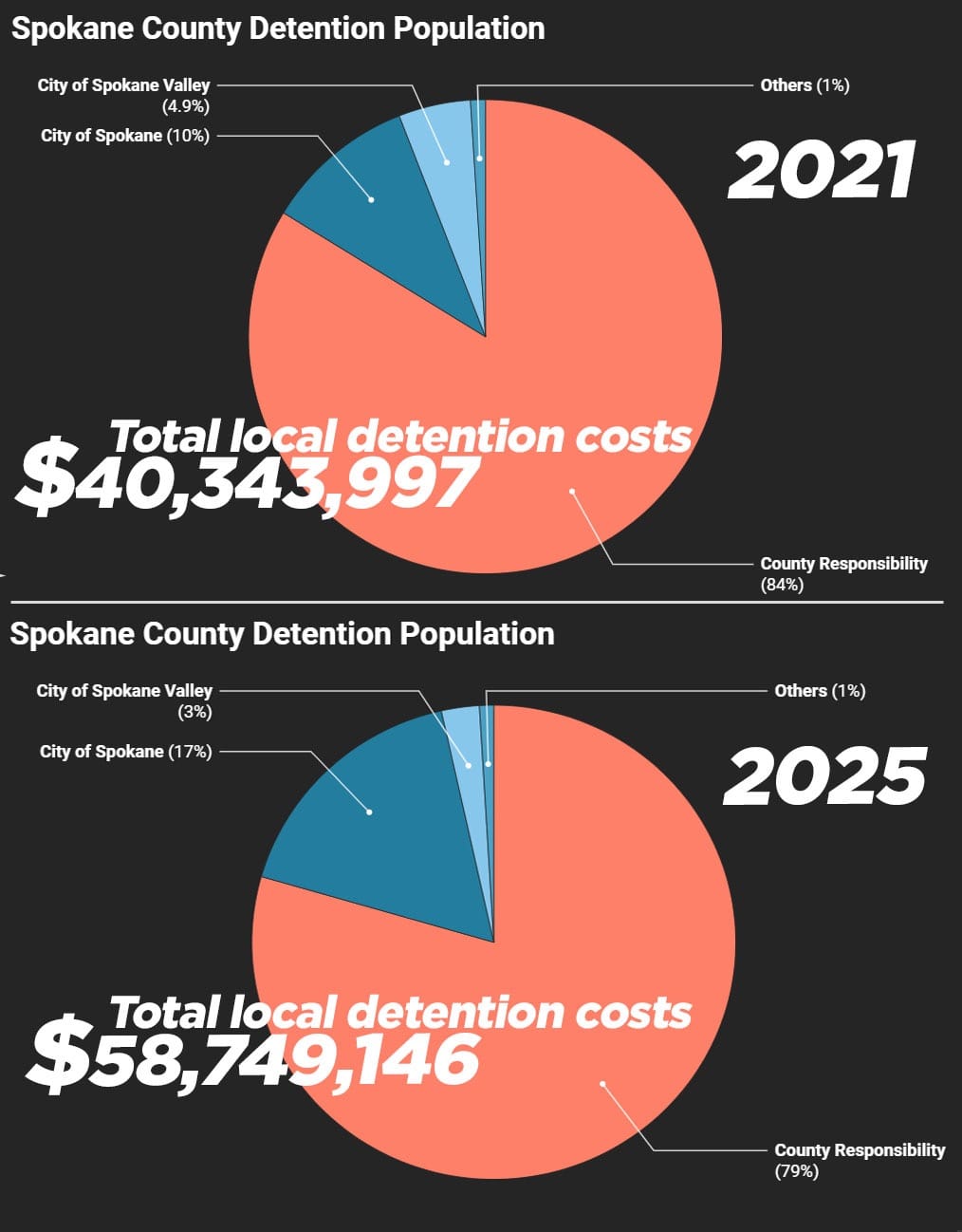
The numbers don’t tell the whole story, but they gesture at one: a tale about the rise of gross misdemeanors that the city has to pay for. The amount of these city-funded prisoners has risen since 2021 even as the share of county prisoners has fallen. Combine that with a sharp rise in labor, administrative and medical costs.
So just as the pie was getting a lot pricier — Spokane was on the hook to pay for a much bigger slice.
From 2021 to 2025, the overall cost of Spokane County jail services rose by 44%. It’s not hard to understand why. Inflation in the aftermath of COVID sent governments at all levels across the nation scrambling to find new revenue. When the cost of living spiked up, unions demanded higher salaries for their members.
“The bargaining units just all settled their contracts, which was an increase to everyone across the board,” Sparber said.
And just like the city of Spokane’s police and fire departments, vacant corrections officer slots have meant the government has had to shell out millions in extra overtime money to keep the jails staffed.
Last year, 13 of Spokane County’s corrections officers made over $40,000 extra in overtime. Michael Egland, a corrections officer at Geiger, made six figures in overtime alone.
And medical costs?
“Oh, man,” Sparber said.
Nearly 40% of the increase in the county’s detention budget since 2021 can be traced to the increase in medical costs.
As the drug epidemic worsened wildly in Spokane County in recent years — opioid overdoses in the county increased sixfold between 2019 to 2024 — the jail had to deal with impact on incoming inmates, including medication to help inmates detox from opioids safely.
“The population we get is a hugely transient population,” Sparber explained. “They're homeless. There's a huge addiction to fentanyl. The jail's a catcher's mitt. We get everything.”
Last year the county signed a pricey renewal with the lawsuit-plagued jail medical contractor, NaphCare, before the company ditched the county halfway through the year. In October, the county selected Mediko Correctional Healthcare as its replacement.
Sparber said that, for a month, they had to pay the bill for both contractors.
But watching all this happen from the outside could be frustrating for the city officials.
Brown sent a letter to the county two years ago, urging the jail to take advantage of the state’s “Medicaid Transformation Project” to provide, at no local cost, medication-assisted treatment to Medicaid-eligible inmates for the last 90 days of their sentence.
But while Spokane County was officially allowed to take advantage of the project in January, it won’t actually be implemented in Spokane’s jails until July. Sparber blames the delay on switching over medical providers. The new provider is going to be handling the administration burden of the Medicaid project, something Naphcare never agreed to.
"We didn't know before, honestly, how we were going to accommodate the billing process,” Sparber said.
SPREADING THE BURDEN
But the increasing overall cost of the jail is only half the story. The bigger problem is that Spokane’s share of the bill has been increasing too.
At one time, for example, the county defrayed the cost of running the jail by bringing in a significant number of prisoners from the US Marshals Service. But, in order to free up jail capacity, Sparber said, the jail reduced that number in recent years. The bill for everyone else went up a bit as a result.
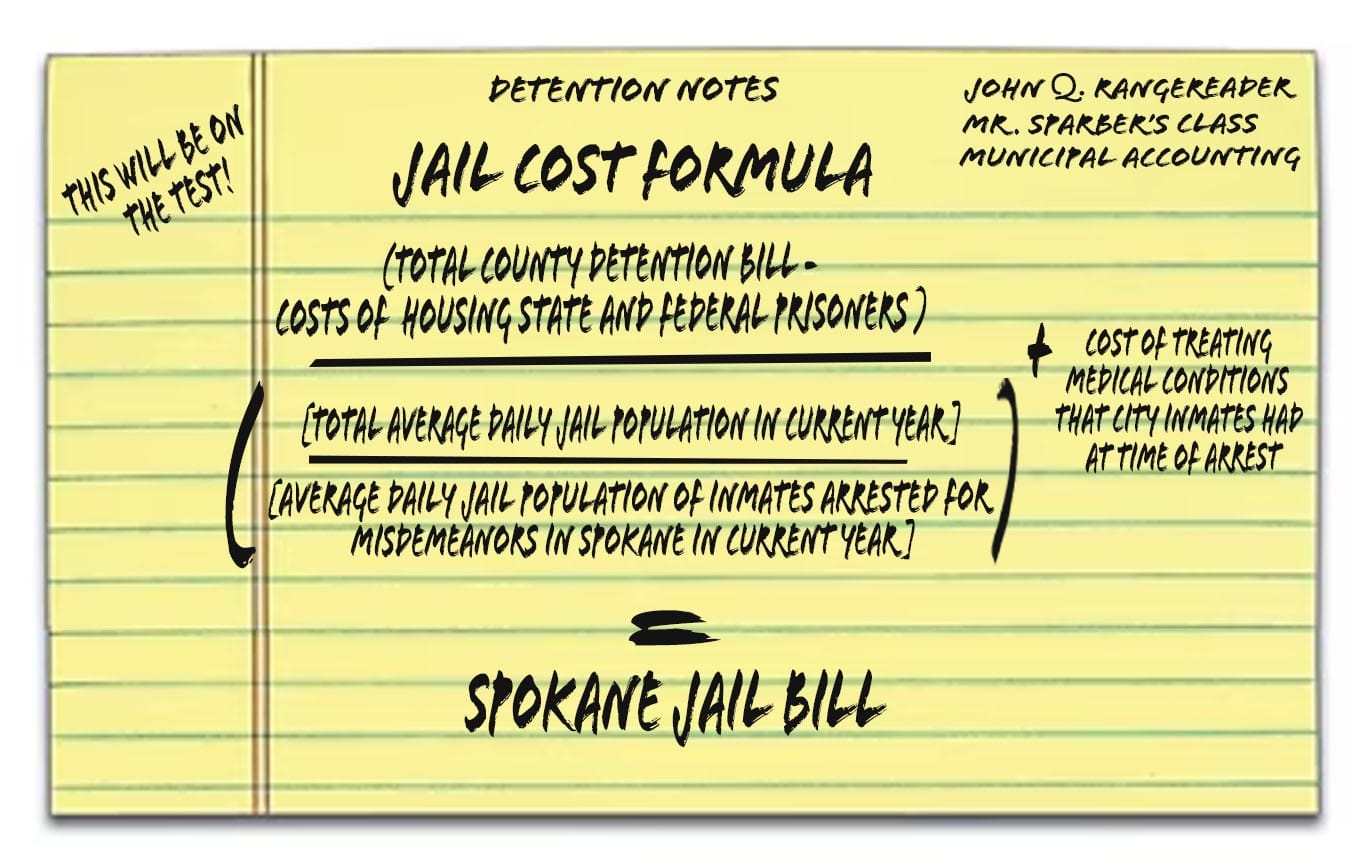
The contract works like this: Commit a felony anywhere in Spokane County, and the county will pay for your stay in jail. But commit a misdemeanor inside the Spokane city limits — like driving drunk or stealing property worth less than $750 — and the city’s going to be the one footing the bill.
That alone means that the city’s jail budget is going to be a lot more volatile than the county’s. Whenever there’s big pressure to reduce jail numbers, for example, it’s not the people accused of serious assaults and murders who are going to be let out on the streets. It’s those arrested for vandalism, trespassing or bike thieving.
That’s exactly what happened during the COVID-19 pandemic: while everyone else was locking down, those in lockup were being let out.
Facing the threat of a deadly virus spreading like mad in the tight quarters of a jail, a March 2020 court order from Spokane’s Municipal Court resulted in 48 low-level prisoners being released.
The city of Spokane had spent nearly a decade whittling slowly away at its jail population through diversionary programs like Community Court, but a global pandemic slashed the population of Spokane’s two jails by a full third in a matter of months. In 2021, the city was paying 20% less for detention than it was in 2019.
Book and release policies mean that when the prisoners with misdemeanors were booked into jail, they were often released almost immediately. Sometimes, Sparber said, the cops wouldn’t be out of the jail parking lot before the suspect they’d just booked came walking out.
Even after COVID restrictions had lifted, book-and-release remained on the books.
"It turns out they just kept adhering to the policy, and eventually the jail population was way down," Spokane County Sheriff John Nowels said.
If nothing else, that was good for tamping down the city’s jail costs.
But other factors were at work: In 2021, the Washington State Supreme Court declared that the state law making simple drug possession a felony was unconstitutional. Inmates with pending possession charges were released. When the state legislature rewrote the law in 2023, it turned drug possession from a felony to a gross misdemeanor.
The result? The city is now on the hook to pay to house drug possession inmates instead of the county.
And when you do a “deep dive” into the numbers, Sparber said, it turns out that the change in the drug possession policy did play a real part in the increase of city-funded inmates in Spokane jail.
The average number of people in jail on gross misdemeanors increased by 75% from January of 2021 and January of 2026. During that same time period, the average daily jail population the county was responsible for went up by 8%, but the city’s went up by 97%.
But Matt Boston, the city’s Chief Financial Officer, said Spokane still needs a lot more data to understand what’s happening, including specifics about costs for administration, booking and release, and short-term and long-term medical expenses. The audit recommended that the city push for access to even more granular real-time detail on the inmates.
“I wish I could look into a crystal ball and say I knew what that path forward is, but without all of the information in front of me — which seems to be difficult to get from the county — we won't be able to have that discussion,” said Boston.
WHAT WE HAVE HERE IS A FAILURE TO COMMUNICATE
Last week, top officials from the city and the county came together in the valley for a summit for the Regional Coalition of Government’s Safe and Healthy Spokane Task Force. They listened to presentations on transforming the region’s criminal justice system, applauded each other, and stood together for team photos.
But the conversations around the audit suggest that, underneath all the expressions of can-do spirit, tension simmers between the two municipalities. Recent years have seen a battle over the regionalization of the 911 system and the collapse of a regional initiative on homelessness.
"I'm sure you know that intergovernmental relationships are difficult in Spokane,” Spokane City Council Member Kitty Klitzke said when asked about the county. “It's just like, everything is more opaque because they don't want feedback.”
While Wilkerson, the council president, said that transparency from the county has been gradually improving, other councilmembers have said they’ve struggled to get clear answers from the county in a timely manner.
In a briefing session last week, the county greeted the audit cautiously, noting the lack of outreach by the city.
"It's nice of them to tell us what we all knew, that there was no waste, fraud or abuse,” County Commissioner Josh Kerns said at a briefing last week. “But we could have told them that."
Commissioner Mary Brooks (formerly Kuney) said she was happy to talk with the city, but preferred to actually talk.
"It'd be nicer if we could just pick up the phone and have these conversations," Brooks said.
But the city doesn’t just want answers. It wants input. In a letter to county commissioners last month, Brown requested that the city get a seat on committees evaluating vendors and providing Medicaid-funded treatment to inmates.
The mayor also directed city staff to create the city’s own internal jail oversight committee
Brown wants to renegotiate the 15-year-old jail contract. Right now, she said, the city’s bill for the jail is calculated “per day,” which she believes penalizes the city for having a population with shorter stays.
“We get charged for a full day, no matter how much time the person is in the facility,” Brown told RANGE. “If they’re there two hours, it’s one day. If they’re there, 25 hours, it’s two days… That is a change we could make in the contract that would be beneficial to Spokane.”
Council Member Paul Dillon said he suspects the city may be getting a raw deal in a lot of areas.
“There's just a lot of budget minefields from past agreements scattered across city-county services,” Dillon said.
Yet when it comes to the jail, Sparber stressed to RANGE, the city isn’t in charge.
“They’re not a partner,” he said. “The county has a responsibility to run the jail. That’s their job.”
Sparber said he’s happy to sit down and talk about the contract, though he does think the city is getting a pretty good deal as it is. For example, he suggests, maybe if a prisoner has both a misdemeanor and a felony, the cost could be split 50/50 between the city and the county, instead of the county paying for the whole thing.
But Sparber is skeptical that the city is losing much money by being tolled by the number of inmates per day, rather than being charged à la carte.
“I would sit down with them and explain all the cost that goes into booking an inmate, the nurses, everyone involved in the booking area, and let's compare that cost to what they're being charged,” Sparber said.
After all, the city’s finances had ultimately benefited from years of prisoners being released right after booking.
On October 20 last year, Spokane’s criminal justice system officially ended that policy. Nowels, the county sheriff, said that some arrestees were “pretty surprised they were getting booked and held and they were gonna have to see a judge” and were pretty miffed about the whole thing.
Misdemeanor prisoners who might have been in for a few hours started being jailed for multiple days. The impact was immediate. Just three weeks after the change, Spokane had over 50 more prisoners in jail — a 44% increase in less than a month. The fact that in the same month Spokane City Council passed a new ordinance that allowed police to arrest some homeless people camping on public property just added to the crowd.
The recent spike means that, if trends continue, the 2026 figures risk being even worse — putting Brown in another inevitable budgetary position if she runs for reelection.
But Brown argued that just zooming in on the jail itself misses the important larger things. She said the city was working on a lot more to improve the quality of life for the community, like outreach teams and a daytime navigation center to help the homeless find the right services.
“To me, focusing just on the jail is a limited perspective when we're trying to do this big picture transformation,” Brown said.


