

It’s March 2023. A homeless Spokane man named Seamus “Shame Dog” Galligan overdoses on fentanyl on a street in southern California. After getting out of jail for stealing from a local deli, he boarded a Greyhound bus, heading back to San Diego to be with his father. But after missing his connection in Anaheim, he finds a hit of fentanyl. A month of detoxing in jail has weakened his tolerance. So he makes the miscalculation that killed so many of his friends. He inhales a bit too much, holds his breath a tad too long. His dad waits for him to call to come pick him up. First hours, then days.
It’s April 2023. A homeless Spokane man named Jeremy Root is stabbed multiple times. His attackers are just kids. Nobody's over eighteen, but all of them have knives. He’s far from the first homeless victim of violent juveniles. It’s one more hazard of living on the streets of Spokane, one more way to die. The knives come for him on the Monroe Street Bridge, where there’s little room to run. Maybe he’s stabbed five times, maybe as many as 17. The sun has set — he doesn’t want to just pass out right there, where no one would find him. So he staggers back across the bridge toward the downtown library, toward where other homeless people are gathered, the trail of his blood dripping behind him.
It’s January 2024. A homeless Spokane man named Joseph Sampson has almost everything he owns stolen. His backpack, gone. His sleeping bag, gone. It was just another indignity he’d experienced in his dozen years on the Spokane streets. He’d been arrested, harassed and booted from public buildings. He’d felt the bitter cold bite through his gloves until he couldn’t feel his hands anymore. He’d made close friends, then grieved their deaths.
And yet: This is a story about hope.
For all the forces conspiring to trap these men in chronic homelessness — drug addiction, poverty, mental illness, criminal history, bad luck — there were equally powerful forces working to rescue them. There was love: a father’s love for his son; a father’s love for his daughter; friends’ love for each other. There was a network of social services agencies, non-profits, and even police officers, crafting paths out of homelessness. And there was individual willpower, the guts and tenacity to break out.
This is a story of three daring escapes.
It’s May 2026. Jeremy Root, Seamus Galligan and Joseph Sampson are alive. And none of them are homeless.
THE WAY OF THE SHAMEDAWG
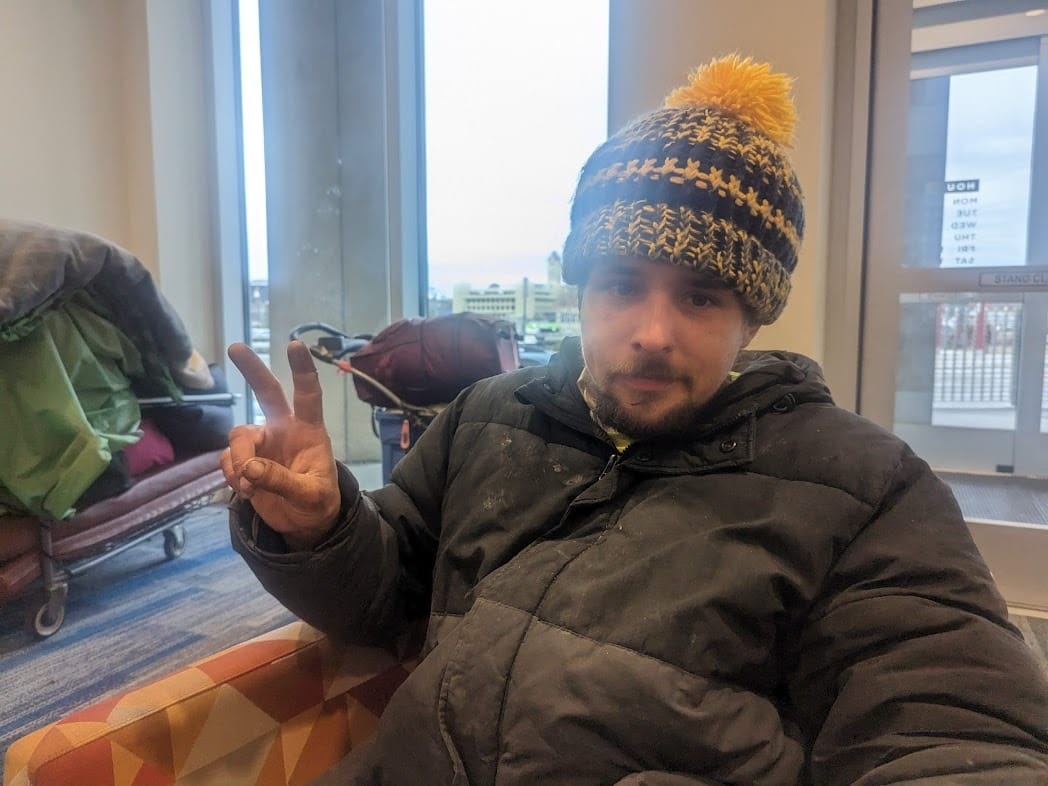
Three years ago in February — one month before Galligan would overdose, two months before Root would get stabbed, 11 months before Sampson would have his possessions stolen — I sat down with all three of them together at the downtown Spokane library.
My story’s premise: The Central Library of Spokane had become a microcosm of all that was beautiful and all that was broken about downtown.
Homelessness was particularly relevant — as a candidate, then-mayor Nadine Woodward had flirted with banning homeless people from the library entirely. Instead, the library became a sanctuary for the unhoused, a hub for connecting needy people with social services. But that created all sorts of new tensions and conflicts.
The three people I interviewed weren’t selected by a social services agency or activists or PR folks. They weren’t cherry-picked. They just happened to all be sitting on the first floor when I walked by.
Sampson, member of the Lower Elwha Klallam tribe, homeless for a decade, came across as contemplative. He’s an older man who’d become a kind of local leader among the unhoused in downtown Spokane. He’d been an activist, pushing back against efforts to criminalize homelessness.
Seamus “Shamedawg” Galligan, with shaggy facial hair and bundled up in winter clothes, had been homeless for three years. He talked like the kind of stoner philosopher who populates many a dorm lounge, cynical and burnt out, but with a penchant for diving into intellectual theory. Tall, lanky Jeremy Root, had been homeless 15 years — nearly half his life — and was eager to flash his intelligence too. When Galligan referenced a seven-story high shanty town in Hong Kong, Root, as if he were buzzing in on Jeopardy, spat out the location: “Kowloon Walled City.”
The three debated drug policy, reviewed the quality of the library snack bucket and mourned friends who had been stabbed or had overdosed. Normally, of course, these sorts of stories aren’t multipart sagas. You type up the quotes, you publish the story, you say hi if you run into the sources on the street.
But shortly after I published the story, Galligan’s dad, a tech executive from San Diego, sent me an email. He had been looking for his son for weeks. That sparked this story in the Inlander, all about Galligan’s father walking the streets of Spokane searching for his son.
It nearly had a darker ending. After overdosing on the way to San Diego, Seamus woke up in a hospital in Anaheim.
But by the last page of the chapter, Galligan had reunited with his father and was looking to the future. He’d had an epiphany: that if he didn’t change his life to escape homelessness and addiction, he’d never move on from it.
Two years passed, and I didn’t look up how Galligan was doing. Too many victories in stories like these are temporary. Roughly nine out of every 10 opioid addicts relapse. The key to the happy ending in stories like his often is when you decide to stop reading.
Instead, Galligan sent me an email.
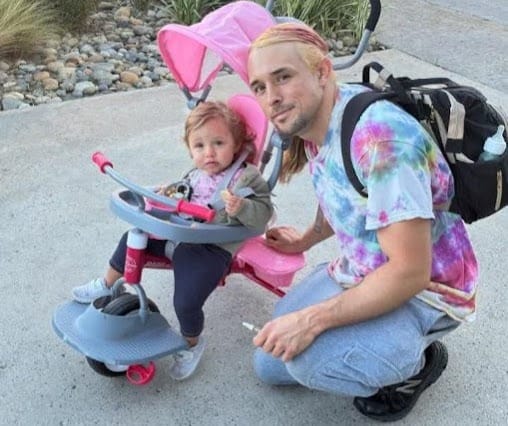
"I'll be two years clean in April," he wrote in an email last year. "I have a baby daughter now with a wonderful woman.”
The difference between his life in San Diego and what his life had been in Spokane felt staggering to think about.
“I'm somebody's father now,” he wrote in a text. “I have a beautiful family and a beautiful home. A short two years ago I was a raving crackhead. Lost to the world, wandering the streets, sheltering in dumpsters. Whoda thunk.”
When he was a teenager, Galligan’s dad had been homeless himself. Galligan’s birth was the kick-in-the-ass he needed to get serious about changing his life around.
Galligan’s life followed the same arc. The birth of his daughter was the moment his outlook truly changed.
“It was holding my daughter for the first time,” Galligan said. “It was knowing that I have a legacy in this world: Leaving a better world for my daughter.”
At first, he simply replaced his opioid addiction with alcohol. But then he set a goal that he could pour himself into: Bench pressing 300 pounds. He enrolled in body-builder competitions too.
It made ditching alcohol easy: he didn’t have the time, he couldn’t spare the calories.
He said he’s become a mobile personal trainer for a local community gym in the San Diego area working with people with autism and other neurological challenges.
“I have neurons that need to be mobilized, that need to be stimulated, that need to be doing something,” Galligan said.
There’s so much to love about his life now. He remembers what it felt walking on the streets of San Diego suburbs, reveling in the kind of high that can only come from sobriety.
“I felt so lucid,” Galligan said. “It was still cloudy out, and I realized I could smell the wet asphalt. and the rain, and when it's raining in La Mesa, it has this particular smell.”
Maybe it’s the way the drizzles blend with the scent of the pink Bougainvillea plants.
“If I was just wasted all the time, I would be missing out on all this shit,” Galligan said.
SAMPSON’S STRENGTH
Joseph Sampson’s path to escaping life on the streets began after the death of Rick Cearns, a homeless man from Oregon.
Cearns was a person, Sampson recalled, who would look out for others. He’d de-escalate fights. When one of their friends was cold sleeping outside the library, Sampson recalled, Cearns was the one who found every blanket he could find and covered him with it in the middle of the night.
The guy didn’t even want to be in Spokane, Sampson said, but he was stuck here on probation.
Three weeks before his death, Cearns posted a photo of the wintery Spokane River right outside the library balcony.
“Rick Cearns is feeling happy at Spokane Public Library,” his Facebook status read. "Got to love the snow.”
Later that month, Cearns asked Sampson — another homeless man killing time at the library — to watch his backpack and sleeping bag at the Library while he looked for a place to take a nap. Sampson was happy to help.
Sampson waited, but Cearns never came back for his stuff.
There was no news coverage, no obituary in the paper, no press release from the police department. The medical examiner’s report said Cearns had been killed from blunt-force trauma to the head, but didn’t conclude whether it was an accident, suicide or homicide. The police case is unsolved.
In the days following Cearns’ death, Sampson overheard people talking about the tragedy at New Leaf Coffee, the coffee shop on the first floor of the library.
An employee of New Leaf asked to see a picture of Cearns, and Sampson showed her the picture on Cearns’ Facebook page: a thirty-something man with a scraggly red goatee and a nest of curly hair. The barista ended up accompanying Sampson to the annual homeless memorial.
New Leaf is more than a coffee shop: It’s a part of Transitions, an organization that provides job training and career services for homeless people. And when Sampson floated ideas that others might have scoffed at — like going to college and training to become a paralegal — the people at New Leaf were eager to figure out how to get him there.
“The one lady there, she really pushed me to get housing and get off the streets,” Sampson said. "I told her how long I was on the streets, and she's like, 'that's too long.’”
The same month I interviewed him, New Leaf hired Sampson to help serve coffee, taking him on for a six-month job training program. Meanwhile, the team helped their new coworker get everything he needed to get a housing voucher and search for a place to live.
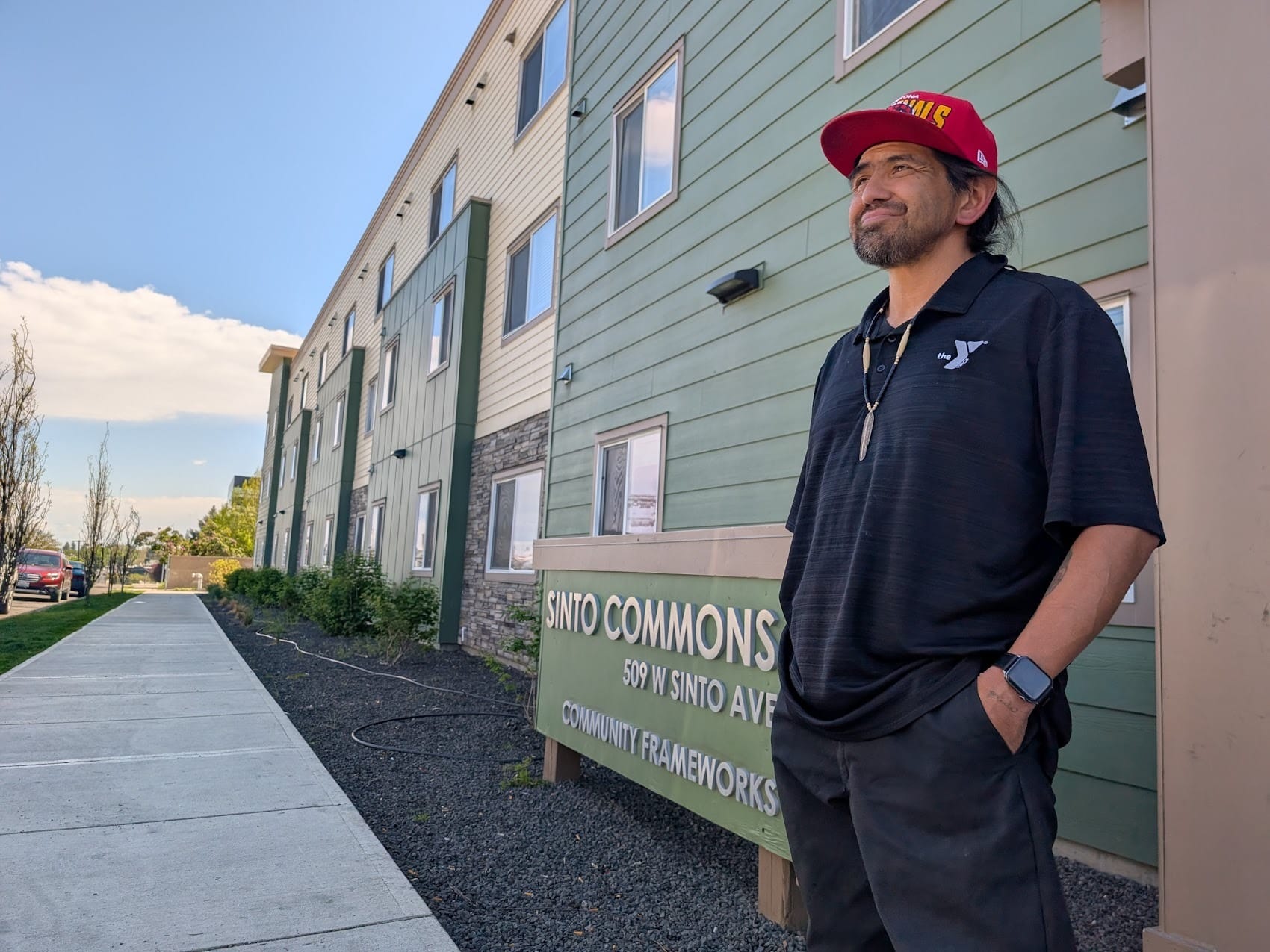
It took more than a year, but by April, 2024, he had a place. Today, he’s living in the Sinto Commons, a four-story affordable housing complex in Spokane that opened near North Central High School.
“There's a certain percentage of the apartments here in this building that are dedicated to people just getting out of being homeless, like myself,” Sampson said.
His small apartment unit is messy, even chaotic, a flurry of dishes and piles of clothes — he is a single guy, after all.
It is, to say the least, a lot nicer than his last place. And it’s his, his own sanctuary, a place to make his own.
He’s lined the walls near the ceiling with a row of vinyl records. His bike — a Genesis Mountain Bike — leans up against a dresser covered in colorful drawings a friend of his made. Just owning a bicycle is a kind of victory, proof of the kind of security he has now. A bicycle wasn’t something he wanted to own when he was homeless.
“I wanted a bike so bad, but I know how quickly people's bikes get stolen out there,” Sampson said.
Sinto is permanent supportive housing, the kind that sparks intense opposition in Spokane’s wealthier neighborhoods. But unlike regular housing, he gets a case manager to help him improve his life. It happened to be Oakley Gunderson, his old supervisor at New Leaf. Every 30 days, they review his life and chart out new goals.
One of those goals: Becoming a paralegal. He’s fascinated by the law. He had a reputation on the street of knowing a lot about the legal system, and he wants to have a chance to use that knowledge for good.
Like Galligan, Sampson has a daughter. Because he’s doing better in his life, he gets a chance to see her more often. Sometimes she’ll hang out in his apartment. Other times he’ll hop on his bike and ride downtown and meet up with her.
“It's hard to imagine she’s 20 years old already,” Sampson said. “It went by really fucking fast.”
So much of his life had been about trying to escape the cold. One winter, he used the little bit of money sent from his tribe to rent a motel room for a week to escape the sub-zero temperatures.
“Maybe I'll just freeze to death," Sampson had written on Facebook during one low point in 2022. "That's what I want anyways.”
It’s warm here, today. It’s safe and it’s quiet. Sometimes too quiet.
“A year in my apartment, and I’m not adjusted to being inside,” he wrote on Facebook.
The indoors had this eerie kind of quiet that made it hard to sleep.
“I was so used to hearing the sounds of the world when I was homeless,” Sampson said
He’d spent a decade listening to the hum of the city as he fell asleep. So at night, he cracks open a window a little bit, just enough to hear the pulse of the cars driving by below.
ROOT CAUSES
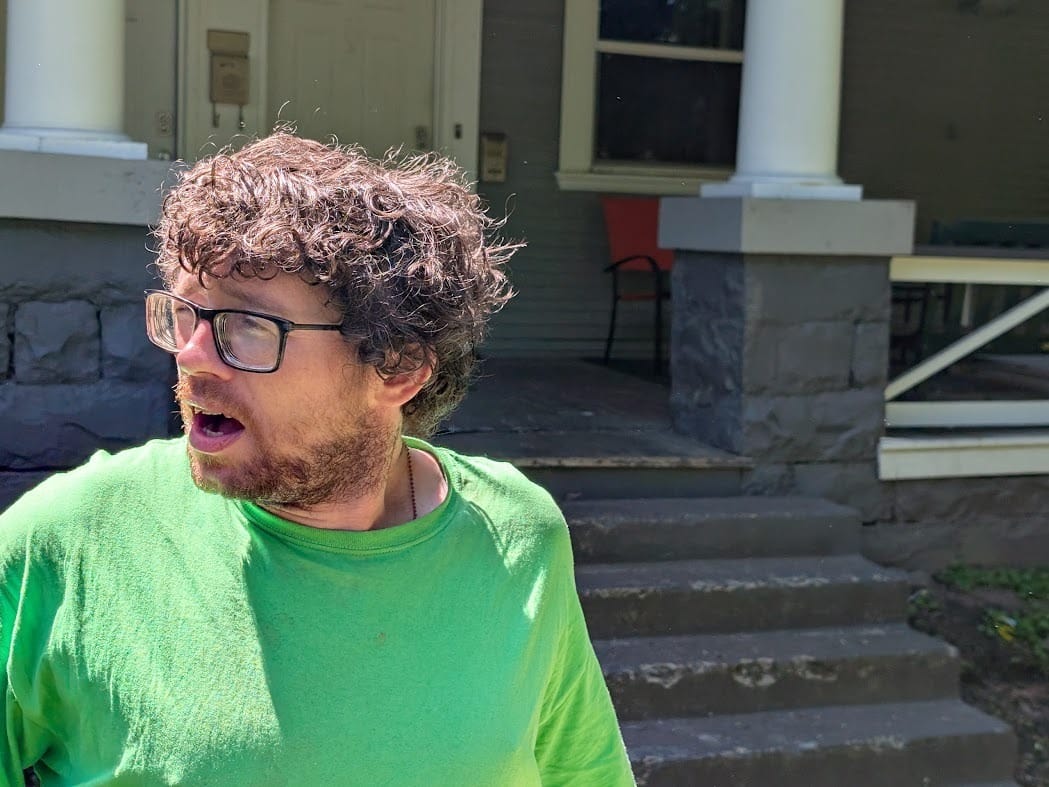
Jeremy Root survived the stabbing. For now, he can’t even see the evidence of the wounds, he said.
"I'm sure, down the road as I get older, those scars will reappear," Root said.
Root is sitting on the porch in front of a sober living house on the lower South Hill, occasionally taking hits from a sour green apple vape pen. I hadn’t been able to reach him for weeks – he was in rehab, it turned out.
“I got sober,” Root said. “I've been doing drugs for two decades… Figured it was time to get my shit together, so to speak."
This housing comes with rules: He has a curfew. He has to attend intensive outpatient behavioral health classes. He has to take drug tests.
Root had assistance from a number of social service agencies — and pressure form the Spokane Police Department — but he’s absolutely clear that getting clean was ultimately his decision.
“The hoops I'm jumping through now, I'm choosing to jump through,” Root said. “I could very easily, you know, give these people the middle finger and go back out onto the street, and go right to my old fucking bullshit.”
For a long time, Root had rejected these sorts of rules. He smoked meth — and used to make a lot of money selling it. Even today, he said, he’d rather go to jail than stay in a shelter.
“It's the same experience, you know,” Root said. “Forty-two dudes burping and farting in the same fucking room all night."
Root had been in a “swordfight of sorts” with mental illness all his life. He was in anger management by the time he was 4-years-old, eventually getting diagnosed with type 2 rapid cycling bipolar disorder. (“Weee!” he added.)
Living without housing has a way of exacerbating mental illness.
“On a long enough timeline, the world around will give you a level of PTSD,” Root said.
There can be a rhythm to homelessness that can be tough to escape: the day-to-day’s you’re living in bleeds into week-to-week’s and then year-to-year’s. The rest of the world blurs by in the distance.
“You blink and it's like 10 years later,” Root said.
All those years curdled into distrust toward society. Try having a dog like Taz — a Tasmanian-striped pitbull — and see him get dragged away to the animal shelter when you get arrested, and then not being able to get him back when you get out because you’re unsheltered.
“You have something you actually give a shit about and it's stripped from you," Root said. "People can get very bitter very quickly."
He’d been stabbed. He’d had frostbite. A brutally cold winter night had eaten at the fingertips and his toes like acid. For months afterward, he felt lightning bolts shoot up his body, his nerves misfiring. He’d been hit by cars – so many, he adopted a rule: go over not under.
But none of that caused him to get clean. The final straw was actually a shift in Spokane’s policing strategy.
"I just constantly was going to jail over this shit — camping charges and, like, trespassing I have from, like, places that I used to be able to just frequent,” Root said. “I got kind of tired of getting caught in the crossfire and all that.”
But this was no accident. This was part of a larger strategy.
When I mention Root’s name, downtown Spokane Police Captain Kurt Reese recognizes it.
"Jeremy's doing great,” Reese said.
Root was one of what the Spokane Police Department called the “Downtown 10” — the top ten people who cops, firefighters, paramedics and social service agencies were responding to more than any other.
Reese had seen similar programs at hospitals and at the Portland Police Bureau that focused on giving extra help to the people who kept getting arrested or kept ending up in the emergency room. He wanted to do something similar for downtown Spokane.
Last fall, the police department, mental health care organizations, prosecutors, defense attorneys and judges all teamed up to focus on the “Downtown 10” — the people who cops, firefighters, ER docs and mental health workers had been responding to more than any others.
“We didn't just pick the low-hanging fruit,” Reese said. “We picked some very tough, challenging people.”
The cops arrested those with active warrants and connected them with service providers the moment they landed in jail. A coordinator began to track every single step of their cases.
"We have weekly meetings where we discuss the welfare of each person and how we can try different tactics to try to get them into services or into some kind of supportive housing," Reese said.
The threat — and reality — of jail was a key part of the strategy. The police department worked with the jail and the prosecutor’s office to hold members of the Downtown 10 until they could and see a judge and be connected with services.
For years, jail restrictions meant there had been few immediate consequences for low-level crimes downtown. One person had been arrested 17 times without having seen a judge, Reese said, while another taunted the police that he’d be out within an hour.
But the Downtown 10 program was part of a strategy to change that.
“After being in jail for a few days, he started wanting to come to the table to talk about how to get into services,” Reese said.
These kinds of “high utilizer” programs were championed in the report recently released by the “Safe and Healthy Task Force,” a coalition of local leaders aiming to figure out the most effective way to spend criminal justice money.
It’s a program that risks drawing fire from both sides of the homeless debate: It suggests using law enforcement and the threat of arrests as a tool to push people to seek help. And it requires a tremendous investment in rehabilitation programs and other support services.
But Mayor Lisa Brown told RANGE that the walls dividing between the two camps on the homelessness issue have began to come down.
"I think we’re at a more nuanced place now," Brown said. She said more people understand that simply sending people to jail doesn’t solve problems, but also that sometimes “the fact that they're in the jail is then the time and place where they get connected to the resources”.
Deciding to change rarely happens in an instant. One social service agency, Root said, had been trying to work with him for more than a year before he agreed to take their help.
Some people seem like they’ll never be ready to take that help, Reese said. But then, “all of a sudden they're ready, and when they're ready, we have to have that warm handoff to get them into services.”
At the sober house, a grizzled old man with an anarchy tattoo on his neck smoked a cigarette on the porch as I talked to Root.
"To actually go from being on the streets to having a place, even if it's just a shared living space ... the rules are totally different,” the man said.
Root heartily agreed.
“I just got out of treatment like — shit — less than a week ago, I'm still just getting used to doing the whole fucking ‘not homeless’ thing,” Root said. “We have to learn to no longer be feral. Learning to interact with society on a normal level.”
Root knows how precarious the recovery process can be. He’s seen plenty of relapses in his time. But this isn’t a moment for those kinds of dark thoughts.
The sun is shining so bright today Root has to squint.
“This program I've been going through, it's given me a sense of optimism that I haven't had in a long time,” Root said. “Like maybe this time things might work out in my favor.”
THOSE LEFT BEHIND
Just recently, Sampson lost two friends to overdoses and another to murder.
When you exit homelessness, it means leaving friends behind. When you have housing and so many of your friends are still on the street, the temptation — the overwhelming sense of human decency — is to give them a spot to crash in your new life.
But that’s typically a lease violation.
"That's what makes people lose their housing, pretty quick,” Sampson said. “A lot of people I've known that have gotten housing, they get their apartment or house and within a year, they're back on the streets again.”
Sometimes Galligan sits in his car and cries about the people he left behind on the streets of Spokane.
“I think about them all the time, many times per hour every waking hour of my life,” Galligan said. He’s animated by revolutionary sentiment, outraged about the exploitation that pervades society, infuriated by an economic system that so easily discards people as worthless.
“There’s a family less than a mile from me who are homeless with a two-year-old child,” Galligan said. “This is a society that does not care what happens to human beings.”
And yet, there are those who care about the human beings that the system has discarded.
A Spokane police detective told RANGE he hasn’t given up on Rick Cearns, Sampson’s homeless friend who was killed nearly four years ago. There’s one more potential investigative lead he’s still hoping will pan out. He encouraged RANGE readers who know anything to contact Crime Check.
Just like the New Leaf coffee baristas didn’t give up on Sampson, and just like the social service workers didn’t give up on Root, Galligan’s dad didn’t give up on him.
"If I could be what I was in 2022 or 2023,” Galligan wrote in an email, “and a short time later be what I am now, then nobody, no matter how dejected, should be written off."
That’s the lesson of Sampson’s story and Root’s story too.
At the sober house, Root raised his pink thermos full of coffee, as if he’s giving a toast.
“It’s the feel-good story of the century,” he said.
Galligan in a text message, offered a slightly different take.
“The good news story will be the end of capitalism,” Galligan wrote in a text message, “and I’m trying to write it every day.”
Editor's Note: This story has been updated to correct typos.


