

After a local TV station reported Tuesday that a potential Avista Corp. customer wants to build a large data center, the power company told journalists it had not given details about the facility sooner because “there was uncertainty around what we could confirm publicly.”
Spokanites had been nervously murmuring about the specter of a data center for months since proposed legislation that would have exempted new data centers from the state sales and use tax failed in the legislature. But while the public remained in the dark about the nature of the proposed “large load” project, Avista’s shareholders found out on May 5, more than a month prior.
At a quarterly earnings call that day between top Avista officials and representatives from Wells Fargo Bank, Barclays Bank PLC and Jefferies LLC, the utility disclosed the project was a data center. Data centers are energy-intensive facilities filled with servers and networked computers designed to store and manage electronic information generated by companies and other organizations, which purchase storage capacity in the centers.
“Negotiations continue with one of the prospective data center developer customers looking to locate in our service territory with a projected incremental load of up to 500 megawatts,” Avista President and CEO Heather Rosentrater told the bankers in an update about the utility’s finances. That’s enough to power as many as 400,000 homes. It could take the equivalent of 250 wind turbines to generate that much juice.
“At the time of the earnings call, this project was still in early exploratory discussions and covered by confidentiality agreements,” Avista spokesperson Jared Webley wrote in an email. That arrangement is designed to protect confidential information. “Heather’s comments were high-level and general in nature. As conversations progressed … we took a more cautious approach in our communications to ensure we were honoring project-specific confidentiality while details were still being clarified.”
According to a publicly available transcript of that call published by the business news aggregator Seeking Alpha, Avista Investor Relations Manager Stacey Wenz and Senior Vice President Kevin Christie were also on the call.
“We are also engaging with policymakers and the Washington [Utilities and Transportation] Commission regarding data centers to advocate for policies that ensure appropriate allocation of costs and benefits associated with the integration of these large loads,” Rosentrater said, according to the earnings call transcript.
Avista signed the MOU with the developer on May 31. Webley said he could not give RANGE that document, partly because it identifies the developer, which Avista is keeping under wraps during negotiations.
But no one in Spokane seemed to know that a specific relationship Avista was building with an undisclosed developer was for a data center until KXLY confirmed it with Avista on June 9.
The Spokesman-Review first wrote about the data center agreement on June 3. The MOU is nonbinding and allows Avista to pull out of the deal. In that story, County Commissioner Al French speculated it could be anything, like a Boeing manufacturing center, which he would have supported.
The Regional Plan Association writes that data centers could consume up to 12% of electricity in the US by 2028.
Memorandum vs moratorium
Webley emphasized that the MOU is only a “framework” for further discussions with the developer, not an agreement on Avista’s part to facilitate the large power load. Most importantly, it commits the developer to paying for all costs associated with the project so Avista doesn’t pass them on to ratepayers, which has been a big concern in other communities where data centers have been built.
Talks with the developer are in the earliest stages and do not represent a commitment by Avista to let the developer tie into its grid, Webley said. He also said Avista has a responsibility to consider such proposals and said the potential customer would pay for an extensive study for the project.
Avista presented to the Spokane City Council on its “large load” development process on March 26, but did not mention any specific projects. Garrett Brown, who manages large industrial consumers for Avista, said in his presentation the biggest concerns in building large new projects surrounds the making of electricity — like wind and solar farms and natural gas power plants — and transmitting that electricity via power lines.
Brown did not mention the specific proposed data center at that meeting, but he said Avista had been approached by a potential customer who was asking for 500 megawatts.
“As we talk to customers who are asking for 500 megawatts, we’re talking to customers who are ultimately asking for a quarter of our peak load,” Brown told the council at the study session.
Council Member Sarah Dixit asked Brown how much land such a project would require. Though he didn’t know a specific amount of acreage, Brown said it “could be a very sizable amount of land.”
He said any proposed facility goes to Avista’s “system planning team,” which models the details of connecting a big facility to Avista’s transmission system. The team determines how to adapt the system to the new load and tell the customer how much it would cost. If Avista and the customer agree to a deal, they then have to have it approved by regional energy commissions. In the case of a data center, it would be the Washington Utilities and Transportation Commission.
Spokane City Council Member Paul Dillon was at that study session and told RANGE he was not satisfied with the utility’s answers. He said he and council members Sarah Dixit and Kate Telis announced proposed city legislation to enact a moratorium on new data centers on Wednesday. The proposal would buy the city time to create a legal framework to approve data centers, Dillon said, noting the city doesn’t have a regulatory framework for data centers.
Right now, “we would be very ill-equipped to address it,” Dillon said. “So it's important that we put this pause in and work on those impacts and how do we get ahead of this because we're so far behind.”
Just this week, the Seattle City Council approved its own moratorium on new data centers.
There are currently five data centers in and around Spokane, but those facilities are much smaller — and have been around for much longer — than the proposed one. It’s not clear where in Avista’s service area, which spans 30,000 square miles in Eastern Washington, Idaho and Oregon, the facility would be built or whether a citywide moratorium would impact this project.
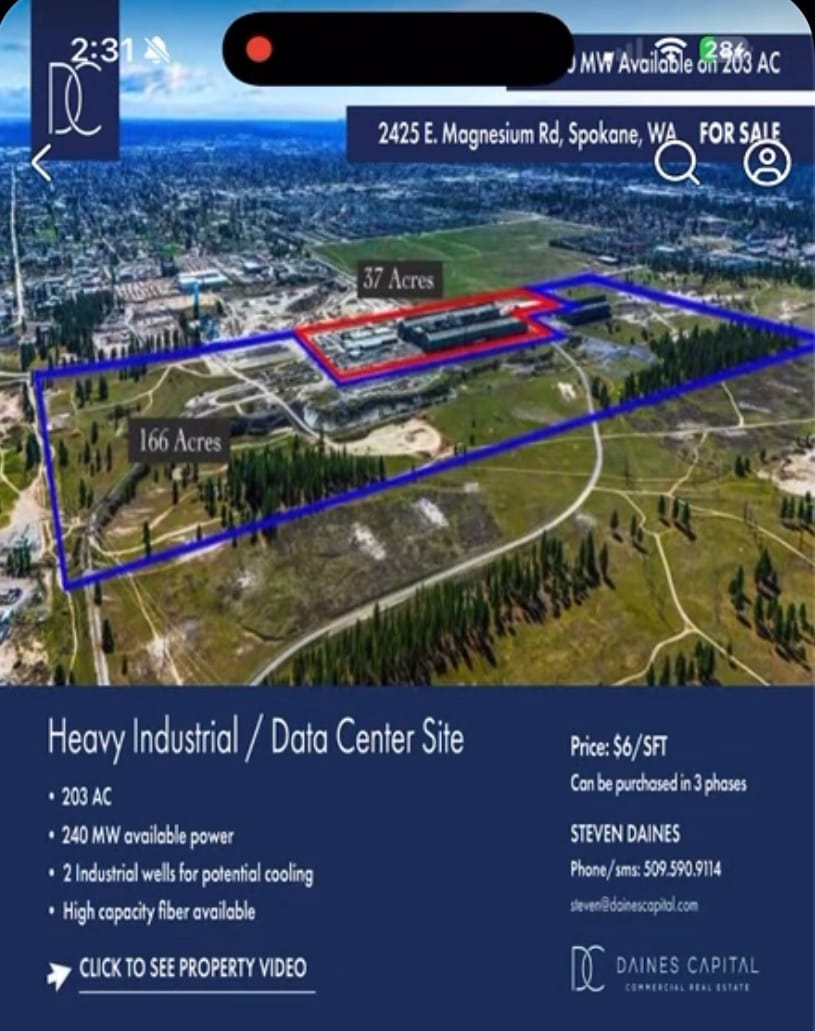
Dillon told RANGE he’d heard of three potential locations for the data center, including one near the Hillyard neighborhood northeast of town. Daines Capital, a realty firm, has published an undated PDF promoting a 203-acre “Data Center Site” that has 240 megawatts of available power. It advertises “high-capacity fiber” and two industrial cooling wells. Steve Daines, who owns the company, did not immediately return a request for comment. The site sits outside the city limits a few blocks from the former Kaiser aluminum plant. The flyer says the property can be purchased at $6 per square foot and in three phases. The PDF was removed from the internet after we published this story, but the listing is still available as a rental here.
County Commissioner French recently asked the state legislature to exempt data centers in Spokane from the state sales and use tax. Representative Timm Ormsby, D-Spokane, introduced a bill during the 2026 legislative session that would do that, but it died.
Environmental impacts
Data centers, especially ones dedicated to generating and storing AI-generated media, are the subject of a heated public debate over the environmental impacts associated with their construction and operation.
They drain electricity, so much so that in some cases, utilities are cutting power to existing customers to accommodate the facilities. People across the nation are opposing data centers. Sometimes they are steamrolled; sometimes they kill the proposal. Community members in the township of Saline, Michigan, tried to stop a $16 billion data center from being built, but the project was approved anyway.
Any new data center would have to go through an intensive, years-long approval process involving local, county, state and federal agencies. For example, it would be subjected to the State Environmental Policy Act, which defines a process that determines whether a proposal would have to undergo an onerous and expensive environmental impact study.
Before that happens, the developer has to apply with Avista, according to a process outlined in its “Large Load Service Request” form.
According to Avista, the data center would initially consume 125 megawatts of power at any second starting in 2029 and would ramp up to 500 megawatts by 2032. That’s about half of all the power Spokane County consumes.
“The proposed single customer could require several times the combined generating capacity of the Spokane River hydropower system, representing a level of demand that exceeds anything currently operating in the region at a single-facility scale,” Katelyn Scott, a water protector with the Spokane Riverkeeper wrote in a blog last week.
Scott noted that the hydropower system, composed of dams on the stretch of river that snakes through the city, generates 137 megawatts of electricity, compared with the eventual 500 the developer wants to use.
She told RANGE there’s very little information to determine whether the data center would alter local water resources.
“This is a black box right now,” she said. “And until we can see into that black box, it's impossible to support.”
Data centers also have to keep their computer systems from overheating, and one way to do that would be to cycle water from a local aquifer through the center’s cooling system and back into the aquifer, where it would cool down again.
But she added that doesn’t mean it’s safe for the river’s ecosystem.
“It can actually have a thermal heating impact on aquifers if there's too much,” she said. “Depending on the volume, we might start seeing temperature changes in our aquifer, which then influences the temperature of the river, which is already impaired for temperature.”
In the Columbia River Basin, one data center generates so much steam through its cooling processes that it disrupts local aviation.
Scott said developers are looking increasingly to the American West to build new data centers. That statement is backed up by reporting in The Guardian. In his presentation to the city council, Avista’s Garrett Brown said that other data center markets are saturated.
Though no one knows where the data center would be built, Scott said the only entity that has rights to the amount of water a data center would need is the City of Spokane, so the easiest legal way for the center to cool its systems would be to hook into municipal water. It could also purchase water rights from other owners, Scott said, but that’s a legally complex and fraught process.
Some of these concerns could be addressed through regulation, she said, but Washington state has a long way to go before it’s home to a safe environment for data centers.
“Washington, as a state, is really close to passing the laws that would lead to the regulation that we think is needed,” Scott said. “But it's not quite there yet. These regulations take years to pass and create, so it's good to hear that Avista also thinks this project is years off. There's a whole process that has to go into this in order for us to really understand what this development could mean for a community and if it's acceptable.”
Community members are also concerned about the dearth of information about the project. Rachel Winder, a water resource agent with the Idaho Department of Water Resources who is trying to organize an opposition group, doesn’t know where to start: “How do you keep a watchful eye on something when you don't know where it is or where it's going?”


