


SOURCING INFORMATION: In reporting this series, we interviewed 10 former employees and contractors who worked at Latinos en Spokane between 2020 and 2025. Because of immigration concerns and fears of retaliation, most of those sources were only able to talk to RANGE on background, anonymously or under the use of a pseudonym.
In the past five years, local nonprofit Latinos en Spokane (LeS) has made a name for itself as one of the premier regional organizations advocating for Latino people in Eastern Washington. Their website boasts dozens of media articles highlighting their immigrant defense efforts, their cultural festivals and events, and their advocacy work around language access, immigrant protections and workers’ rights.
Two of RANGE’s most powerful investigations into the horrific labor conditions many immigrants live under were the direct result of tips from LeS. We wrote about their work to keep border patrol agents out of classrooms. In 2025, as President Donald Trump’s mass deportation efforts ramped up, we continued to cover their advocacy, like lobbying the Spokane City Council for a resolution in support of the Keep Washington Working Act, and speaking out against violent immigration arrests. We also reported on executive director Jennyfer Mesa’s suspicions that federal agents were surveilling her.
Through the chaos of the first year under Trump’s second term, LeS advertised free legal services for immigrants; hosted monthly legal clinics in partnership with Inland Empire Legal Aid, The Way To Justice and Washington Courts; and fundraised, asking for donations to sustain legal services through their Poder Legal department. In a “2025 Wrapped” post on Instagram, LeS highlighted the work of Poder Legal, writing that the department had provided immigration services to 405 people, hosted eight immigration clinics and 11 legal clinics, among other accomplishments.
The organization, founded and headed by Mesa, also continued to provide other crucial services for local Latinos, like community events, financial workshops, tax clinics, case management through their Community Comadre social worker program and fresh, free food distribution through their Mercadito Cultural Market. Social media posts paint a picture of a nonprofit working hard — and succeeding — at stepping up to care for clients made even more vulnerable by a hostile presidential administration.
Behind the scenes, though, LeS was becoming a ghost town.
In the organization’s 2024 Annual Report, 18 people were listed as being part of the team at the end of the year, pictures of their smiling faces stacked in rows. In June 2025, that number was down to 14 employees, according to an interview executive director Jennyfer Mesa gave the Spokane Journal of Business.
As of publishing, at least 12 of the 18 people in the Annual Report were gone: some quit, some laid off, some fired. Four other workers who were hired after the Annual Report was created had also started jobs but already left.
Mesa and the board contend many of those ended jobs and contracts were due to budget cuts, though they didn’t respond to direct questions in the interview or an email after asking how many positions had been cut in the last year.
“ I don't think it's turnover. I think it's more of our funding. We are contingent upon funding,” Mesa told RANGE. “ We did have to do some layoffs this year. We're not the only ones. So did Amazon, some other millionaires. We're working as we can and we've had to do layoffs because we just simply couldn't sustain the program because of funding.”
Board members added that recent funding cuts and grant reductions have created one of the biggest challenges the board has faced as they decide which programs to prioritize for the community.
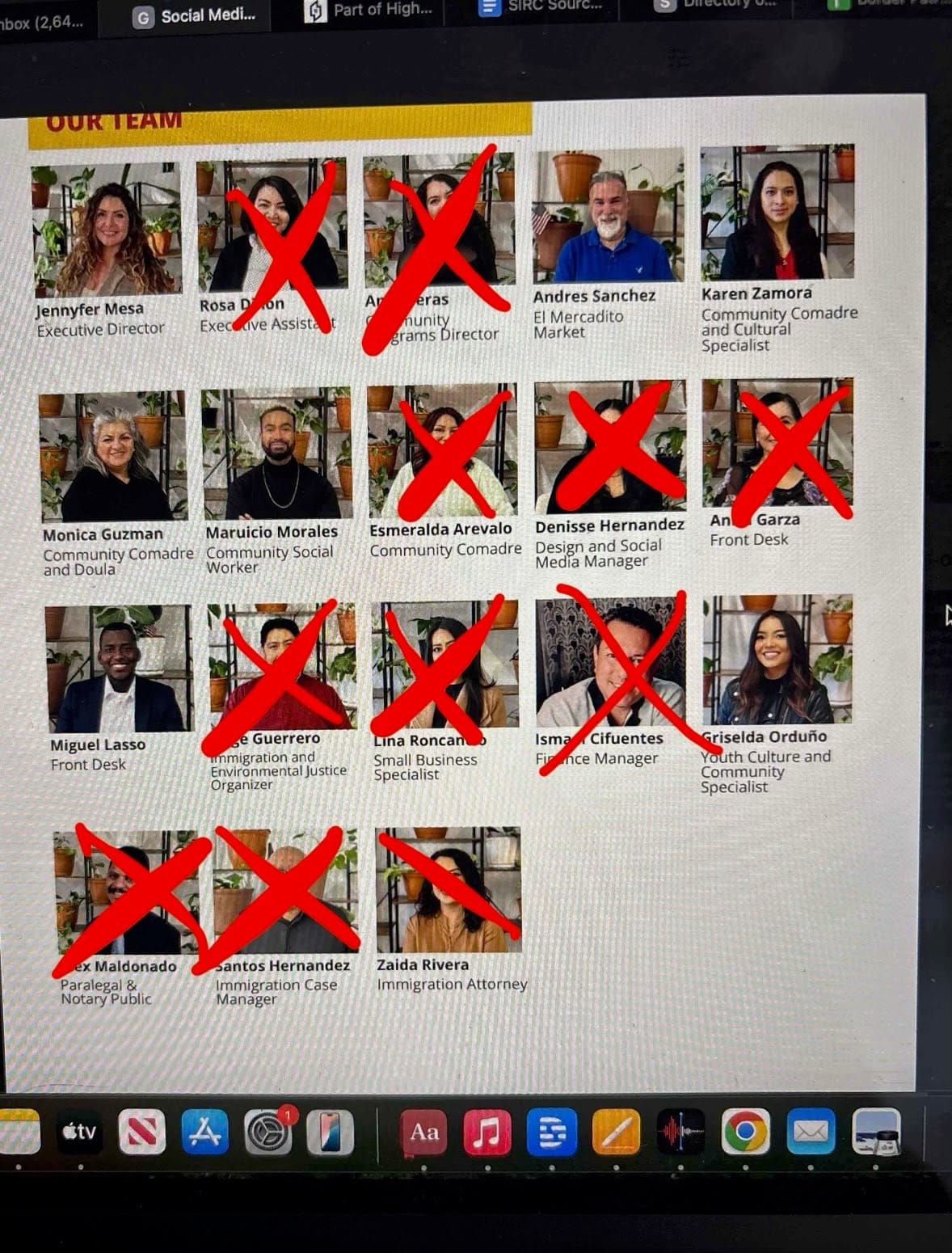
While Mesa and the board wouldn’t answer questions of how many workers had been fired or quit in the last year, RANGE has confirmed at least four, as well as a contractor who said Mesa failed to renew her contract unexpectedly and without notice.
In May 2025, community leaders and former workers from LeS began reaching out to RANGE, talking about a frantic and, to some, increasingly toxic work environment and adversarial management style behind the scenes.
We’ve now interviewed 10 employees or contractors who have worked for the organization at points ranging “from the beginning” to late 2025. Most of the people we interviewed asked to remain anonymous or use pseudonyms, citing immigration purposes or fears of retaliation from Mesa.
The only former employees who were willing to use their names were Santos Hernandez, who now works for a large nonprofit immigration firm in California; Richard Martinez, who now works in labor; and Jorge Guerrero, who initially spoke to us anonymously but is now willing to speak on the record.
For those who stayed off the record for fear of retaliation, those concerns appear to have been justified.
While RANGE was reporting this story, Mesa found out we had interviewed one of LeS’ former contractors, a person we are identifying as Alicia (a pseudonym), who was now working for a different organization. Mesa called the executive director and board president of that other organization and tried to get them to sever ties with the contractor. Mesa denies this allegation but the executive director and board president of the other organization, who also asked for anonymity to protect Alicia’s identity, corroborated the contractor’s story.
“We were encouraged not to continue working with [Alicia],” the board president said.
Days after this conversation, LeS paid a lawyer to send Alicia a cease and desist letter, threatening to “escalate matters further,” if she continued to speak about her experience at LeS with reporters or former coworkers.
Another contractor showed RANGE proof that Mesa threatened them with legal action if they did not return a payment they had received for completed work. Other community activists have described seeing similar retaliatory behavior from Mesa, like a young organizer who told RANGE that Mesa had called her boss to complain after the activist organized a protest against immigrant rights violations without including her.
Overworked and underpaid
The staff members at LeS we were able to interview described loving the organization’s mission and the work it was trying to accomplish, but facing harsh criticism, long hours and impossible working standards from Mesa.
For her part, Mesa said that her job isn’t easy and she can’t make everyone happy. She pointed to the federal political climate as causing difficulty for LeS.
“Since 2025, we’ve definitely had a lot of challenges at the federal level,” Mesa said. “There are extremely high needs in our community and very little resources and ability to respond but we’re doing what we can. I think we’ve developed a very strong team.”
We asked Mesa exactly how big that team currently is, including how many staff and contractors work in various programmatic departments. She said she would get back to us with those numbers, but never did.
For some, working with LeS had been a dream job — one they were willing to uproot their lives for, like Santos Hernandez and Alicia, who moved to Spokane from Texas and Arizona, respectively. Others joined the organization by responding to a job posting or through friendship with Mesa that turned into a job or contract
Once they started though, the working environment was different than was presented prior to their employment. Almost every former employee and contractor we talked to said they were pressured or directly asked to perform extra work for free on personal time. Some said that Mesa created a toxic work environment, playing favorites and punishing employees who didn’t invite her out socially. One described being hired under false pretenses, with the promise of a full-time position dangled over his head for months. Another described being called constantly after hours and on the weekends, and feeling like she’d be in trouble if she didn’t work extra hours for free.
When Richard Martinez first connected with LeS, he was working as a loan officer for a local bank. He remembered reaching out to Mesa to offer his services as someone who was bilingual and wanted to help the community. At first, there was an informal relationship where Martinez would refer Latino clients in need of other services to LeS and Mesa would refer LeS clients in need of loans to Martinez.
“ After working with each other, sending people back and forth for several months, she came to me and was like, ‘Hey, I love your personality. I love the way you deal with clients. I've had nothing but great reviews,’” Martinez said.
In 2022, Mesa asked him to join LeS as the small business project manager, helping clients apply for business licenses and permits while navigating other complex government paperwork involved with starting a business. He would work part-time at 30 hours for the month of June, but Mesa promised that would bump up to full-time in July, Martinez said. RANGE has reviewed emails between Mesa and Martinez that confirm this was the offer.
He took the deal, and began building the small business support program from the ground up. Martinez made inroads with state agencies and local organizations like Spokane Regional Health District, creating contacts that could help him help clients.
His first month flew by. “It started off great, I’m not going to lie,” Martinez said. “It was fun.”
Soon, though, it was July. At that time, Martinez said Mesa increased his workload, but refused to increase his hours.
“I need you to start running social media,” Martinez remembered her telling him. She wanted him to post small business tips, reminders of his services and hours, and edited videos promoting small businesses in the LeS network.
Mesa refused to answer questions about Martinez or his work both in an in-person interview and in follow ups over email.
“I’m not a social media expert,” Martinez said, but he tried anyway. He’d spent hours at a time visiting small businesses and recording content for social media. But Martinez said Mesa asked for more, telling him to produce three videos a week.
“ So I told her, I was like, ‘Look, I don't think I could produce that on top of running Facebook, Twitter and Instagram.’ She even wanted me to run TikTok,” he said.
Even though social media work wasn’t in his job description, which RANGE has reviewed, he said he’d try, if Mesa would honor her promise and increase his hours to full-time. Again, she said no.
Martinez tried to balance her social media demands with his regular job duties, but after a few weeks where he only posted one small business video a week, “She came to me and she was like ‘Why aren’t you doing more?” he said.
“‘I physically can’t,’” Martinez recalled responding. “‘You’re not giving me the hours that I needed that you promised me and you’re not going to give me any more pay … sorry, I’m not going to sit here and bust my butt for no more money or no hours.’”
Then, he said Mesa told him he could just record videos on the weekend or on his personal time when he visited local restaurants. When Martinez refused to work for no pay, she told him he wasn’t “dedicated to the cause,” he said.
We asked Mesa about every characterization Martinez’ made about her actions and behavior, but she declined to discuss specifics. During our interview, she did deny in general asking Martinez or any other LeS member to work extra, unpaid hours.
After about three months of work, he asked one more time for the full-time pay he and Mesa had agreed to before he was hired.
“ I was like, ‘Hey, can I see the contract one more time? Because I'm not getting paid accordingly and you promised me this. I'm trying to tell you that you still have to uphold your end of the bargain,’” Martinez said.
Martinez said he was told by Mesa when he started that the grant he was paid through was supposed to cover his salary for the whole year, but in that final conversation, Mesa now claimed the grant hadn’t been renewed and she couldn’t offer him more pay or more hours. Then, Martinez said she started to critique his performance, stating he wasn’t doing enough within his 30 hours.
“ Finally, she was like, ‘You know what? I could do your job a lot better than you … I could produce a lot more videos and do all the stuff that you do and do my job better than you can,’” Martinez said.
According to Martinez, Mesa then fired him, telling him to finish his appointments for the day, leave his laptop and turn over his passwords.
“ I was like, ‘If you just let me go, there's absolutely no way I'm gonna go and do those appointments. If you think you could do my job better, you go and do all those appointments,’” Martinez said. “ And then that was it.”
He never returned to LeS. Later, he heard Mesa was disparaging his time there to staff. “She painted me in a bad light as far as, ‘Oh, he just left on a whim, he didn’t care about us and he just left.’”
Alicia, who later contracted for the same work Martinez had been doing, confirmed that Mesa spoke poorly to her of Martinez’s job performance and level of commitment to the organization.
When asked explicitly by RANGE if she made negative comments about Martinez’s work, Mesa said twice, “no comment.”
Martinez now works in labor, helping other workers in need, with a focus on clients who speak English as a second language.
Since leaving, Martinez said he has kept tabs on LeS. He noticed when the person Mesa hired to replace him lasted less than a year before they left. He heard when Alicia, the third person to hold that title, had her contract terminated early. He worried about a Community Comadre he had left behind, who had talked to him about issues she was having with Mesa.
RANGE interviewed that Community Comadre, who worked at LeS for a few years. She asked to remain anonymous due to concerns of retaliation. The comadre described the work environment as “toxic,” and said Mesa promised them one amount of money for their work on a contract connecting clients with income-based assistance benefits, then later “she changed her mind and said, ‘No, the money will be different.’”
The comadre stuck up for herself, sending Mesa an invoice for the original, promised amount and was paid accordingly, but later found out that her fellow comadres were paid less.
This wasn’t the only time the comadre witnessed pay discrepancies.
“[Mesa] would change her mind; she’d tell you, ‘I want to pay you $20,’ and then later when you come in to get paid, she’d say, ‘Oh no, I’m gonna pay you $12.’ This is not fair,” she said.
When asked if she’d ever promised employees or contractors one amount and then paid less, Mesa said, “ No, we have contracts in place. We also have confirmation of, ‘You can accept employment or not.’”
People who worked for LeS more recently than Martinez and the community comadre described a similar work environment.
When we initially interviewed Jorge Guerrero, who worked at LeS in 2025, he asked to remain anonymous. He was on the job hunt after being terminated from LeS, and was worried that if Mesa found out he spoke to the press, she would retaliate and negatively impact his employment search.
“She knows how to tell a story, how to sell a narrative … She’s able to dot every ‘i’ and cross every ‘t’ to make sure that she’s able to tear down something by attacking someone’s character,” he said.
Guerrero also had complex feelings about his employment there. He had looked up to Mesa, describing her as “amazing,” “a brilliant mind” and someone with “a lot of positive attributes.”
Six months later, when we spoke to him again, he had decided that he wanted to be on the record.
He worked at LeS as an immigration and environmental justice organizer, focused on advocating for workers’ rights, health equity and economic opportunities for undocumented immigrants in Washington. He was brought on in the fall of 2024 and gone by May 2025, shortly after he planned and orchestrated LeS’ May Day celebration.
Guerrero said it was his decision to offer honest feedback about the preparation for May Day that got him fired. First, Mesa asked him to cancel a planning session with other outside collaborators at the last minute because she was going to be too busy to attend. Guerrero said he wanted to respect the people who had set aside time to be there, so he changed the planning meeting into a walking tour of the May Day march route. The next day, Guerrero said, Mesa wrote him up for being disrespectful — for going on the walk without her.
Mesa’s disciplinary action came the same day that one of Guerrero’s friends was violently detained by ICE. He almost quit, but he didn’t want to leave LeS in the lurch for May Day. He planned to leave right after.
“May Day happened, everything went fantastic. [Mesa] even gave me the [next] day off,” Guerrero said. After taking the day to absorb the successful event and the work LeS was doing, he decided to stay at LeS and “remain in the fight.”
Still, he was also reflecting on the month leading up to May Day, full of canceled meetings, communication issues and expectations of long work hours.
So Guerrero — whose job involved advocating for better working conditions for Latino workers across the state — decided he would ask for change for himself, too.
He wrote a three-page letter to Mesa, which RANGE has reviewed, and gave it to her on May 6. In writing the letter, Guerrero said he was especially careful with his wording, and took pains to identify the places he should have done better as well.
“ I want to start by saying I respect your leadership and all the work that you do. I know how committed you are to our mission, and I appreciate your passion and the direction you provide. I also want to acknowledge the importance of communication and planning in my role, and I take full responsibility for not always keeping you updated,” the letter began, “ I also want to be transparent about some things that I've been staying quiet about.”
Guerrero then outlined key issues he was having, including micromanagement, communication issues and Mesa deviating from agreed-upon plans at the last minute. He also said that he was feeling pulled between pressure from Mesa to do more immigration-related work like Know Your Rights workshops, and also needing to complete the requirements for a large grant LeS had received from the Washington State Department of Health that funded his position before an upcoming deadline.
“ I consistently work over 40 hours a week trying to meet the demands of this position, but still find myself falling short,” he wrote. “ I know this role requires growth and adaptation, but the amount of and pace of work combined with the multiple expectations across departments often feels unmanageable.”
Here, Guerrero told RANGE he chose to be vulnerable: “Right now, I feel overwhelmed,” he wrote, “ I care about this work and I want to be successful in this role, but I do not feel like I have space to grow and make mistakes.”
Guerrero finished the letter by thanking Mesa for listening to him and stating that he was committed to growing and working better with her. He gave the letter to Mesa at a meeting, and thought the conversation afterward went well. He worked the following weekend, going to a conference Mesa asked him to attend on Saturday and Sunday. He took Monday and Tuesday off to balance his hours.
On Wednesday morning, his dog was dying.
He had been told LeS policy allowed him to flex his hours, but by 10:30 that Wednesday, LeS’ HR contractor sent him an email asking him if he was coming in for the day. Guerrero responded that he would be there after 11 a.m. At 11, his dog was put to sleep at the clinic. He took his family home and then rushed to work. Later that day, he received a second email from HR scheduling a meeting for the next day, Thursday, May 15.
During that meeting, just over a week after he had handed Mesa his letter outlining both concerns with the work environment, but also acknowledging he had asked for space to grow and become a more effective employee, Jorge Guerrero was fired.
He said Mesa told him he was a poor communicator in the meeting. She also accused him of breaking her trust by taking home plants and flowers as a gift for his wife, sister and daughter — who were all mothers — that he thought were leftovers from a Mother’s Day event. Guerrero said he apologized and offered to bring back the plants.
Guerrero said his termination letter stated he had stolen from LeS. It did not state that it was plants taken by mistake. Mesa declined to show us the termination letter, and Guerrero was not able to locate his copy by press time.
Mesa further declined to answer specific questions on Guerrero’s termination or employment.
Speaking to RANGE in summer 2025, Guerrero teared up as he described the final meeting at LeS. He said he still had a lot of respect for Mesa, but was afraid to speak up about his experience there because of the termination letter that claimed he stole from the organization.
“ I'm afraid because she is very well liked and very well respected, and then she continues to attack my character in a very public fashion,” he said. “I gave her all the speakers, my megaphones, the DJ stuff that we have for events, the keys. Everything’s there. But three flowers came up missing. Gosh, man. And it was by mistake.”
By February 2026, Guerrero had a different perspective. He now wanted to be on the record — he wanted to speak up in hopes that conditions could change for the co-workers he left behind.
Micromanaged
It wasn’t just the amount of work they were being asked to do, former workers said — it was also how they were asked to do it.
“She is a massive micromanager,” said Hernandez, the former Department of Justice accredited representative in Poder Legal. “I used to joke that, ‘No, I don't need you to pick out the color of my underwear.’”
F.C., a contractor, who worked with LeS for about three years and asked to be be referred to only under a pseudonym, told RANGE that one of LeS’ key programs was her idea — which RANGE agreed not to directly identify to protect her identity based on concerns of retaliation — but as soon as it got off the ground, Mesa refused to give her any credit and began micromanaging her work on the project.
“I couldn’t [invite] vendors if she didn’t like them. She had me create an Instagram and I couldn’t post anything without her approval, but I would send her stuff and she would wait until the last minute to say yes or no,” F.C. said.
All 10 workers we talked to described the same thing: Mesa would create a bottleneck by demanding specific deliverables on tight deadlines, then wouldn’t approve or engage with their work in a timely fashion. She would skip meetings, ignore emails and put things off, sometimes until too late. If employees tried to complete the task on their own, Mesa would tell them it was wrong.
“She says to everybody she interviews that she’s not a micromanager,” said Perla, an employee who worked at LeS for more than a year and asked to use a pseudonym because of immigration status and retaliation concerns.
“But in my first weeks, I found that was a lie. She likes to have a say in everything,” Perla told us, saying Mesa would get mad if work wasn’t done to her exact desires. “I just felt like I couldn’t do anything without getting some kind of reprimand.”
“She’ll criticize and be like, ‘I didn’t approve this and that.’ But then if you don’t do it, it’s also wrong,” the F.C. said. “I just am not used to that kind of work. It’s not very professional.”
“There's no compromise,” said Guerrero. “There's no respect for people's point of view or perspective or thought process.”
“For every single thing that I did, I would have to send an email, get approval. Her approval would take weeks,” said Alicia. “If I posted something [on social media] and she didn't like the color, she would give me a hard time like, ‘Why did you post it without my permission?’
“ I was running a department,” she continued, “but I couldn't do certain things without her permission.”
It made it difficult for her to take initiative or make timely headway on her work.
Mesa argued that what the former workers described as micromanaging was actually mentorship.
“As executive director, when somebody comes in, I have to provide ample opportunity for them to get training. There is no playbook or degree that you get in organizing. You have to learn how to do this. And that also means that you have to accompany people to meetings,” Mesa said.
She also described pairing employees with a mentor in the community to help them develop.
When it came to accusations that Mesa required final approval of social media posts and emails, she described that as standard workflow.
“If you are posting, for example, on behalf of the organization we do have to have a second look,” she said. “We do have to have a second look of how you write emails, because you’re representing the organization. And that’s not just LeS, that’s everywhere else you work, you’re going to have that oversight.”
One of her biggest responsibilities as executive director, Mesa said, was to ensure that grants and contracts were completed. “That is my job — not to micromanage,” she said. “If I have to micromanage you, then that’s super hard for us as an organization.”
For Cynthia, a former employee who worked at LeS for more than two years and who asked to use a pseudonym due to concerns of retaliation, the most peaceful time at LeS was last year, when Mesa was on a three-month sabbatical.
“It was calm, it was so nice. I would actually want to go into the office and work,” she said. “When she was gone, I felt like we all worked well. We were able to communicate. We were able to get stuff done that we couldn’t because she kept getting in the way.”
When Mesa micromanaged things like social media posts, workers said it was annoying, but the stakes were sometimes higher, like when she tried to run roughshod over the legal department.
Hernandez said Mesa would try to control what legal cases they were working on, asking them to put aside ongoing cases for people Mesa handpicked. Another former employee, who asked to be referred to only under the pseudonym F.E., said they witnessed Mesa instructing staff to fill out important documents for clients that they weren’t legally allowed to handle, which put both the clients and the staff at risk. Hernandez, Alicia and Cynthia also confirmed that Mesa asked employees with no legal training to take on client intakes at one point, which included reviewing private legal documents, which Mesa has denied.
When told that RANGE had reviewed a photo taken by a former worker of intake forms piled on the commercial kitchen table, Mesa again refused to comment on “ legal matters or anything from the organization that has to do with legal intakes.” Then she said “There’s a picture? Great,” and laughed.
“ She just doesn't know what the hell she's doing and she's not listening [to staff],” F.E. said. “She’s too loose of a cannon.”
Behind closed doors
In public, Mesa presents as an outspoken champion willing to go to the mat for local immigrants.
Behind closed doors, her staff said she was different.
At staff meetings, workers said she would belittle them, criticize them and yell at them in front of their peers.
Cynthia said the easiest way to tell someone on staff was in trouble is when Mesa would pull people in for closed-door meetings. Occasionally, that person would be in so much trouble, Mesa could be heard yelling at them from inside her office.
“I think it all depends on what you consider yelling, but no, I don't yell at my staff,” Mesa said.
“There is a profound disconnect between her social media persona and the reality of who she truly is,” Alicia wrote in a statement to RANGE. “While the former advocates for and champions the most vulnerable on a daily basis, the latter punishes anyone who dares to challenge her authority.”
That was a common theme throughout all of our interviews: Staff felt that Mesa set a clear precedent that anyone who challenged her, pushed back or got on her bad side socially would be punished. Whether it was Alicia not inviting Mesa to her birthday, Hernandez refusing to prioritize certain legal clients at Mesa’s request or Guerrero reading her a letter asking for clearer work expectations, the consequences for their perceived offenses were made clear almost immediately.
“ The people that would speak up, she would find a way to get rid of you,” F.E. said.
When asked if this was true, Mesa responded, “ I think if it was true, they could go through the proper channels and they can report me to L&I, report the organization. There's proper channels to that. My job as an executive director is to ensure that we are operating our finances, that our resources are going into where they needed to go to, and that we are complying with our contracts and grants.”
In the past, Mesa has been an outspoken critic of L&I, especially for Latino workers. In 2024, Mesa told RANGE of L&I: “Most workers are scared to start this process and those who do, don’t have the resources alone to keep pushing through a broken system like this,” Mesa said. “Situations like Francisco’s happen everywhere and there’s a price to that … Organizations like ours are often the only safety net for undocumented workers because L&I is reluctant to take their cases, or it’s a maze.”
In the same interview, Mesa told RANGE that she believed the L&I system is broken for people working contingent jobs: contractors, those working under the table and especially workers who are undocumented.
After Guerrero was fired, Cynthia said that everyone who was left on staff was too scared to say anything. She thought about pushing back on a few of Mesa’s decisions that she had ethical issues with, but ultimately decided not to, and focused on trying to continue helping her community for as long as she could.
Even after she separated from LeS, Cynthia was scared of speaking out because she had heard Mesa talk poorly of past workers like Hernandez and Alicia, “trying to discredit them.”
“That’s kind of scary,” Cynthia said. “I know she has legal connections in Seattle and I’m just kind of scared that she would go after me, too.”
All told, the 10 former workers RANGE interviewed shared very similar stories.
When they started, each believed strongly in the mission of LeS. Many of them described caring deeply for their clients and their co-workers, and continued to worry for them even after leaving the nonprofit.
All year, Perla felt a creeping sense of dread as she watched more and more of her co-workers disappear. Eventually, it was her turn.
“Part of me felt like it was coming. I just wanted to believe it was not gonna happen to me,” she said.
Still, even after she left the organization, Perla wants the best for LeS.
“They do great work,” she said. “I just think they need a leader that knows how to lead and empathize with people, not dictate.”
Cynthia echoed that sentiment.
“I have a lot of love for LeS as an organization, as a whole, outside of Jennyfer,” Cynthia said. “We all stayed there for as long as we could because we all felt like we needed to help our community.”
During our interview, we asked specific questions to try to understand the various reasons for LeS’ turnover, like “How many employees are currently on staff,” and “Over the course of 2025, there was a staff reduction. How much of that staff reduction was due to grants ending or layoffs, how many people quit, and how many people were fired?”
Mesa originally agreed to get us these numbers and respond to additional questions sent via email. An hour after the publication deadline we gave LeS, we got an email from the board — sent from Mesa’s email address — that did not answer any of the direct questions or follow-ups we asked and instead pointed to the importance of their work, their great benefits package and HR consultants that they would not confirm they still had on contract. We’ve included a full list of the questions we sent at the bottom of this story.
“We encourage all workers to seek support through L&I or other agencies that oversee workplace matters,” the statement read. “When we have had to terminate employment, it has been because employees did not meet work performance expectations, failed to perform critical job functions, or compromised the interests of the organization, and most importantly, the interests of our vulnerable clients.”
In person, Mesa said that “not everyone can handle that kind of work.”
The ongoing situation at LeS has negatively affected the Latino workers who spoke to RANGE, leaving many without their sole source of income in an uncertain economy and dangerous political climate where they could be stopped and questioned just because of their ethnicity.
Those same workers voiced fears that the high turnover and chaos behind the scenes at LeS has also left the vulnerable people who rely on the organization for services needing more.
Additional reporting contributed by Luke Baumgarten.
COMING NEXT: A close look at the impact of downsizing at Poder Legal, the team intended to address emergent legal concerns for Spokane’s underserved immigrant and refugee population, including undocumented people.
Unanswered follow-up questions we sent:
Agreed-to followups
- We asked “Did LeS update Poder Legal’s address with the DOJ after the move to 1309 W. Dean?”
- Jennyfer said she would check
- We asked “Santos Hernandez showed us a resignation letter he took to board president David Castro in the fall of 2024. Was any of the rest of the board aware of that conversation or the issues Santos raised? If so, did you look into them?”
- Lupe said he would look back at this
- How many employees are currently on staff (Break out full time vs part time if possible)? How many contractors have contracts with you currently?
- Jennyfer agreed to check
- Over the course of 2025, there was a staff reduction. How much of that staff reduction was due to grants ending or layoffs, how many people quit, and how many people were fired? How many contracts were ended early or not renewed in 2025?
- Jennyfer agreed to check
- Why did LeS initially respond to Santos’ unemployment claim by telling the state he quit?
- Jennyfer said she’d check with HR consultant
- When did Loi Lumala come on as a supervising attorney?
- Jennyfer said she’d check.
- Was Richard Martinez ever bumped up to full time hours?
- Jennyfer said she’d check
Additional Questions
- How many people are currently employed at Poder Legal? How many people are contracting?
- How many people were employed at Poder on June 11, 2025? How many were contractors?
- There is still a full-time attorney position posted on the website. Is LeS still trying to find a fulltime employee for that role? Is there still budget for that role?
- In addition to the cease and desists sent to Alicia, another contractor showed RANGE proof that Mesa threatened them with legal action if they did not return pay they had received for work completed. How many contractors or former employees has Mesa sent legal threats to? If you had to estimate, how much money has been spent on paying lawyers to send legal threats to former workers?
- You said in our interview that “Karla Tiul is a VIP client.” Your website states that you only take on legal cases through WA Mass referrals. Were the Tiul Caal family WA Mass referrals? If not, how do you decide which additional cases to take on?
- Were you still hosting free immigration legal clinics on the 2nd Thursday of every month as of July 14, 2025? At that time, your website said that you did
- Because of the allegations of micromanaging employees, including those hired in management roles, we asked the board what steps the organization is taking to ensure the new future Executive Director and Development Director don’t experience similar micromanaging by Mesa, who is moving into a new role but still has tremendous sway within the organization. The board members didn’t really give a direct answer. Would you be willing to answer that question now?
Specific allegations
You blanket no-commented many HR questions, and that is absolutely okay. Because of the seriousness and directness of some of the statements, though, we are going to ask them again:
- Richard Martinez said you hired him after seeing his work with a different company and partnering with him on community referrals. He said that you invited him to come on as the small business project manager and had nothing but great things to say about the way he handled clients before coming on. Is that true?
- Martinez said you increased his workload in July but didn't give him the additional hours promised. Is this true? If so, why?
- At that time, did you ask Martinez to produce 3 videos a week for social media?
- We’ve talked about Martinez at length, but Erin started to ask this question and was interrupted - did you ever tell Martinez you could do his job better than him?
- Did you ever tell community comadres they would be paid one amount for work on a grant contract, and then pay them a lower amount?
- Jorge Guerrero said in the month leading up to May Day you cancelled multiple meetings including one he felt he couldn’t cancel in deference to community partners, so he held a walking route tour with those partners instead. He says you then wrote him up for being disrespectful for going on the walk rather than cancelling the meeting. Do you dispute or have any comments about that description of events?
- Did you expect Jorge to work longer hours or hours outside his normal hours leading up to May Day? Was he an exempt employee?
- We’ve reviewed the three-page letter Jorge wrote you offering feedback. He believes he was terminated at least in part due to that letter. Is that true? Was that letter part of why he was fired?
- Jorge says his termination letter lists theft as a termination reason. He thinks the theft allegation is for plants he took accidentally and offered to return. Is that the only thing LeS alleges he stole?
- You told us you don’t yell at people in front of the rest of the staff. We have a quote from another employee who said that there were times you pulled staff members into your office and yelled so loud everybody else could hear. This is a small but important distinction and we want to offer you the chance to comment: Do you believe you have raised your voice loudly enough when disciplining an employee or contractor that the rest of the office could hear?
- In general, the former workers we talked to said turnover at LeS has left vulnerable people who rely on the organization for services in the lurch. Do you believe that the staff reduction across 2025, regardless of the cause, has negatively impacted LeS’ ability to serve its community?
- Because you told us the recent relatively drastic reduction in staff is due to loss of funding, we are hoping to at least identify employees and contractors who were lost due to downsizing.
- These are the workers highlighted in your 2024 annual report whom we believe no longer work for the organization. Can you tell us who was lost through downsizing and who was lost for other reasons?
- If you don’t feel comfortable commenting on specific employees: it appears that 12 of the 18 people listed in your 2024 annual report under “Our Team” have now left the organization. That list appears to be a mix of employees and contractors. Can you tell us how many of those 12 departures are because of reductions in funding? Include both employees laid off and contracts not renewed, if possible.
- We have also heard that 4 people hired after the annual report was published in July 2025 have also left. Between then and today, how many employees and contractors have you hired, and how many are still with the organization?


