

 Daisy Zavala Magaña
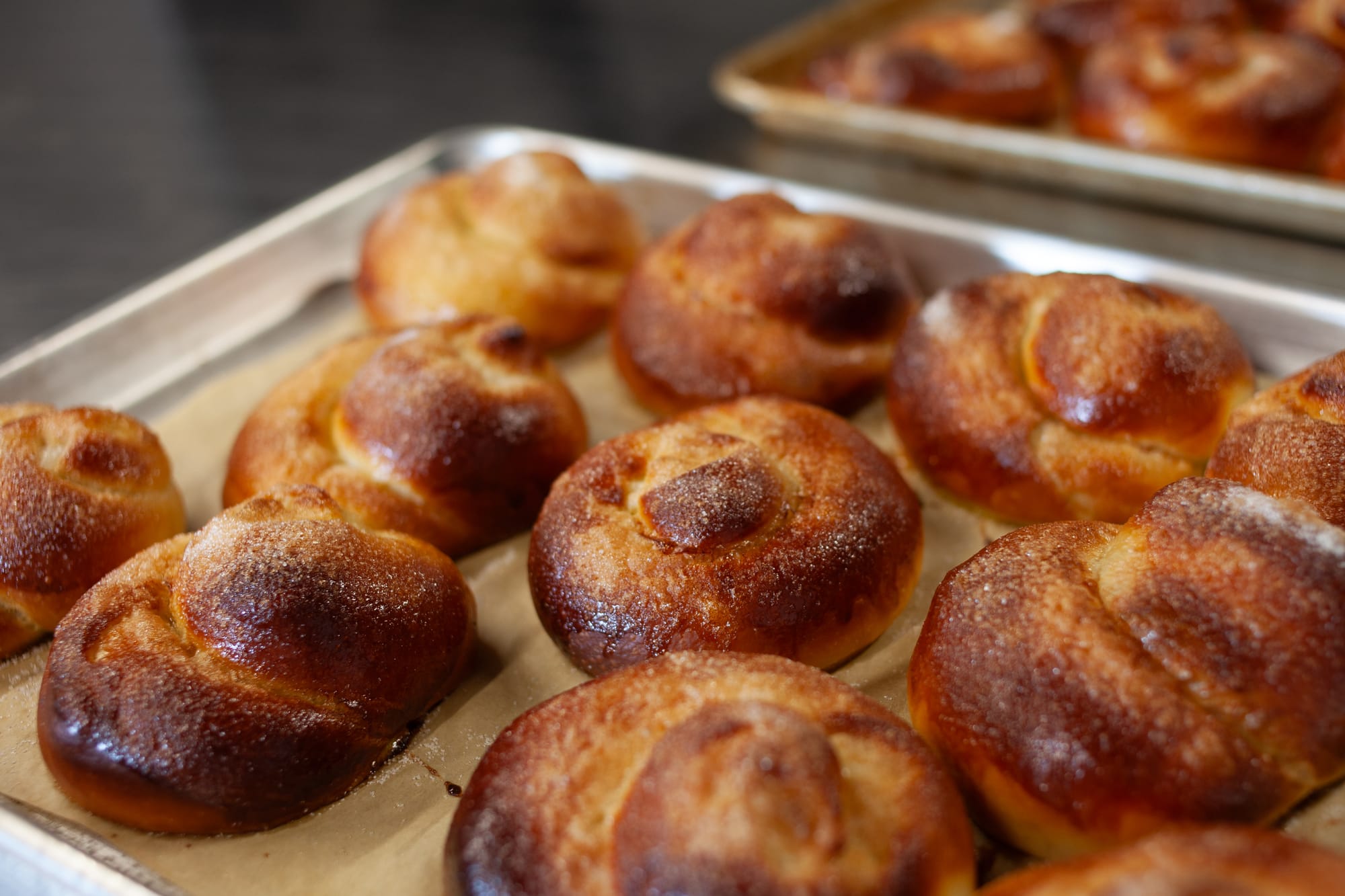
Under the dim fluorescent lights of a Spokane commercial kitchen, Diana Alejandra Sanders coated a guava-filled ring-shaped bread known as a roscón with egg wash.
She did this until all three large trays of breads were coated and ready for the oven where the glaze would give the rings a golden-brown finish. The lightly sweet rings are a staple in Colombia and will make their way to Spokane area markets, alongside other goods Sanders bakes.
“In Colombia, we eat a lot of bread — let’s say, for breakfast or dinner. People often have it with coffee or hot chocolate in cold weather, for example. Even with soda,” she told RANGE in Spanish.
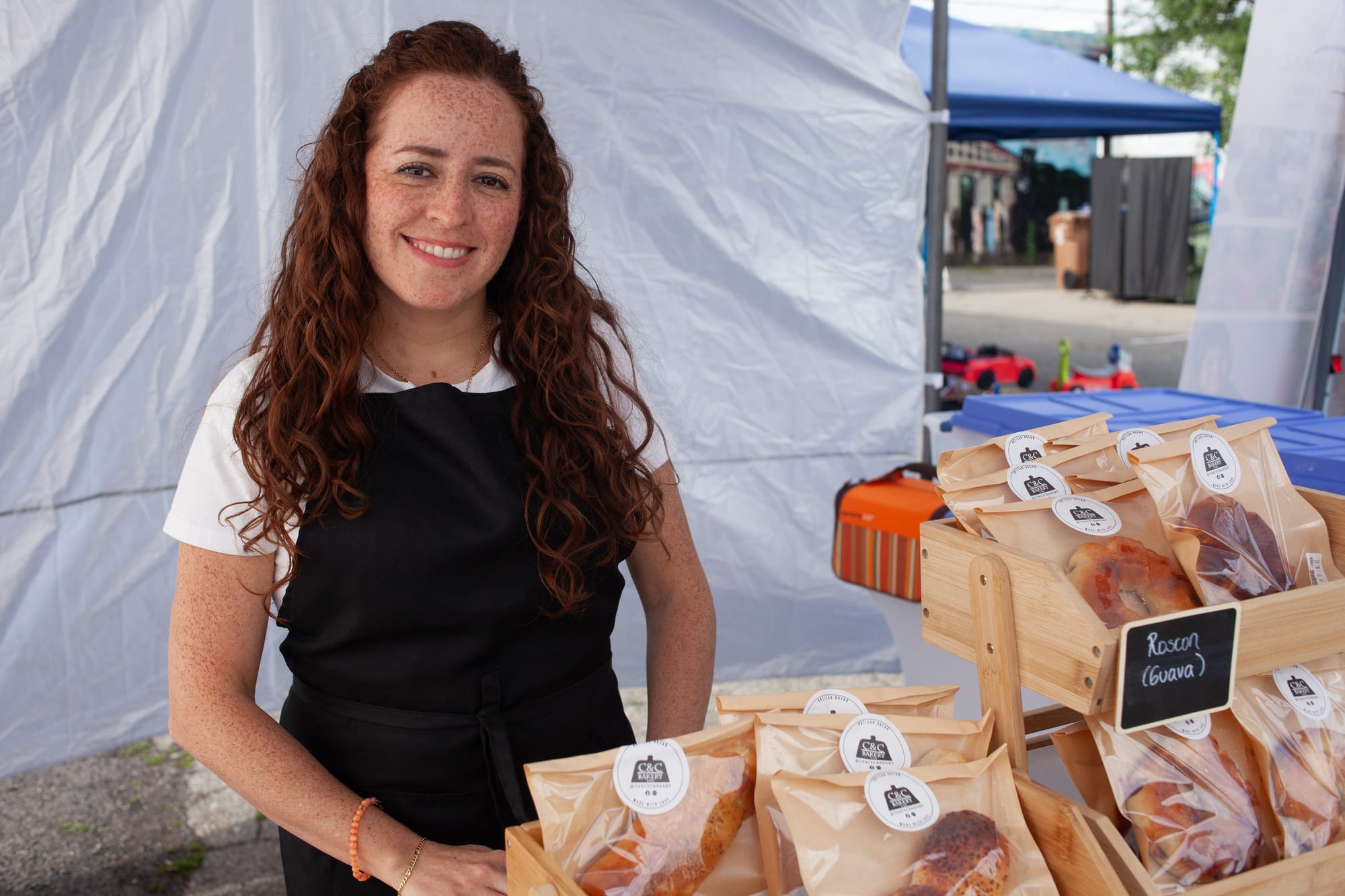
An accountant by trade, Sanders began selling Colombian breads and pastries around the summer of 2023 at El Mercadito, which is a monthly outdoor market organized by Latinos en Spokane. She uses the organization’s commercial kitchen at its Monroe Street office to bake her goods. This year, she expanded and brought C&C Bakery-USA to the weekly Global Food and Art Market in the Garland District.
Sanders bakes Colombian goods that can’t be found anywhere else in Spokane, like the roscones, fluffy bread rolls known as mojicones and a sweet and savory cheesy bread called pan agridulce.
Where to find her:
- C&C Bakery- USA
El Mercadito
- Last Saturday of every month, 1502 N Monroe St, Spokane, WA
Scale House Market
- Every Saturday until mid-October, 4422 E 8th Ave, Spokane Valley, WA
“People really seem to appreciate the product and… they appreciate that they can get it here,” Sanders said of her interactions with some clients. “Many people have told me when they try it, ‘Oh, I felt like I was back home in Colombia.’”
The recipes come straight from Colombia, specifically from her brother, David Alberto Calderon Castelblanco, who owns a bakery there and taught them to her while he was visiting the same summer she started selling the goods.
In the early days, the prospect of establishing a baking business was daunting for Sanders: she felt underequipped and wasn’t familiar with the process of starting a food business in the US. She said Latinos en Spokane was immensely helpful in helping her get permits and access to an affordable commercial kitchen.
But the biggest challenge came when her brother — who lives in Colombia and was supposed to return to help her — was denied entry into the US.
A bump in the road
She told RANGE that nothing would have been possible without her brother sharing his talent and knowledge with her.
He had planned to return to the US in 2024.
Speaking in Spanish, Castelblanco said that he was denied entry because he was accused of working — something his visa prohibited. But he disputed that, telling RANGE he was just helping and teaching her.
“And he wasn’t even here for that. It just sort of happened— like, ‘Hey, why don't I teach you?’ And I was like, ‘No, I’m not going to make a career out of this anyway.’ So it was just, ‘oh well, let’s just do it– just to do something cool while he’s here,” Sanders said. “But then it turned into something more.”
For a bit, the “unjust” experience set Sanders back and she stopped for a bit, she said. But after people continued to ask her about the business and feeling a sense of commitment, she decided she would keep pushing forward.
The siblings began video calling, bridging the nearly 4,000-mile distance between Neiva, Colombia and Spokane, Washington. Castelblanco continued to share his culinary knowledge with his sister.
“Teaching through video call isn't very precise,” Castelblanco said, noting the tactile process of working with dough. “There’s nothing like her making the dough and me being able to touch it to make sure it’s at the perfect consistency.”
But Sanders is a quick learner as much as she is meticulous, he said, noting she followed the recipes to a T.
Castelblanco said he felt proud of his sister and also felt “great joy and great satisfaction” to have been able to help his sister start her business in Spokane.
Colombian roots
The bakery’s foundational origin really begins in Bucaramanga, a city in northeastern Colombia that distinguishes itself for its sprawling green spaces.
Around 2015, Sanders was working there as an accountant while her brother studied culinary arts. He began making cakes and would get clients through word-of-mouth. Because Sanders’ work was flexible, she was able to help him with accounting and with things like decorating cakes and cupcakes.
“We’ve always been very close since it’s just the two of us, we’re two siblings,” Castelblanco said.
As the business grew, they wondered what they would call it, Sanders said. They settled on C&C Bakery, drawing from their parents’ surnames: Calderon and Castelblanco.
He later moved back to his home city of Neiva, an urban center in south-central Colombia known as the Bambuquera capital of America. It’s where he met his wife and opened a brick-and-mortar space for C&C Bakery, he said.
Sanders would eventually leave to the US to visit family and practice her English. After meeting her now husband, she decided to stay and moved to Spokane in 2021.
Finding her footing
Sanders had a steep learning curve: Not only was she new to the nuts and bolts of baking, she also had to accommodate for factors like the different elevation and climate in Spokane — things that can change the way breads and pastries bake, like making a mojicón dry or a roscón collapse.
“At first, I was incredibly sore, like I’d been to the gym,” she recalled of working with large amounts of dough.
Sanders remembers walking into the Latinos en Spokane office with her brother, who was visiting family in 2023, with the intent to get information about how she could sell handmade earrings. After talking to staff about their baking backgrounds, the staff members encouraged them to also consider selling the baked goods at El Mercadito.
The local nonprofit’s Emprendete Business Center has offered various services to help small business owners and entrepreneurs, such as assisting with business licenses and marketing. According to their webpage, people can also rent the commercial kitchen, a food truck and vendor equipment for pop-ups.
“You're in another country, there’s a different language, new rules, new things — you're completely lost. You feel like, ‘No, I won't be able to pull this off.’” Sanders said. “But they helped.”
Then there was the question of her customer base. Because the products she offers are affordable and readily available in Colombia, Sanders said she worried that people would expect that same pricing in Spokane.
The cost to make roscones and other Colombian breads in the US is higher. A small vendor making artisanal goods can’t compete with the prices that larger businesses with lower production costs can afford to offer consumers.
But people have been supportive, she said.
Sanders still splits her time between running her small business and her job as an accountant. She hopes to expand gradually and eventually be able to do that full-time.
As she grows her business, she finds herself filled with a sense of personal satisfaction at having overcome the difficulties of the early days. She said she also finds joy when people enjoy the baked goods she makes — whether it’s their first time trying them or not.
“It’s something I never thought in my life I’d be able to do on my own,” she said. “So, it’s like seeing that I really am capable of doing something that is really quite difficult."


