

 Daisy Zavala Magaña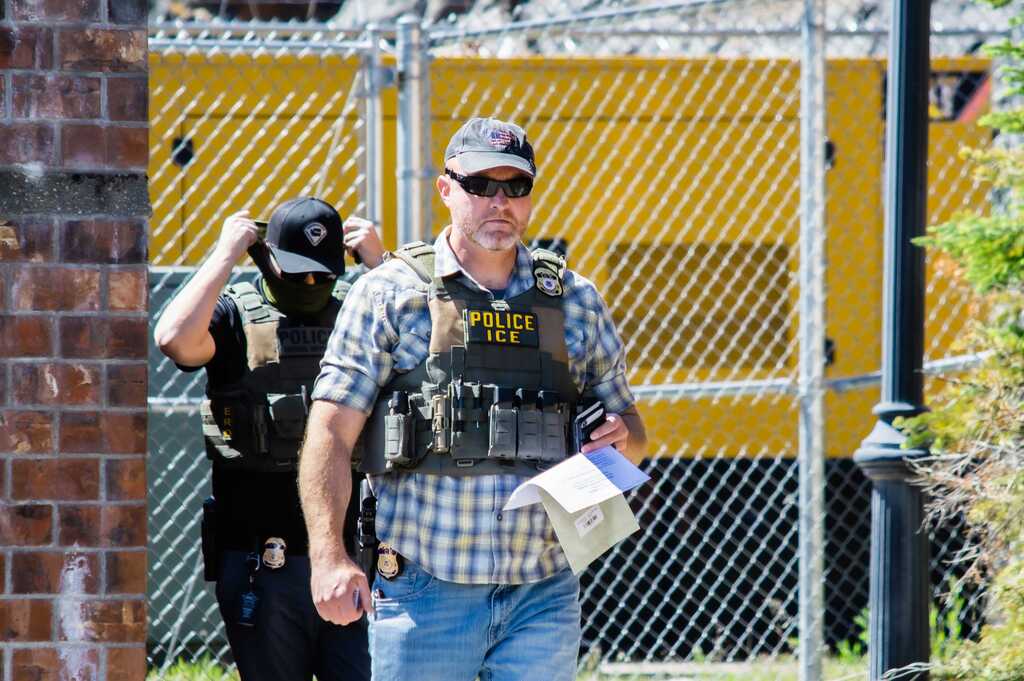
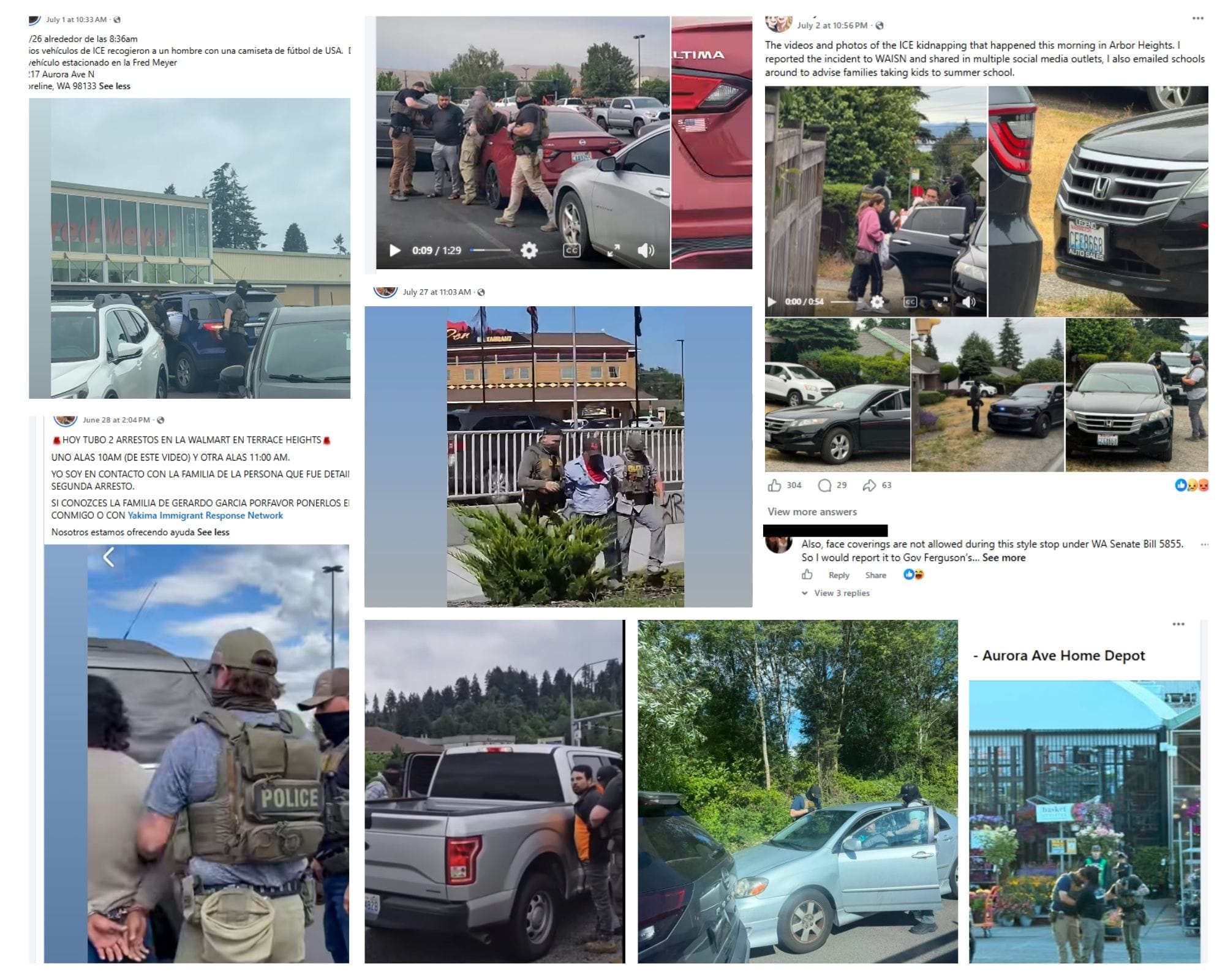
A man being handcuffed on a sidewalk by two men in gaiter masks and green tactical vests near a gas station in Wapato.
Two masked men with just their eyes exposed under black hats surrounding a driver on the side of a Washington road.
And a squad of men in black gaiters arresting a person in the parking lot of the Yakima Home Depot.
These are some of the images and videos people have shared across watchdog groups on Facebook, months after Washington passed a law prohibiting law enforcement — including federal immigration officers— from hiding behind masks.
“What happened to them not being able to wear those masks? Who is not enforcing this?” one person wrote under a Facebook post about masked ICE officers arresting street vendors in Kent.
Gov. Bob Ferguson signed Senate Bill 5855 into law on March 19. It immediately took effect to ban law enforcement at all levels from wearing facial coverings like gaiters, tactical masks, ski masks and balaclavas while carrying out their official duties.
Bill sponsor state Sen. Javier Valdez (D-Seattle) said in a statement at the time that masked enforcement had sown "fear, terror and distrust" within communities and that the new law would ensure accountability and visibility of people exercising power over others.
"Transparency is not optional, and justice should never hide behind a mask," he said.
So where is this law falling short when it comes to federal officers?
That answer isn’t linear, according to Michael Cecil, an assistant professor of law at Gonzaga University whose expertise spans constitutional law, legislation and immigration, who described the law as “ineffective.”
That’s due to a number of reasons, Cecil explained. For one, the state isn’t responsible for enforcing the law. Instead, that burden falls on the person who was harmed by ICE or CBP having to take legal action alleging that a federal officer violated the state law, he said.
This effectively leaves undocumented immigrants who could be languishing in detention centers or placed in fast-track deportation responsible for filing a civil suit to seek accountability.
“It wouldn't be the state government,” Cecil said. “It couldn't be a bystander or something like this… unfortunately, it places a big onus on immigrant communities.”
There’s also the lingering question of whether the law itself is even constitutional, he added.
“We have this kind of tense federal/state structure where states are trying to push back — I think thoughtfully so — against overreach by the federal government in immigration enforcement,” Cecil said. “But there's only a certain number of avenues in which they can pursue those efforts.”
A surge in arrests
ICE arrests throughout the Yakima Valley nearly tripled from June to July — from 20 people the Yakima Immigrant Response Network helped that month to 55 in July — according to David Morales, a volunteer with the Yakima Immigrant Response network. He said arrests hovered around three to four people a day in July, and that the heightened pace had continued as of August 11.
But even those numbers could be undercounts, Morales said. The network’s monthly totals have sometimes climbed after cross-checking its data with the University of Washington and the Washington Immigration Solidarity Network, he said.
Data-sharing for civil immigration enforcement directly violates the Keep Washington Working Act, passed in 2019 to keep local and state resources from being used for that purpose. Despite calls to close the loopholes that allow it, the University of Washington Center for Human Rights has reported that this data sharing continues. The center has also noted the Act lacks strong enforcement mechanisms.
Morales said most of the arrests have been made in the parking lots of stores like Wal-Mart and Home Depot. He said it seemed ICE officers were scanning license plates to identify people who are undocumented through the International Justice and Public Safety Network system, which gives ICE and CBP access to Washington's Department of Licensing database. He added advocates also suspect that federal officers have been using Flock cameras to search for and track immigrants.
“They are operating at a very high tempo,” Morales said of ICE. “What I can say for certain is… that our rapid response team is responding to getting called out at what feels like twice the rate.”
He estimated that 20% of the arrests in July were made by masked ICE officers. By the first two weeks of August, most of the arrests in the Yakima Valley had been made by masked officers, he said.
Yet, the organization has not heard of any lawsuit filed against masked officers for violating the state law.
The picture statewide is less clear.
Mike Faulk, deputy communications director for the Washington State Office of the Attorney General, told RANGE that because of the way the law was written, they are not “empowered” to enforce it. Still, some people have reached out alleging violations.
“But they are few and we don’t have comprehensive info on how many times this may have happened in Washington since the bill became law,” he said.
Faulk said he had not heard of any plans for the Attorney General’s Office to collect that information and make it accessible to the public. The Governor’s Office did not return RANGE’S request for comment about whether any other state agency would.
A spokesperson with the Washington Immigration Solidarity Network, which runs the “only statewide hotline” for deportation reports, said that the organization could not accommodate RANGE’s requests for comment on the law in April or immigration arrests statewide in July.
A symbolic stand?
When the mask ban passed, hopes seemed to run high that the law would prevent ICE officers from operating anonymously as they carry out the Trump administration’s increasingly violent and deadly immigration crackdown. In Spokane, community leaders and members gathered for a watch party to see Ferguson sign the bill into law.
In a statement to RANGE, Jazmyn Clark, the ACLU’s Smart Justice policy program director, encouraged people to reach out if they’ve witnessed unlawful behavior from ICE.
“With the law and its enforcement mechanism being somewhat novel, it remains to be seen how enforcement will play out,” Clark said. “Our organization is committed to holding ICE and other law enforcement accountable to the constitution.”
Because there is no federal law or regulation that dictates whether an ICE officer can or cannot wear a mask, the state law meant to fill in that gap, Gonzaga law professor Cecil explained.
Washington’s mask ban allows people that were detained by masked officers to sue them in their official capacity, including federal officers. He noted the law focuses on providing civil remedies — like financial compensation or through court orders — rather than criminal enforcement.
“A state could literally pass a law saying we can arrest federal officers, but that's not going to be constitutional, right? So there's a difference between what a state can pass and what a state can enforce,” Cecil said.
But it would be “very unlikely” that a private claim would succeed against an ICE agent, Cecil said. If someone filed a suit alleging that a federal officer violated the state law, the US Attorney – which represents federal officers being sued in their official capacity – is likely going to file a motion to dismiss the case due to Sovereign Immunity, a legal doctrine that says the US has to consent to being sued and one that only Congress can override, he added.
“[W]e’re really in this low ebb of state power [in relation to] federal immigration enforcement, for the very fact that it’s just a historically federal area of law,” Cecil said.
The Trump administration legally challenged California’s No Vigilantes Act that would require federal immigration agents to identify themselves as unconstitutional. In April, the Ninth Circuit Court of Appeals — which encompasses Washington — blocked a section of the law as the litigation continues.
The three-judge panel, composed of two Trump appointees and one Obama appointee, unanimously found the legislation likely violated the Constitution’s Supremacy Clause, which bars states from directly regulating federal operations even when the law applies equally to state operations.
The Supreme Court has previously held that the federal government holds exclusive power over immigration law. Cecil noted that while the Court hasn’t specifically addressed the topic of state restrictions on masked federal officers, past rulings have limited direct state regulation of federal operations.
‘Doesn’t mean anything’
Some laws the state legislature have passed, like the mask ban, do more to show where politicians stand than to actually have a meaningful impact on the ground, Morales said.
For instance, people have continued to report ICE arrests outside courthouses to the Attorney General’s Office despite a state law protecting against warrantless civil immigration arrests there, but there hasn't been an enforcement response, he said.
“The laws are kind of unenforceable or [go] through such unuseful systems that very few or no people actually get relief from these laws,” he said. “The legislation could go much further than they choose to go.”
The mask ban carves out certain exceptions that raise even more questions about its efficacy. For instance, it says that an officer is not liable if they’re “reasonably identifiable” under a separate state law — meaning their name is clearly displayed or other identifying information is visible to the public. Officers on undercover operations are also exempt.
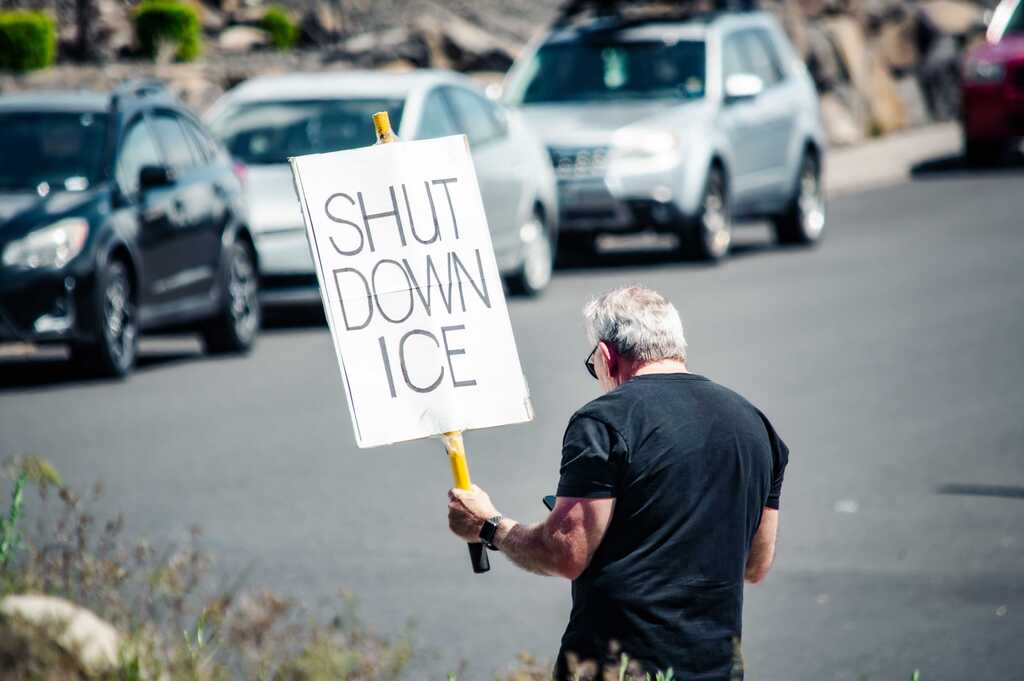
Carlene Brusca, who attends weekly protests outside Spokane’s ICE holding facility on Cataldo Avenue, told RANGE in late April that she has sent letters to local and state government officials telling them that ICE officers have continued to wear masks outside the building.
To Brusca, the law seems designed to “appease people.”
“They're making the people go ‘yay, governor’ when in fact, what he's doing doesn't mean anything,” she said.
Brusca said protesters have contacted the Spokane Police Department, who sent out an officer to talk to them.
“It was a back and forth about what the law is, and why the police can't enforce it, and why we think they should at least go through the motions,” she said.
SPD Assistant Chief Steve Wohl told RANGE that local law enforcement won’t be arresting federal agents. He said the agency did not want to put its own officers in a situation where they would be obstructing a potentially lawful federal action.
Wohl said local police could respond to situations to keep the peace. But when it comes to someone being arrested by a masked officer, the affected person should instead look into filing a suit, as that’s what the statute affords.
“There’s civil remedies for that, [it’s] not something that [local] law enforcement is going to enforce,” Wohl said. “We’re not the police of the federal law enforcement agencies.”
In those situations, he said, local law enforcement faces restrictions under the Supremacy Clause, given that federal law prevails over a conflicting state law.
Although Cecil called Washington’s relatively new mask law a “good effort” to try and push back against an aggressive executive branch, he said the state’s energy might be better spent strengthening laws that limit state and local coordination with federal immigration officers and shoring up protections around public buildings like schools.
“There's a difference between obstructing federal enforcement and simply not cooperating,” Cecil said. “States have the capacity to enter into arrangements with the federal government to sort of coordinate on this, but no state is required to.”


