

 Hal Bernton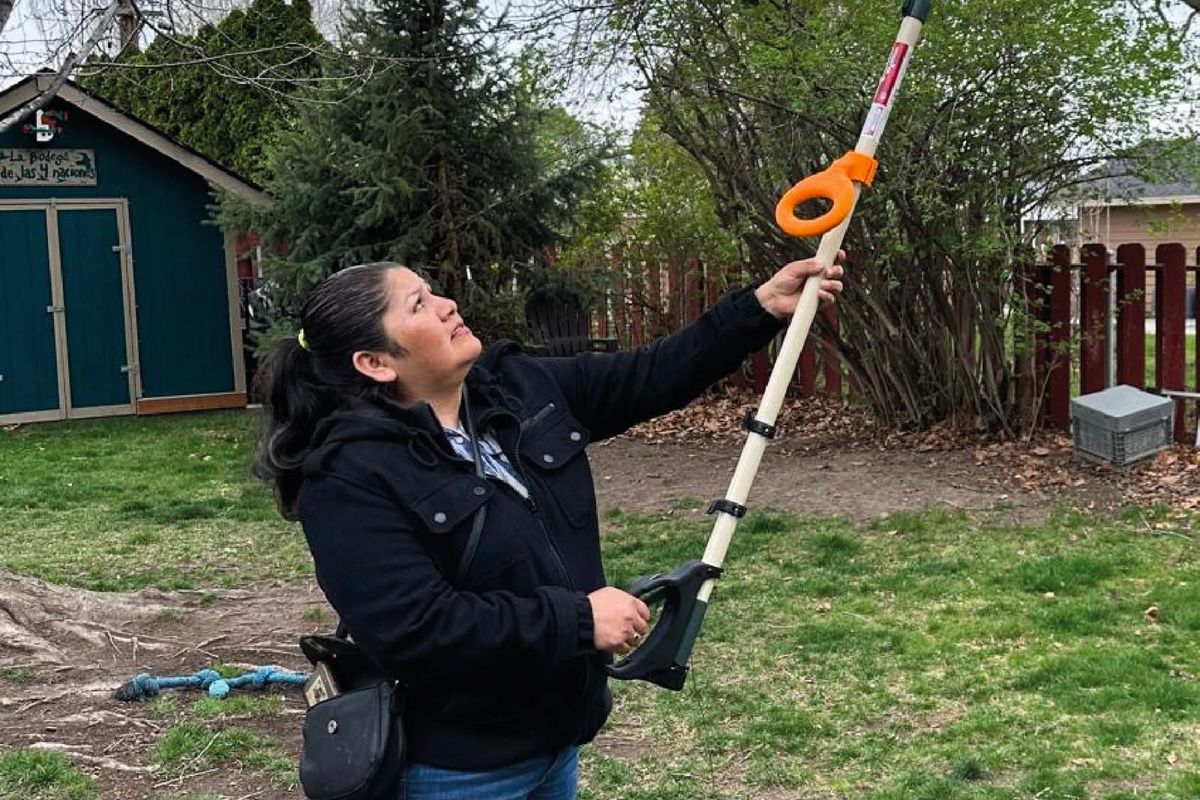
In early January, Flor Sánchez departed from her Yakima Valley home in Sunnyside, leaving behind her husband and then six-year-old son — both U.S. citizens — to self-deport to Sinaloa, Mexico.
For 12 years, she worked in the fruit orchards of central Washington, one of thousands of undocumented men and women who remain a vital part of the labor force in a region that produces most of the nation’s apples.
Sánchez, 41, had hoped to gain legal residency in the United States. But after speaking with attorneys she learned that was unlikely due to two illegal border crossings she made into the United States that created a big hurdle under federal immigration law.
Last fall, the Trump Administration’s immigration crackdown spread through central Washington. Some farmworkers who were arrested in central Washington languished for months at a Tacoma detention center where the University of Washington’s Center for Human Rights has documented medical neglect, unsafe food and other abuses. Fearing a similar fate, Sánchez made the wrenching decision to go on her own terms. She would depart Sunnyside on a bus destined for Tijuana along with her eldest son – even though that meant splitting up her family.
“They never came after me. But they came after people close to me. People who I knew at work, whose family members were deported.”
Sánchez is part of a broader wave of immigrant workers who have self-deported from Washington and other states during the second year of the Trump Administration’s immigration crackdown. In the Yakima Valley, this difficult-to-quantify exodus appears to be on the rise as federal immigration agents — after a brief winter dip in enforcement efforts — have picked up the pace of detentions.
Those who have self-deported include immigrants who want to avoid arrest as well as family members of detained immigrants who have agreed to return to their home countries.
“They’re trying to scare people into leaving, and it’s working,” said Danielle Surkatty, a volunteer with the Yakima Immigrant Response Network, who keeps a collection of donated suitcases in her basement that she increasingly has handed out to people opting to self-deport.
‘Come out of the shadows’
The pressures facing these undocumented immigrants are unlikely to ease anytime soon.
When seeking reelection, Donald Trump called for the “largest deportation operation in U.S. history.” Since moving into the White House, his Deputy Chief of Staff for Policy, Stephen Miller, has repeatedly pushed for wide-ranging enforcement efforts now bankrolled through a nearly $70 billion, three-year funding bill signed into law June 10 that includes more money for detention centers.
But the administration’s immigration policies also have faced increased pushback. Some Republicans have called for a more narrow focus on undocumented immigrants with criminal records rather than widespread sweeps such as those conducted by the Department of Homeland Security during the winter surge of federal agents into Minnesota.
That surge triggered widespread community resistance, which intensified as federal agents fatally shot two protesters. During a March Senate hearing, Sen. Tom Tillis, R-North Carolina , lashed out against arrest quotas that federal agents had been under pressure to meet. He lectured then Department Homeland Security Secretary Kristi Noem that the total number of arrests doesn’t matter. “Quality matters. Not quantity – quality,” Tillis declared.
Other Republicans support more wide-ranging immigration reform. They have backed House legislation that would offer legal residency, but not citizenship, to undocumented workers who have been in the U.S. for at least five years and have no criminal record.
The Dignidad (Dignity) Act is championed by Rep. Maria Elvira Salazar, a Cuban-American Republican from Miami who introduced the legislation last July along with Rep. Veronica Escobar, a Democrat from El Paso, Texas.
The bill attempts to seek bipartisan compromise that includes provisions to streamline – and dramatically speed up – the processing of asylum applicants and require employers to use E-Verify, a federal online service that can confirm whether a new hire is eligible to work in the U.S.
Salazar has repeatedly called on Congress to pass this bill and enable undocumented workers to “come out of the shadows,” and keep working jobs — such as harvesting crops — that are vital to the U.S. economy. She has talked about the importance of keeping families together, and has included provisions to ease the hurdles faced by more than 4 million undocumented immigrants, such as Flor Sánchez, who are married to U.S. citizens.
The bill has gained 19 other Republican co-sponsors, including outgoing Washington Rep. Dan Newhouse, whose family operates a 850-acre farm in Sunnyside that relies on immigrant labor to help cultivate hops.
So far, 20 Democrats also have backed the bill.
But the bill faces formidable opposition and, nearly a year after being introduced, has yet to even gain a hearing in the House. Some House Democrats have balked at the terms of the compromise that offers only legal residency. Fifty, including Washington Reps. Adam Smith and Pramila Jayspal have opted to co-sponsor alternative legislation proposed by Rep. Zoe Lofgren, a California Democrat, that would offer immigrants over time the opportunity to become a citizen over time.
Meanwhile, many congressional Republicans deride the bill as unjustified amnesty for those that have broken immigration laws. This group has a powerful White House ally in Miller, the deputy chief of staff who is a longtime opponent of offering any legal status to undocumented immigrants.
But Salazar’s bill has gained the backing of dozens of industry trade associations, chambers of commerce and faith organizations. And she has repeatedly maintained that Trump, who in June 2025 told reporters that farmers have “very good workers” who should not be sent back to their home countries, will eventually emerge as the “the Abraham Lincoln” of immigration reform and rally around her bill.
"We still have over 10 million people or more working in construction, hospitality, agriculture, dairies, fisheries and slaughterhouses who are undocumented but are not criminals — human beings invisible to the average American, but without them, we will not have food by Friday," Salazar said when she introduced the bill last year. "Yes, they broke the law, but someone gave them a job because they needed those workers."
An orchard innovator
Sánchez, before she left her Sunnyside home, was one of the immigrants who filled the need for labor in Central Washington, where agricultural workers have been in chronically short supply amid a 21st century expansion of orchards and vineyards.
Growers increasingly have turned to employing foreign workers brought into the region under H-2A temporary visas.
But many growers still rely — either in part or entirely — on a local resident workforce, which draws heavily from the ranks of some 32,000 Yakima County men and women who lack legal status, according to a 2023 report by the Migration Policy Institute.
These workers, who often are only able to work with the aid of false documentation, are largely from Mexico, according to the institute’s reports that estimated the total number of undocumented Mexican immigrants in the United States at 5.5 million.
Sánchez was raised in the southwestern state of Guerrero, where poverty and violence linked to drug trafficking prompted many to immigrate to the United States during the last two decades. She first left in 2013, making a treacherous border crossing on foot. Later, she moved to central Washington, where she found ample orchard work as growers expanded acreage and shifted to higher-density tree plantings.
She rose before dawn to pick cherries in the early morning hours when cool temperatures minimize the risk of fruit bruising and spent the late summer and fall picking apples. In an industry where men still claim most of the leadership roles, her formidable stamina and skills helped her to gain a job as a crew boss, supervising some 24 or 30 workers this past fall.
Sánchez also was an innovator, developing a new hand tool — a long pole with a fork-like snipper — to assist in thinning excess blooms and young fruit overlooked by her crew. For seven months, she consulted with Oregon State University engineering students to refine and improve the device. The collaboration was chronicled in a 2025 video made by Semillero de Ideas (Hotbed of Ideas), an organization that assists farmworkers in sharing their knowledge about how to improve their jobs.
In the video Sánchez was asked what she wanted for her community of farmworkers.
“First, I would want recognition that the work we do in the fields should not be undervalued, “ Sánchez responded . “Here in the fields, there are so many people with potential ... there are many ideas here.“
In 2016, Sánchez returned to Mexico to spend time with her ailing father. She cared for him, then hoped to obtain permission to enter the United States legally by requesting asylum at a port of entry. She cited the violence in Guerrero as the reason. However, a federal official told her that violence was present everywhere, and her request was denied, she said in an interview with RANGE. Frustrated by the rejection and lacking an understanding of the immigration system's complexities, she decided to once again cross the border on foot without authorization in 2017.
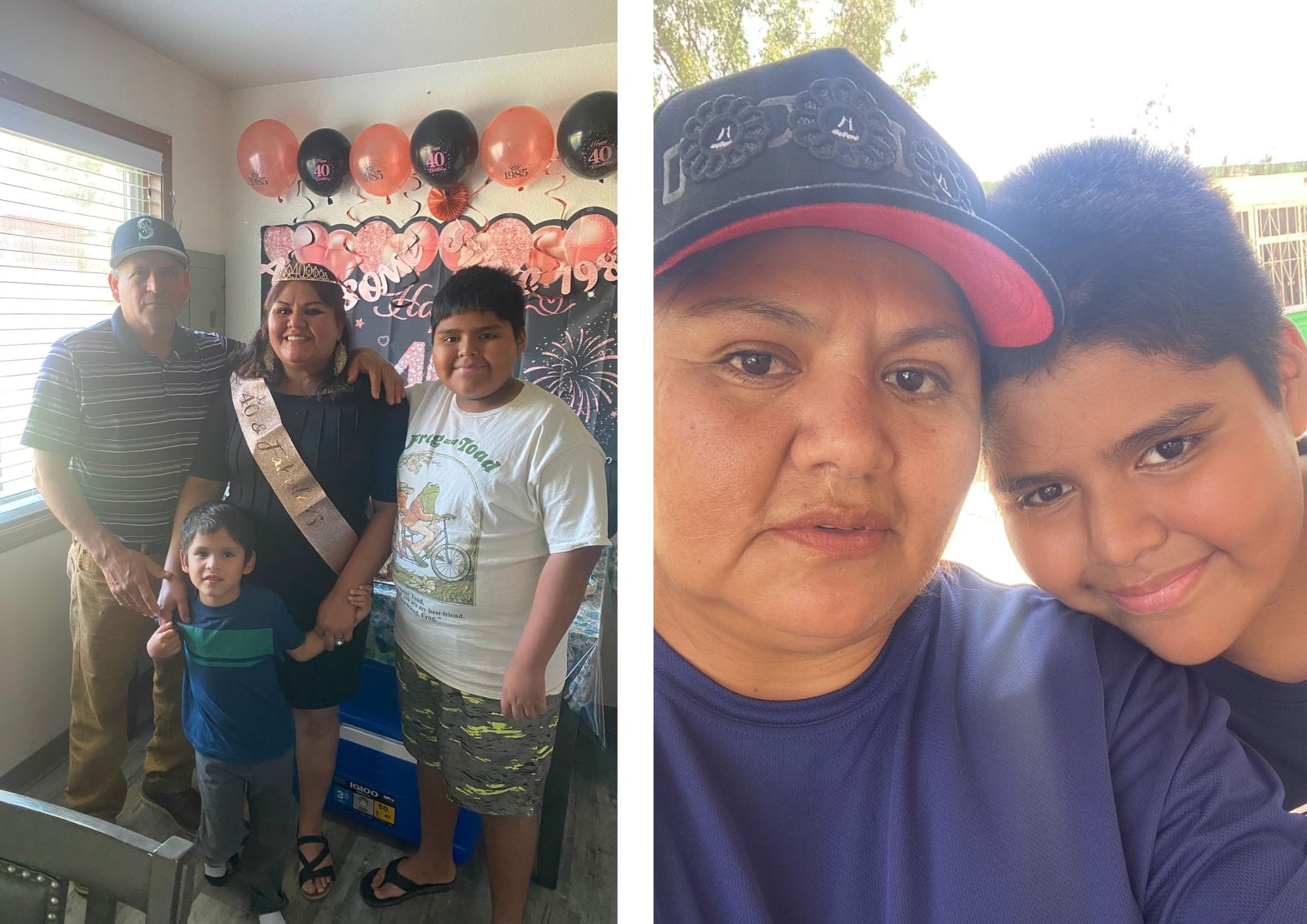
She met her husband, Robert Ramos in the summer of 2017, when they were both working in a fruit orchard. Sánchez and her son, Seth Jesus, settled with Ramos in a modest apartment in Sunnyside, a Yakima County town of 16,000 that is more than 80% Latino and a major hub of the farmworker community.
In 2019, their family expanded with the birth of their son, Emanuel.
Ramos had legally immigrated to the United States under a visa program, and later was able to become a naturalized citizen. He hoped that his wife would be able to gain legal residency.
But when they consulted immigration attorneys during the Biden Administration, they were told that that was unlikely.
A 1996 law created a major hurdle, barring undocumented immigrants with two illegal entries from gaining residency even if they were married to a U.S. citizen.
That law required Sánchez to leave the United States for 10 years before applying for legal status.
“That’s when I started crying,” Sánchez recalls.
Ramos was angry, blaming the Biden Administration. He was a U.S. citizen, and still his wife could not be assured of a life in this country even as -– under Biden — more than 5.8 million immigrants entered to apply for asylum or under programs such as humanitarian parole that granted temporary legal status.
In the 2024 election, he cast his ballot for Trump.
“I was just really angry at the time,” Ramos said.
A renewed sense of dread
Sánchez’s second border crossing after visiting her sick father was a perilous one: a densely foggy day, sirens blaring somewhere close by, likely from border patrol.
She was alone, with a coyote smuggler on the other end of her cell phone guiding her and telling her to run straight, because she couldn’t see around her.
“This was terrifying,” she recalled.
She felt a renewed sense of dread last fall as the Department of Homeland Security ramped up enforcement efforts in Yakima County. Agents circulated through communities, detaining people as they shopped, bought gas or commuted to work.
By the end of 2025, federal agents operating in Yakima County had taken 477 people into custody. This represented the highest 2025 arrest rate per capita of any county in Oregon or Washington, according to a University of Washington analysis of data from the Department of Homeland Security.
“As I watched the raids increase in intensity, it increased my desire to leave,” Sánchez said.
By the end of December, she was planning her departure. She would go with her eldest son, Seth Jesus, who was 12 at the time and—like his younger brother—had been born in the United States. They would first return to Guerrero to visit her family, then settle in central Sinaloa in the unfinished house that her husband had been slowly building as a retirement home.
The Trump Administration has offered what the Department of Homeland Security bills as a “historic opportunity” for illegal immigrants who opt to self-deport. They can reportedly receive a free flight home as well as a $2,600 “exit bonus” paid by U.S. taxpayers.
Sánchez said she was not aware of the federal aid. But her mistrust of the Trump Administration is so profound that, even if she had known, she says she would not have contacted the Department of Homeland Security.
“Was it just being used as bait, and then they would throw you into a detention center?” she asked.
Adapting to changes
In Sunnyside, Sánchez’s husband Ramos is trying to adjust to life as a single parent. Before the summer break, he shuttled their younger son, now 7, to and from elementary school. He was also recovering from a foot operation and had been unable to work in recent months, but he hopes to save up enough money to visit his wife in the fall.
In the meantime, Flor’s absence looms large.
Ramos says his son is like him, able to adapt to changing circumstances. But one night, several months after his mother’s departure, he teared up when Emanuel started hugging a plushie, pretending it was his mom.
Sánchez, who now lives in a Sinaloan community of about 800 people, has begun what she views as a kind of decade-long exile that she hopes will allow her to one day reunite her family back in the United State
As of mid-June, she was still searching for work. Though the cost of living is lower in Sinaloa, the pay is also drastically lower – with a laborer often earning less than $25 a day there compared to wages of more than $150 a day in Yakima.
Sánchez said she is wary of going to work in the often-fierce heat of the fruit and vegetable fields, recounting a heat stroke she suffered in the Yakima County orchards. So, she is considering a warehouse job but she lacks a car to visit potential job sites.
Her eldest son, Seth Jesus, graduated 6th grade in July as he also navigates the massive changes to his entire life and his family. Sánchez said he would be returning to Sunnyside.
She is relieved to be free of the threat of incarceration by immigration agents. But the separation of her family is a deep and enduring pain.
Every day, she video calls to Sunnyside and yearns for the day she will reunite with her youngest, Emanuel.
“I only ask God to give me patience until the time my husband can bring him to me,” she said. “It has been a tremendous sacrifice we are going through.”


