

If you believe everything you see on Facebook, Gonzaga men’s basketball coach Mark Few has had quite the basketball season. To start with, as the Zags Pride Basketball fan page claims, there was the diagnosis of Stage IV brain cancer — the same disease that other fan pages claim Gonzaga alum Adam Morrison contracted before his untimely death.
Sure, Few may have been reeling over the deaths of NBA star John Stockton and the team’s ball boy and two former Gonzaga stars killed in a California avalanche and that little boy from the Shriners Children’s Hospital ads. But all those tragedies didn’t stop Few from getting up and delivering a stirring rendition of the National Anthem that brought the whole arena to tears.
Few was undaunted, regaled the Facebook pages: He’s gone toe-to-toe with Whoopi Goldberg and Joy Behar on The View, White House Press Secretary Karoline Leavitt, sports analyst Stephen A. Smith, former First Lady Michelle Obama, and, for some reason, Australian politician Fatima Payman. When even President Donald Trump himself threatened him in a late-night phone call, Few refused to back down.
Of course, the hacks in the legacy media won’t write about any of this. They won’t talk about Mark Few’s principled refusal to wear a gay pride jacket. They don’t want to tell you about the $900 tip that Mark Few gave his waitress or the brand new SUV he bought for the janitor who helped him change his tire. They refuse to report on the $2 million Few gave to donate to local homeless shelters or the $10 million he gave to victims of the American missile attack that destroyed an Iranian school.
Only these Facebook pages will tell you about the time that Mark Few used his vast fortune to purchase a luxury hotel after it had disrespected him, just like in the first chapter of Crazy Rich Asians. Only Facebook will reveal that a horrific car accident left Mark Few’s wife in critical condition, and only Facebook will tell you about how her tiny black bikini photos had set social media ablaze.
Yet amid all this chaos and tragedy, Few can take solace in one thing: absolutely none of these stories are true.
FAKE FANS
In the last four months, at least a half-dozen fake Gonzaga fan pages on Facebook — with names like “Northwest Hoops Family,” “Gonzaga Court Zone” and “Street to Court” — have been racking up thousands of likes.
Many of the posted stories are ridiculous on their face, (“Michael Jordan selects Gonzaga star Braden Huff as the face of the Air Jordan empire!”) yet other fake stories on the pages have fooled Spokane attorneys, teachers and politicians.
Fake clickbait news stories are hardly a new phenomenon: A decade ago, BuzzFeed News — back when BuzzFeed News was a thing — published an investigation revealing that Macedonian teens were churning out fake right-wing clickbait content on Facebook in the run-up to the 2016 election. American clicks generate more ad money, and in countries like Macedonia, $100 per day goes further.
"If Trump loses I plan to redirect my site to sports," one Macedonian teen told BuzzFeed.
But in the last few years, something shifted: big AI has made it incredibly easy to shovel out metric tons of fake content. At one time, creating a fake photo took significant talent and time. Now, a deepfaked picture of Mark Few or John Stockton in a hospital gown can be generated with a few keystrokes.
Where fake news was once national, it can now be hyperlocal, targeting specific fanbases.
RANGE’s investigation reveals numerous similar fake slop pages for other college sports teams across the country: Of the top 32 seeded teams in the NCAA tournament, at least 27 have been targeted by the same brand of Facebook pages pumping out a steady stream of false clickbait stories. That includes all the top four seeded states Duke, Michigan, Florida and Arizona.
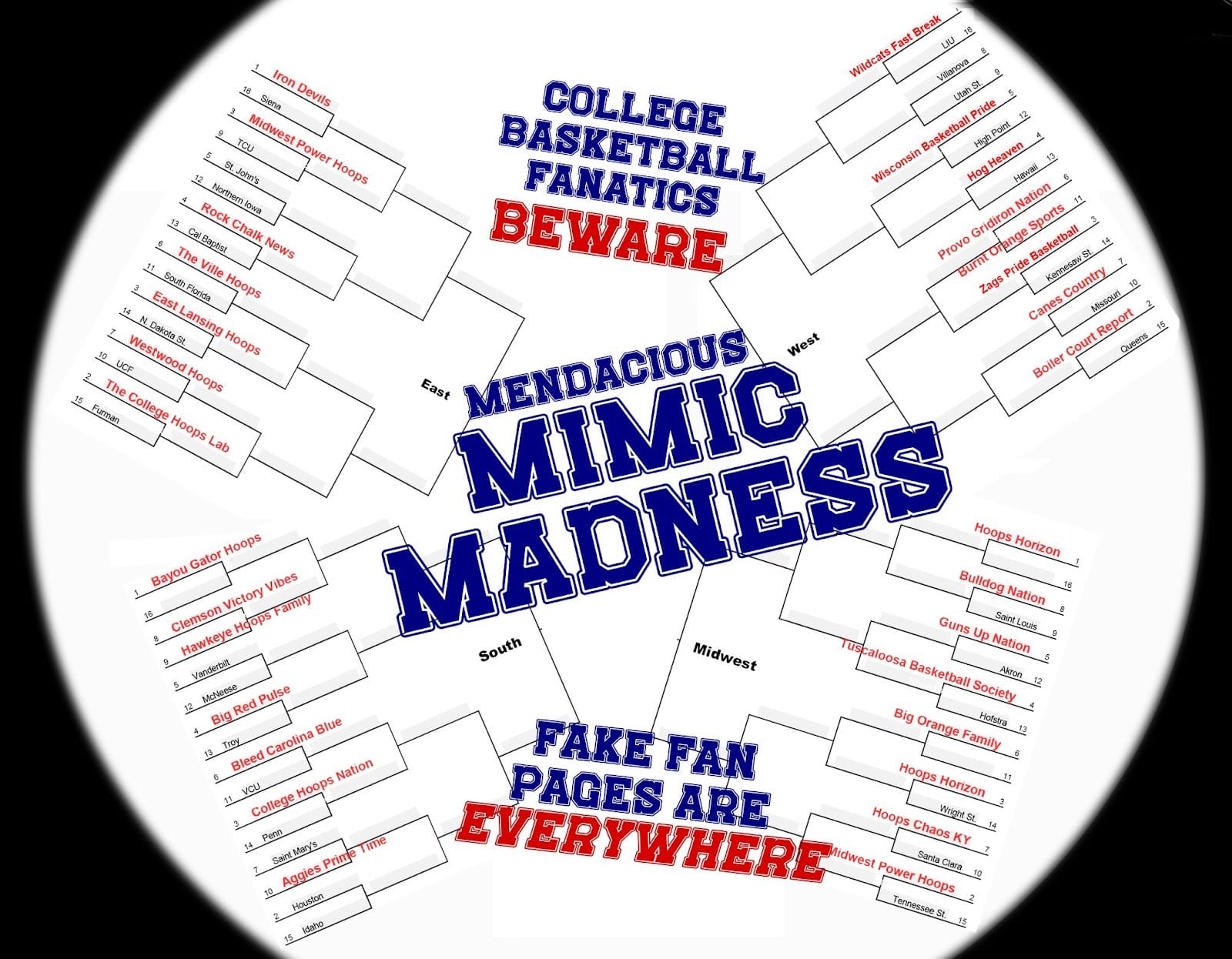
The top football teams in every NFL division, including the Seahawks, have the same brand of fake fan page on Facebook. So do a slew of NBA and Major League Baseball teams. (See our spreadsheet with links to many of the fake pages here.)
This is an international operation: nearly every page, according to Facebook’s page transparency data, is being managed out of Vietnam.
It appears to be the same operation identified in an investigation by BBC Wales last week. New pages were being created almost daily to put out fake stories, using deepfaked photos to portray British politicians like Nigel Farage in a hospital bed or storming off of a news show.
These Ai generated photos of, say, former prime minister Boris Johnson confronting someone on a BBC news show look almost identical to the faked photos of Mark Few on the View, which show Few in the same position, standing over a seated host, finger wagging in righteous indignation.
Last month, Gonzaga’s communications staff took the step of putting out a warning about these kinds of pages on social media.
“Did you hear about Gonzaga’s new $3.2-billion upgraded arena?” the post said. “An article online will tell you all about this new addition, even though the story is not true, but rather a result of AI clickbait.”
TIFFS, RANTS OR BUTTS
Savvy social media users have seen plenty of reasons to be suspicious.
The titles of several Gonzaga pages hint that their creators do not have a strong sense of where Gonzaga is located (“Provo Pioneers”) or a strong sense of the English language (“Ball is College”). The monitor on a picture of Few recovering from surgery, one commenter pointed out, showed his heart rate as “10.”
And then there’s the fact that, just two weeks after “Zags Pride Basketball” claimed John Stockton had died, the same page announced that Stockton, apparently having conquered death and risen again, was praising Donald Trump.
But plenty of smart people were tricked by other posts. Coeur d’Alene Councilman Dan English liked a fake post claiming that Gonzaga power forward Graham Ike had announced the birth of his first child. Former Spokane City Councilman and current state legislative candidate Jonathan Bingle liked a fake post about Netflix announcing a Gonzaga documentary.
That mistake, at least, was understandable: Gonzaga did recently have a documentary released, though on Tubi, not Netflix.
Bingle told RANGE he probably clicked “like” while browsing Facebook late at night, but said he began to get suspicious when he saw other posts about Mark Few making particularly conservative statements. But Bingle says that he’s heard from people who have been fooled by even some of the more outlandish claims.
“Somebody the other day was like, ‘Did you know, John Stockton had brain cancer?” Bingle said. “With the rise of AI and the ability to generate quick content and quick images, it has created a new avenue for something like that."
Getting fooled by these fake sites is a bipartisan affair. Robin Ball, former state committeewoman with the Spokane County Republican Party, liked a post about Mark Few refusing to wear a gay pride jacket.
Dan Lambert, former state committeeman for the Spokane County Democrats, shared a fake post about Gonzaga players spontaneously coming together after defeating Oregon State to sing the school’s traditional fight song with “raw, unfiltered emotion.”
“Thank you, Gonzaga!” Lambert wrote.
Informed by RANGE that the post was fake, Lambert was gobsmacked. To him the picture looked real. He could see players he recognized.
“Is it getting to the point where you basically have to fact-check everything you look at?” Lambert said. “I liked it because they had their hands over their hearts. Well, it got me.”
The lesson, he said, was “don’t let your heartstrings grab your brain cells.”
Sometimes all these sites have to do to get engagement is ask for it.
“Gonzaga Court Zone” posted 63 times in the last four months “SAY YES IF YOU LOVE Gonzaga Bulldogs.”
But other times these pages play the old clickbait classics. Newborn babies. Heartwarming displays of sportmanship, generosity or patriotism. Tirades, whether against the transfer portal or in praise of Donald Trump. Sickness. Death.
A particularly grotesque post on one fake fan page claimed that a UCLA Bruins player had been shot and killed on the UCLA campus — a campus familiar with school shootings.
There is, of course, a more ancient and primal way of driving viewership: Butts, and rumors of butts.
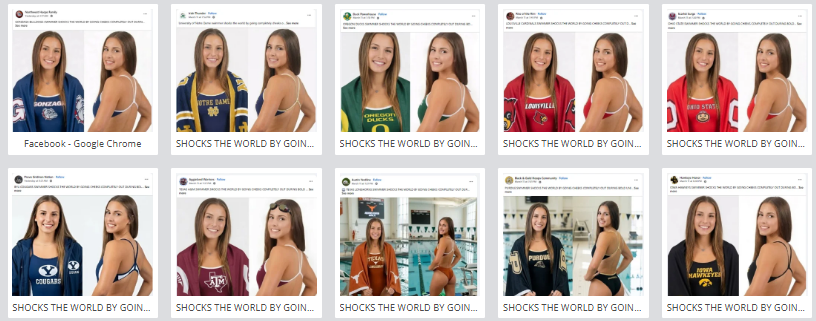
“Gonzaga Bulldogs swimmer shocks the world by going cheeks completely out during bold university photoshoot,” announced one post, complete with a picture of a woman wearing a one-piece Gonzaga swimsuit.
At least 20 other pages with identical images of the same “woman” in the same pose, wearing the same outfit but with different colors and team logos — like the Iowa Hawkeyes, Texas Longhorns, Texas A&M, the BYU Cougars, Oregon Ducks and the LSU Tigers.
But nothing, of course, gets Facebook users in a tizzy like a good ol’ culture war.
A “Street to Court” post about an unnamed Gonzaga player saying he refuses to turn "basketball into a political circus" by wearing an "LBGT armband" got over 1,100 likes. Search “LGBT armband” on Facebook, and you’ll find variations of the same post written countless times with other celebrities, like a sports star Mad Libs. Besides athletes playing for teams like the Duke Blue Devils, the New England Patriots, and the Nebraska Cornhuskers, other fake posts name musicians like Neil Diamond and Bob Dylan as being part of the anti-armband resistance.
Sometimes the clickbait machine goes haywire: one post that spells basketball, “basetbal,” claims that Bruce Springsteen is a professional golfer who plays for the "Iowa State Cyclones."
Cyclones golf pro Bruce Springsteen, you better believe, won’t be wearing an “LGBT armband.”
SPAM A LOT
An entire cottage industry has sprung up around AI slop spam on Facebook, the tech journalism site 404 Media detailed in 2024. In India, Vietnam and the Philippines, social media influencers tout ways to make money by taking advantage of the Facebook algorithm.
It isn’t just the fact that small amounts of money can go a lot further in those places, wrote Jason Koebler, co-founder 404 Media, it’s the way that the sites provide very little oversight internationally.
“American tech giants are obsessed with conquering and colonizing the entire world with products that are half baked and are extremely poorly moderated in languages that are not English,” Koebler wrote.
Tools like FewFeed, an app from a Filipino developer, allow users to automate spam — scheduling bulk posts across a wide variety of pages, duplicating viral posts from other pages, even snagging abandoned pages with high follower counts.
“Another, even more powerful spam tool is marketed by a Vietnamese company with dozens of employees, 24/7 tech support, has a brick-and-mortar office in Hanoi, and which throws conferences and events about ‘marketing’ on Facebook,” wrote Koebler.
Sometimes Facebook would pay the creators of viral content directly, through monetization programs. Facebook does not disclose the exact figures needed to start getting monetized, but several user pages cite 5,000 followers as an important threshold. Almost all the fake sports fan pages identified by RANGE have at least 5,000 followers.
But in other cases, spammers try to convince readers to click a link to an ad-laden page off site. Readers who click a link on the fake Gonzaga fan pages, for example, to see exactly which star player Few had kicked off the team, will be sent through a slew of recently registered domains — with nonsense names like “Vireon” “Brizomist” and “Clayglow” — and redirected to sites like Daily 24 World, a massive fake news slop trough. But behind those sites, according to their admin pages, is a Vietnamese site called LiveXTop, a bad actor responsible for numerous fake news stories in the last year.
In the past two years, fact-checkers have called out LiveXTop for viral claims about a celebrity boycotting Pride month, a football player starting a horse sanctuary, heartthrob singer Josh Groban confronting Trump, and Stephen Colbert rescuing abandoned twins.
Sometimes the users spreading these sorts of stories know from the get-go they’re bullshit.
Lambert, the former Spokane County Democrats committeeman, acknowledged sharing some fake news stories he knew were fake, simply because he found them funny.
Yet other stories he could swear were real. Lambert had seen a post from Zags Pride Basketball featuring Gonzaga star Braden Huff hugging a Pepperdine player after the game, a heartwarming gesture of sportsmanship. Lambert was sure it was true. He recalled seeing it happen on TV and everything.
But it had never happened. Huff was out with a knee injury and hadn’t even played that game.
A goofy spam Facebook page had effectively rewritten his brain with false memories.
“That’s some high-tech stuff,” Lambert said. “It would make Pavlov blush.’


