

This story was written in partnership between RANGE and Stonewall News Northwest, a newsroom serving the rural LGBTQ+ community of the Pacific Northwest. Learn more about Stonewall News Northwest’s work here.
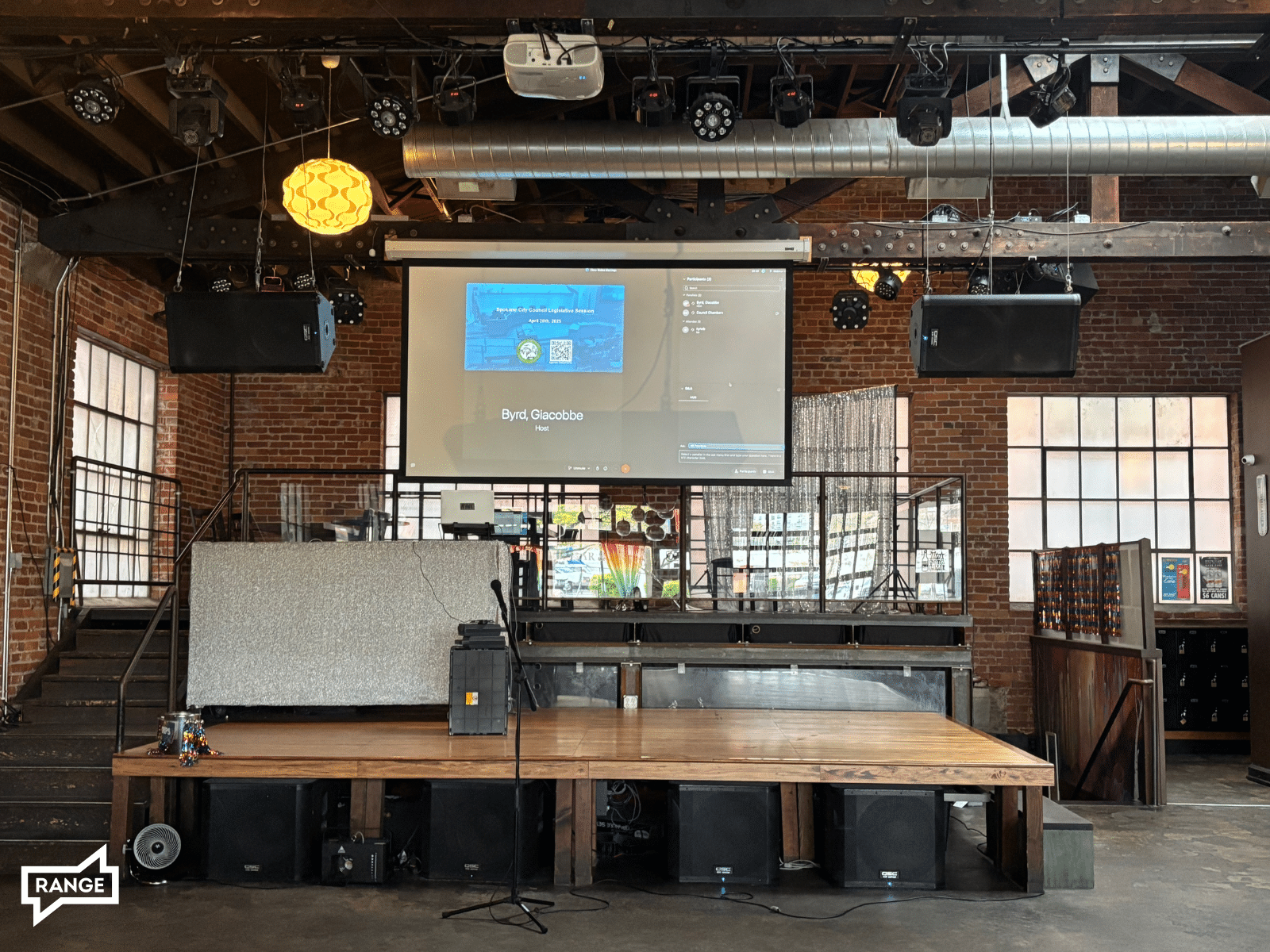
Nyne Bar & Bistro opened up on a rare Monday evening this week for something a little different than their usual fare. There were no drag performers, karaoke hosts or DJs. Instead, there was a single microphone onstage in front of a projector screen.
At 6 pm, the projector flickered alive, and Matt Danielson and Jeff DeBray gave opening remarks as the Spokane City Council meeting livestream started to play behind them.
Danielson and DeBray, from Spokane Pride and Fuse Washington respectively, were two of the organizers behind the event, a watch party for dozens of Spokane queer folks and their allies to gather and testify in support of the council’s ordinance to declare Spokane a Shield City and grant additional protections for the LGBTQIA2S+ community in the city. Spectrum Center, Trans Spokane and Odyssey Youth Movement were also involved, with Spectrum holding training sessions over the last two weeks to teach people how to testify.
As Council President Betsy Wilkerson read the council’s rules on the screen behind him, Danielson blew a kiss to the room and the meeting began. For two and a half hours, people waited as council voted on other items, and then heard testimony on the LGBTQIA2S+ protection ordinance. Some of them testified from Nyne, stepping up to the microphone onstage when it was their turn and returning to their tables to the applause of the room.
When detractors of the ordinance testified, making transphobic claims like calling queer people “confused,” comparing homosexuality to bestiality (like former Spokane County GOP chairperson Cynthia Zapotocky) or insinuating that the ordinance was Satanic because it was numbered C36667 — see the 666 in the middle of the number — the watchers at Nyne booed, jeered and corrected false statistics.
Across the county, the school board at Mead School District was discussing a transphobic policy that could require teachers to out transgender students to their parents, and members of the Central Valley School Board were drafting a Title IX complaint against Washington to the Trump administration because of the state’s trans-inclusive sports policy.
But at Nyne and at Spokane City Hall, queer people scored a victory: about two and a half hours after the meeting had begun, the council voted 5-2 to pass the LGBTQIA2S+ protection ordinance, affirming queer peoples’ rights in the city. Nyne erupted into cheers, with people shouting, clinking their glasses and celebrating loudly.
What the ordinance does
We covered it in depth here, but here’s a refresher on what exactly the ordinance does now that it’s passed:
- Created a Shield Law for Spokane, which means that no city resources will be used to assist in investigating or detaining an individual for exercising their rights, which include seeking gender-affirming care. This clarifies city-specific protection, in addition to the state’s standing Shield Law, which queer community leaders have asked for amid concerns about Governor Bob Ferguson’s commitment to the LGBTQIA2S+ community.
- Replaced outdated language in the city’s Human Rights code, defining gender-affirming care in the city’s glossary and added “Two Spirit” — an indigenous queer identity — to the LGBTQIA2S+ community definition.
- Prohibits the city from collecting or disseminating information about anyone’s sex assigned at birth, unless it’s related to a criminal investigation.
- Guarantees health insurance for city employees and their families will cover reproductive and gender-affirming healthcare, as well as care for HIV+ people.
- Created an LGTBQIA2S+ liaison officer position at the Spokane Police Department who will act as a point of contact and build trust with the community.
- Requires the city to conduct regular review of policies and practices to ensure they’re equitable and affirming for LGBTQIA2S+ people.
- Directs the city to collaborate with LGBTQIA2S+ leaders and event organizers to ensure public safety and well-being for community members and event attendees.
What does it cost?
One argument expressed against the ordinance was that it wastes taxpayer dollars. Even Council President Betsy Wilkerson expressed nervousness about the sticker price of the ordinance, which she said was around $400,000 every year.
But Council Member Paul Dillon, who proposed the ordinance, said that an HR department analysis of the costs associated with the ordinance found it would be “budget neutral” and that it currently costs Spokane taxpayers no additional dollars. That roughly $400,000 cost would only come into play in a worst case scenario, like if the state stopped covering some of the costs of insurance coverage and left the city committed to paying for gender-affirming, reproductive and HIV healthcare.
Even if the state did remove coverage and Spokane was on the hook for the cost, to Dillon, “it’s worth every goddamn penny.”
“Saving a life is worth it,” Dillon said. “A right isn’t a right unless you can access it.”
The testimony
The ordinance brought out one of the largest crowds of the year to council, rivaled only by the community support of the resolution to reaffirm Spokane’s commitment to the Keep Washington Working Act. Over 67 people had signed up to testify on the ordinance, so many that the council voted to limit testimony to two minutes each instead of the usual three.
For hours, people shared vulnerable stories with the council, speaking about their experiences as queer people living in Spokane.
Jacob Schwartz, a board member of Spokane Pride who testified from Nyne, said that he’d built his life here in Spokane, growing up here, working here and worshipping here “as a proud gay Christian.” He said that without support from queer community here, he “wouldn’t be alive today.”
He thanked the council for bringing the ordinance forward. “My younger self needed you, our youth needs you now, and we are here to stay,” Schwartz finished. At Nyne, he was met with cheers.
Evee Polanski, a frequent testifier at city meetings, spoke about the culture of fear that had been created by President Donald Trump’s barrage of anti-LGBTQ+ policies.
“We’re seeing how these national policies have a real impact locally: they create stress, anxiety and fear for our community,” Polanski said. “You’ve probably noticed the sheer amount of people doing their testimonies virtually because of the fear it causes.”
In the wake of chaotic and cruel federal policymaking, Polanski said, “it is important that our local city government prepares and puts protections in place, like this ordinance that provides safety and freedom for all of our community members, in particular, our LGBT community members that are currently under attack.”
While testimony is old hat for Schwartz and Polanski, who are associated with progressive organizations doing advocacy work, for other queer people, it was their first time stepping up to the dais to share their stories.
Alexander, who asked to use his first name, showed up to the April 21 meeting, where council held their first reading of the ordinance. The room was much emptier than it was this week, and Alexander felt “terrified,” and alone, like he might be the only trans person in the room that day.
When he showed up to a full room at City Hall on Monday, Alexander was heartened. It was a big step for him to speak publicly about his experience as a trans person.
“I live a pretty quiet, introverted life and I didn't think that it was important for me to talk about who I am or my personal experience previously, to be completely honest,” Alexander told RANGE in an interview this week. “ But with tensions being as high as they are and my community being as persecuted as it is, I think that it's really important for everyone to step up a little bit.”
“ In places like Spokane where it's such a melting pot of religious and political and cultural backgrounds, I think that it's important for people to say who they are, so everyone knows who they're working with, who they're friends with, who provides them services, and who is their friendly neighbor,” Alexander said.
Alexander wasn’t the only person who had never testified before and turned out just for this ordinance. There were allies at the meeting too, people like Jason S., who said he didn’t even know what council district he lived in.
“I’ve always been a passive supporter, I’ve never shown up. I’ve never stood up, but it’s time to show my support for the vulnerable members of this community,” Jason S. said. “To the members of the LGBTQIA2S+ community, you have more friends than you know. And to the friends that they didn’t know they had, it’s time for you to stand up.”
Alexander found Jason’s testimony especially moving.
“ When there's such a vocal, hateful portion of the population, it's really important to know that there are very quiet people out there who support you, who don't hate you,” Alexander said. “You have to be explicit in your advocacy or risk complicity. That is a big part of why I wanted to provide my testimonies and a big part of why I so deeply appreciate allies providing theirs.”
Celebrating in community
The second the ordinance passed, the livestream at Nyne was turned off so people could celebrate, buying each other drinks, congratulating each other and complimenting those who took the mic to testify.
Soon, people who had been watching from City Hall began to trickle in, met with applause as they joined the group. Someone put on a playlist of queer pop music.
Chappell Roan was blasting in the background 45 minutes later when Council Members Lili Navarrete, Paul Dillon and Zack Zappone, three of the five council members who had voted in favor of the ordinance, showed up at the bar to celebrate with the community, joined by some city staffers, too.
On Tuesday, nearly a full 24 hours after the ordinance passed, Alexander feels “fantastic.”
“2025 has been very difficult for me. It has been very difficult for my partner, and for my friends, in the face of all the bigotry that has been at the forefront of the media,” Alexander said. “I don’t want to not believe in people and everything that has been happening has honestly hurt my faith in humanity a little bit.”
“But I don’t want to be passive and I don’t want to be cynical. I want to fight and surround myself with cool people and care for others in the way that I want to be cared for. This ordinance felt like doing that in a real way,” he said. “I think that it felt like a very much needed win. Probably the first big win for me in 2025.”
For anyone who, like Alexander, has been feeling down or “doubting their place in this nation and in this community,” Alexander wanted to give a piece of advice:
“Step up instead of stepping back, because helping people really does help yourself, and caring for other people is caring for yourself.”


