

On the streets of downtown Spokane during a heatwave magnified by blacktop, sun rays gleaming off tall buildings and the crush of a heating climate, unhoused folks take care of each other.
Walking from a “cooling station” at City Hall toward the southwest corner of Riverfront Park Wednesday, Crystle Burgett approached five or six unhoused people catching naps in shaded spots scattered across one of the bright green lawns. It was 104 degrees Fahrenheit, and she was on a mission she felt was a specific duty for someone like her.
“We're gonna check in with these guys over here and see what they need,” said Burgett, the cofounder of the Music Arts and Culture (MAC) Movement who lives in a decommissioned prison bus in North Spokane. “The city's not gonna do that. They're afraid of this. This is scary territory for a lot of people.”
By contrast, people like Burgett who have experience living on the streets are used to approaching their neighbors. Burgett was doing an outreach round with her volunteer colleagues Joseph Sampson, who became housed three months ago after more than a decade on the streets, and Keisha Nesdahl, who is couch surfing with friends.
“People that have lived experiences — like us three — we're not afraid,” she said.
Unhoused people helping unhoused people is one form of an organizational model called mutual aid, in which fellow community members mobilize to short-circuit the bureaucratic crawl of government programs. It is especially beneficial for marginalized people who can have a hard time accessing government care — such as the unhoused population of downtown Spokane. Need is ratcheted up another level during emergency situations like the current heat wave, during which public cooling centers and other services exist, but are limited by inadequate funding and a tangle of rules and procedures.
“I know what it's like to struggle,” Nesdahl said in a short interview. “It's nice to be out here helping other people to see them struggle less, at least for a moment.”
Sampson said the harshest reality of being unhoused is simply the logistics of daily life — trudging the physical distance from a place that offers one essential service to a far-flung place that offers another.
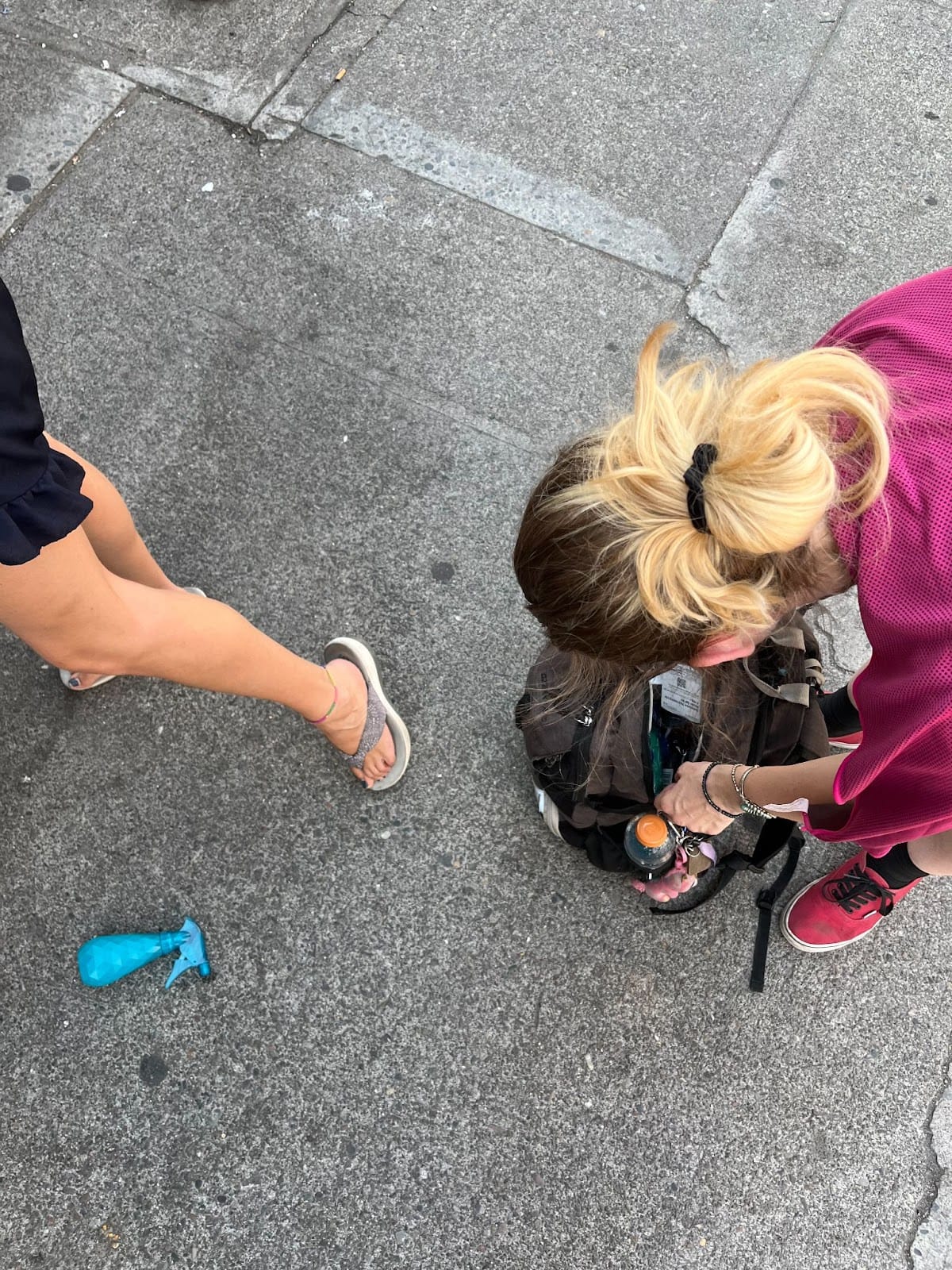
The first person the group came to as they walked into the park was a man resting his head on a pack.
“You want some juice?” Burgett asked the man, who raised his head from his makeshift pillow. “He perked up at ‘juice,’” Burgett noted. She brought him a bottle and asked if he needed Narcan — an agent that reverses opioid overdoses — a banana or a spritz from the blue spray bottle she carried.
Burgett has proactively assumed caring for her fellow unhoused people’s basic needs through direct action. The MAC Movement is part of a coalition of groups and people called CoolSpokane that mobilizes during any stretch two days or longer when the high temperature reaches 90 degrees Fahrenheit. They stage cooling stations where volunteers distribute water, sandwiches, electrolyte packages and Narcan to anyone who walks by.
Dante Jester mobilizes services for local and state government programs, helps regional entities create long-term plans to respond to extreme heat and educates citizens on the danger of heat for the Spokane Regional Health District. All that work is part of their job running the Climate Resilience Program for Gonzaga University’s Institute for Climate, Water, and the Environment. Jester said such resources are diverse and many, but some people don’t have access to information about them or they can be hesitant to access cool public places unless there is a friendly face or a welcoming environment.
“There's all sorts of barriers in the way for different people to access those things,” Jester said. “There's also not enough resources. Meals on Wheels was just this morning asking for more donations for fans because they're running low. What people really need is actual cooling — AC resources — and that's obviously much harder to access, especially for low income folks.”
They said programs like CoolSpokane, which they have volunteered with in previous summers, are important for two reasons. First, they provide needed services. The second reason is closely tied to Jester’s work educating the public about the immediate dangers of extreme heat.
“I think after the 2021 heat dome, when 19 people died in Spokane County, a lot of people were like, ‘Oh, this is serious,’ Jester said, “But still, I talk to people who talk pretty casually about the heat.”
Seeing people like the CoolSpokane volunteers working on the streets jogs people into realizing that heat is dangerous, Jester believes.
“They're raising awareness of the fact that this is a serious issue that is threatening people's lives,” Jester said. “When you walk by a cooling station or you see their posts on social media, you say, ‘Oh, this is a big enough problem that people are volunteering to mobilize around it.’”
A gap in understanding
They began their 2024 operations on Tuesday, calling out to passersby from a cooling station on the big concrete apron of City Hall, “Free ice water, juice, sandwiches, Narcan!”
One man, neatly dressed in a pressed, cornflower blue button-up, was sour about CoolSpokane’s efforts, responding to the offer by saying, “How many of my tax dollars are going to pay for this? Why are you helping people?”
“Not one cent, sir,” replied volunteer Lacy Russell, who sat under the canopy CoolSpokane had erected. The cooperative is operated entirely by human power and donations.
As that man walked away, Dave Bilsland, a CoolSpokane volunteer who has lived in makeshift housing or on the streets of Spokane for more than 20 years, said some people don’t understand the difficulties of being unhoused.
“They haven't thought about it, because they don't walk where the common folks go, where their needs are,” Bilsland said.
Bilsland pointed to his car, a forest green sedan riddled with dents and hood paint that was yellowed and nearly white near the windshield.
“She’s beautiful,” he said. “I like the patina on the hood. I really do. The discoloring. That's actually a quality thing.”
But despite the beauty of his car, he still makes it a point to walk every day. It’s important to know how big the city is and, “I need to get some exercise anyway.”
Unlike the man in the cornflower button-up, most who passed by the station during several hours of midday heat Wednesday either smiled and politely declined or enthusiastically accepted a drink.
“You’re awesome,” said one man who emerged from City Hall and walked by around 3:30 pm.
In addition to its City Hall location, CoolSpokane has started two new cooling stations, one in Spokane Valley and another at Shalom Ministries at 518 West 3rd Avenue.
‘Disaster. Devastating. Unrealistic. Senseless. Sad world.’
At least once a day, the volunteers do an outreach walk — like the one during which Burgett approached the slumbering man — in the area surrounding the station. They drag a cooler with a bag of ice and water bottles, handing them to anyone they see and letting people know about the cooling stations. They focus on the most parched-looking individuals, many of whom are unhoused.
Keisha Nesdahl hands out boxes of Narcan to unhoused people on a downtown Spokane street corner. She is currently unhoused and couch surfing with friends. (Photo by Aaron Hedge)
The products they gave away were donated by grocery stores, restaurants and individuals. Russell, a photographer from Spokane Valley, founded the nonprofit Trident earlier this year, which participates in CoolSpokane. She brought bananas and sandwich material donated by Yokes and Grocery Outlet.
Russell said that though the direct action CoolSpokane does downtown is necessary, she considers it an “emergency response,” “a Band-Aid on a sucking chest wound,” and said governments must provide more systemic solutions to the homelessness crisis. It’s especially heartbreaking, she said, when she sees available resources sitting idle.
“I drive around town all the time and see so many empty buildings and I'm like, ‘We could convert that,’” Russell said. “We have people who are in construction. We have people who know how to do this. We can convert this into somewhere livable for someone, and then they have an address. They can get a job. They can support themselves or their families.”
The city of Spokane itself often uses the human power of unhoused people to do its outreach. Spokesperson Erin Hut told RANGE the city procured 104 cases of water and Powerade this week and distributed them through Jewel’s Helping Hands, CoolSpokane, House of Charity and the Salvation Army, whose volunteer base is largely made up of unhoused or formerly unhoused people.
Burgett assigns other, more informal roles to people she meets on the street. A few moments after talking to the man sleeping on his backpack, several blocks south of Riverfront, Burgett approached a young shirtless man who wore sunglasses and sat in a chair under a business awning on a downtown street corner. A few dozen unhoused people milled around him as he told Burgett of the devastation of watching the homeless crisis unfold in the heat.
“Disaster,” the young man said. “Devastating. Unrealistic, almost. Senseless. Sad world.”
Burgett gave him a small blue spray bottle, the same kind hair stylists use to wet hair, and told him, “You’re the spray guy around here. You got to spread it around.”
Red Ambrose, who came to Spokane from his Wyoming cattle ranch in 2020 to settle a legal dispute and immediately found himself homeless and unable to escape the streets, now volunteers with CoolSpokane, calling the group family.
He said he has lost his entire family and wanted the housed population to understand what it was like to be on the streets.
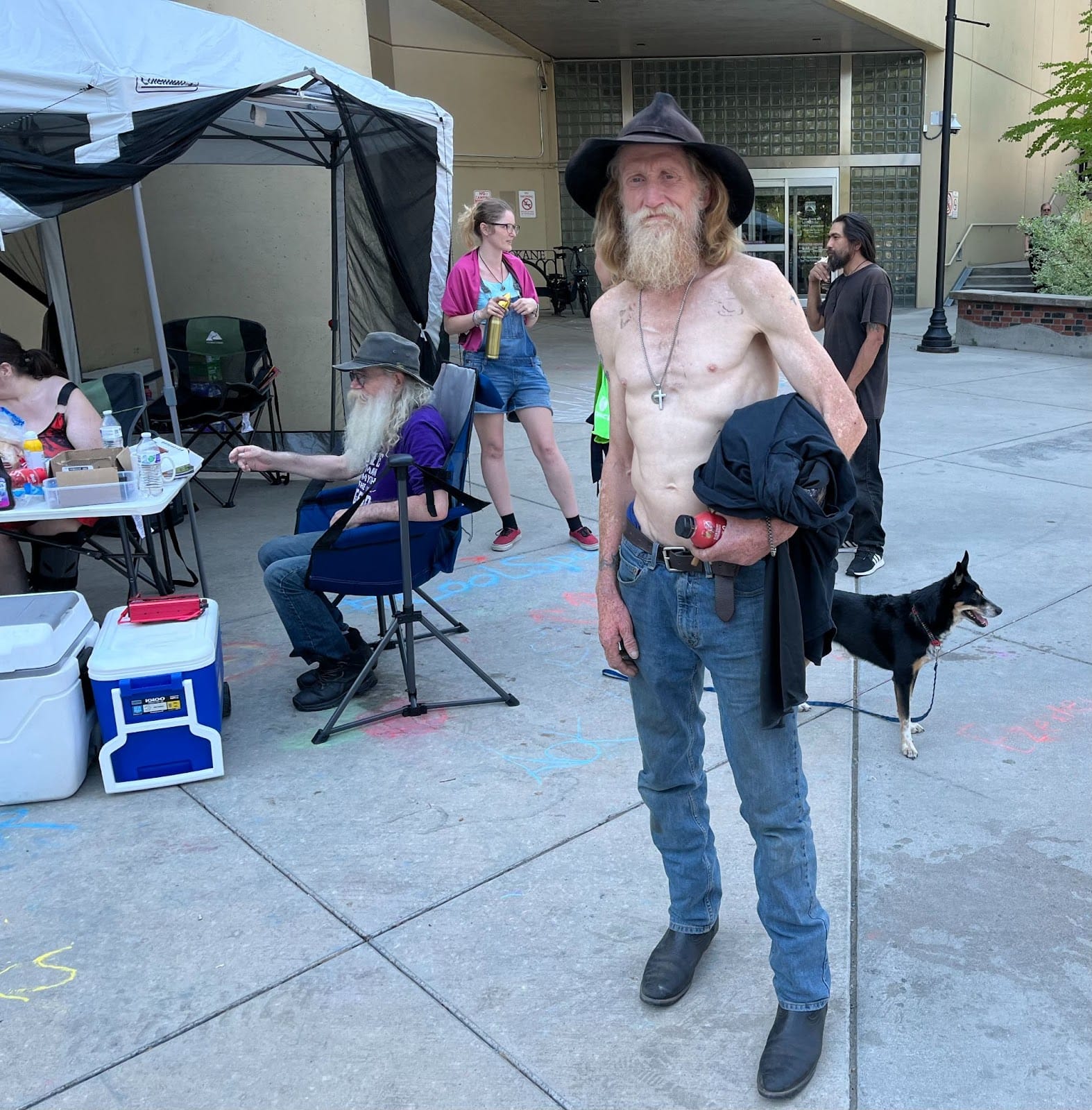
Red Ambrose, a former Wyoming cattle rancher, has been unhoused on the streets of Spokane for the past four years and volunteers with CoolSpokane. He said he recently got a housing voucher and hopes to have a place to live soon. (Photo by Aaron Hedge)
“I pray that it never happens to” people who don’t know what it’s like, said Ambrose. “I pray to God it never happens to them. Because I've seen a lot of people that's never been unhoused before that it has happened to them. They've lost everything they ever had and everything they ever cared for.”
Ambrose, who said he works part time for a horse facility in North Spokane, said the city has a responsibility to provide enough resources for unhoused people to be safe.
“The homeless population is part of that constituency,” Ambrose said. “So they have just as much responsibility to them as they do to the guys that's living up there in that mansion on the hill.”
‘It’s not reaching the most vulnerable’
Burgett said direct action of the sort CoolSpokane provides is needed in a society that encourages people to just grin and bear it in the context of an intensifying global heating crisis, faltering government resources and a shortage of housing.
“All of us see the need for mutual aid and how it helps people,” Burgett said. “A lot of times we have all this funding going to homelessness, and it's not reaching the public. It's not reaching the most vulnerable population that are desperate for these services.”
Part of the problem is that, though services like shelters, job programs and addiction treatment centers exist, some unhoused people can’t or are afraid to access them. Many places housed people can enter to cool off are hostile — unintentionally or intentionally— to unhoused people.
“Some people are banned from those locations for whatever reason,” Burgett said. “That's not our responsibility when it comes to survival to decide who gets resources and who doesn't.”
On top of this, many unhoused people take their chances on the streets because resource centers can represent trauma to them. Bilsland, the man with the beater sedan, said he spent a winter in a shelter many years ago.
“I'll never go back to a shelter again,” said Bilsland.
“That was just downright traumatic,” he said. “Shower with nine homeless guys sometime. Tell me it's not traumatic.”
Still, he acknowledged many unhoused people need and want shelters. He took a moment to lament the recent US Supreme Court decision that allows municipalities to bar unhoused people from erecting tents in public places even if they don’t provide shelter.
“We don't have enough shelters for people,” he said. “So why are they making homelessness illegal when they're not providing a place?”
During their work on Wednesday, the unhoused volunteers with CoolSpokane repeatedly stopped to marvel at the inadequacy of systems that exist to respond to the homelessness crisis. The converging issues — climate change, government dysfunction, the opioid crisis — that have created homelessness and worsen its most troubling aspects show no sign of relenting, but neither does CoolSpokane.
“If we don't know the answer to something, we're going to figure it out for you,” Burgett said of her fellow volunteers. “I have full faith that our people do that. If this person is in crisis or they're about to be in crisis, how do we prevent that?”


