

Spokane County and the Inland Northwest are no strangers to devastating wildfires, from the devastation of Malden in 2020, to the still infamous Fire Storm ‘91, all the way back to the Big Burn, our region is prone to deadly, wind-driven fires.
Fire is an essential part of our local ecology that has been shaped by Indigenous stewardship since time immemorial. But, with climate change and more people moving into the Wildland Urban Interface — the area where unmanaged timberlands meet human development — the risk is greater than it’s ever been. After the hottest May on record in Spokane, much of the Inland Northwest has above normal wildfire risk for June and beyond, according to the National Interagency Fire Center.
It’s a frightening reality that is going to require a regional and ultimately global solution, but for individual people in any given year like this, the preventative measures are relatively straightforward, and might even save you a little bit of money in the long run. As the old saying says, an ounce of preparation is better than a pound of cure.
That’s why RANGE reached out to Guy Gifford, the assistant division manager for the Washington Department of Natural Resources Community Resilience Program. Gifford leads a team that works with homeowners and communities to prepare for wildfires before they ignite. We’re sharing some of the insight from his work, as well as resources people can access to be ready for wildfire season.
This conversation has been edited for clarity and length.
RANGE: What can people do to better prepare themselves for the wildfire season?
Guy Gifford: If people want site specific information, we have a program where people can request a firefighter to come out to their property, walk around the home and give an assessment and recommendations on the steps to take around their structures to reduce them burning in the next wildfire.
And, that's just going to wildfireready.com and signing up for a wildfire ready visit. It's no cost, it's free. That's the easiest thing to do.
RANGE: Aside from having a firefighter come to your home, what are some steps that you generally recommend for wildfire preparation?
GG: When I work with people and give presentations, I ask what causes fire, and most people think it's big flames, trees burning down, burning your homes down. And the reason people think of that is that's what they see. The pictures on the news all show those big flames burning structures down and when homes burn, they see big flames.
The research tells a slightly different story. A lot of fires that burn down homes aren't started by those big flames, but it's from the embers the fire leaves. Fires release little matches that get blown and land around the home, and that's actually what starts over the half the homes on fire is what we call the ember shower.
The nice thing about that is the things you need to do to protect your home from the ember shower are actually generally very cheap and cost effective compared to thinning trees, which is [also] needed.
Looking at priorities, the biggest priority people can do is start with a house and work out. Keeping your house looking nice and pretty and clean is half the battle.
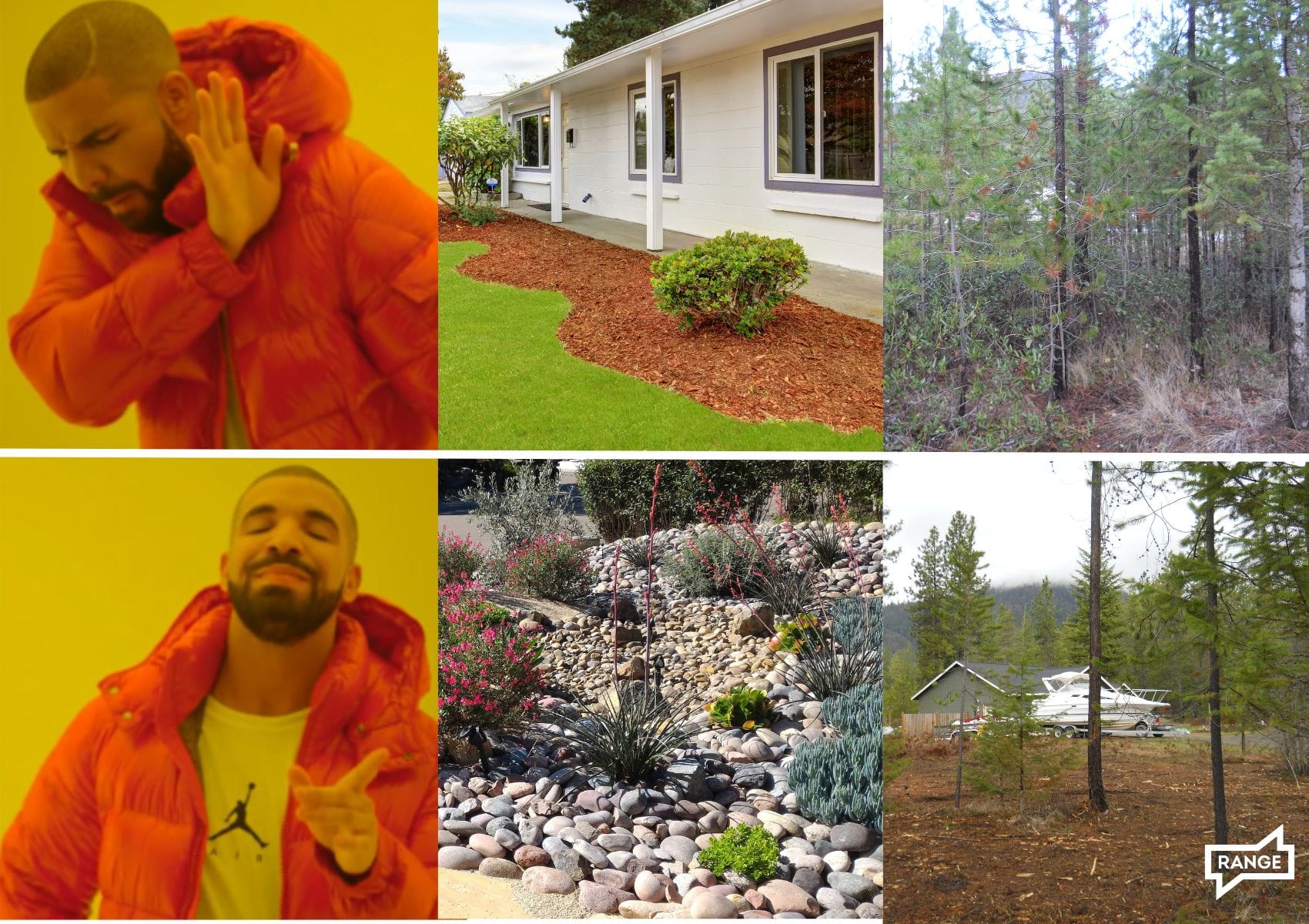
So, the question we ask people is: What around your home in that first five feet, could you start with a single match? That's what you want to get rid of. So that could be the beauty bark for your landscaping, leaves and the needles next to your home. It's the firewood pile. It’s all those things, like garbage, or the recycling bin next to your home, all those things that a single match could start on fire you should be looking at removing and storing somewhere else. None of those things generally cost money or cost very little.
HOME FIRE PREPAREDNESS TIPS
RANGE: What are some examples of some changes you’ve made?
GG: Over the last two years, I've been doing this stuff around my house and a lot of things I've been doing to improve my house, I just had to make different choices. Instead of selecting plant A, I select plant B and the cost is the same.
Instead of using arbor vitae, which has needles that release turpentine gasses, I did a Japanese maple. I’ve added daffodils and irises, because they're succulent, they hold in moisture and they don't accumulate a lot of dead material. As we get older, we're looking at things that require less maintenance.
And, we've just reduced how many plants we have around the house and we’ve changed the landscape so it’s not a wall of green in that five-foot zone, but more scattered. In that zone we’re really trying to get to nothing that will burn and we're removing all the beauty bark we have and replacing it with rock that is lower maintenance.
Rock is more permanent and we like the look. It’s a little higher investment than our beauty bark, but we don't have to replace it every three to five years like we used to. So, long-term it is actually going to save us money. A lot of the stuff is actually cost-effective.
So that's one of those simple things people can do: In that five foot zone just make sure nothing's there that can ignite.
And, one of the things I talk to people about is: When wildfire season hits, pay attention to the weather.
If you know it's August, and we’ve got one-hundred degree temperatures and wind coming, you may want to double-check that [five foot] area. Because how many times do we leave [something flammable] in that zone next to our house … it happens.
So, just do what I call the wildfire safety check, especially if you're going away for the weekend.
I always used to do a security check around my home to make sure everything's put away, locked up before on vacation. Now, I also walk my home and say, what can an ember start on fire? So, I'm combining two tasks now before I go on vacation — the security check and the fire check.
RANGE: What about the area further than 5-feet from your home, what are your recommendations there?
GG: Outside of that you have your yard, the area from five-feet to 30-plus. There you're trying to do some of the same things, but you could have something burned. You could have a plant that's not the perfect plant there.
The research shows if it's a small fire there your house actually takes a lot of heat to start on fire from what we call radiant heat. And that's when a bush burns, it gives the radiant heat off. That's the same heat you feel from the campfire or you feel from the sun. And as long as you have those [less than ideal] plants or beauty bark outside that five-foot zone – if the chips burn, they'll give off a four-inch flame — it won't burn my house, so the risk is low.
One of the things to look at in that zone is what kind of trees you have. Like, if I have conifer trees, spruce trees are very common in yards, will the branches start on fire? What I recommend is to remove the branches touching the ground or change that beauty bark to rock under the tree. So, you have the choice of how to minimize starting a fire.
One of the big things is just minimizing the amount of dead material in what we call zone two in your yard and garden. Try not to have any big accumulation of material that will generate a lot of heat, like a big wood pile. You just don't want big heat sources near your home.
The other key thing people forget: you’ve got to do that for your other structures. A shed 10-feet from your house that ignites easily will start your house on fire.
You’ve got to be aware of those other outbuildings to make sure they're protected well. I used to get snow in my garage, because I had broken seals. Embers could get in those same locations. So keeping your house winterized makes it more resilient to wildfire because embers can't get in the house. Again, you're achieving two goals at one time, saving money by reducing heat loss or cold loss and reducing impact for wildfire.
RANGE: What about the area beyond your yard? What can private landowners, especially those who live near the forest, do to prepare for wildfire?
GG: The area that people focus on a lot or think about as a problem a lot is that area that's not maintained — the forest, the woods. That is usually the most costly area to do work, very labor intensive and that's at 30 feet out we call the unmaintained area — the area that you don't mow or water.
When pine trees burn, they don't give off big flames for very long. They burn like a Roman candle. They just go poof — in about 60 seconds they're done. That's why those big flames don't always burn your house down, whereas a shed burning near your home burns for a long duration and will ignite your home. A long duration fire near your home is more likely to set your home on fire than a big flame that dies really quickly — that's what the research supports.
Research has supported that a 30-feet area of lean, clean and green landscaping protects your home from that radiant heat, so when those big trees do burn the heat they release will probably not just ignite your home.
In that area we recommend spacing the trees out so you could fly like superman with your arms spread out and not touch any branches. Thinning out there is what's recommended and there are programs for the Department of Natural Resources to help reduce those costs. We call it the cost share program. It can pay half the cost of thinning smaller trees. Our definition of smaller tree is generally non-commercial, about 20 to 30 feet high.
If you're in Spokane County, you can just call (509) 684-7474 and ask for a service forester and about the tree thinning program. They come out and do a site visit, and they actually are foresters so they can also help people with forest health issues like bark beetles, diseases and help them have a healthy forest ecosystem as well as one resilient to fire.
RANGE: Beyond individual efforts, what are the large goals community and state-wide in terms of wildfire preparedness
GG: The state created a community resilient program in the last year to really help people be prepared for a wildfire. One of the programs we launched is called the Wildfire Ready Neighbors Program.
We’re working with neighborhoods to form what we call a Firewise site, where they're taking actions as a community working together to reduce wildfire. Because, if I do the work around my house, I do benefit, but if my neighbor does things, I actually benefit from their work as well.
With neighbors working together, we get synergy and they get more bang for the buck. That's where one plus one doesn't equal two, but one plus one will equal three or four if neighbors can work together. Because, if my neighbor’s house 75 feet away ignites, that house burning will ignite my house even if I've done these other steps.
RANGE: What about when a fire happens? What do you recommend people do if they're in an evacuation zone or an area that could be evacuated soon?
GG: A couple things. If you know there’s a fire in your area, it’s important to have what we call situational awareness. Literally, that's just being outside and looking and seeing where the smoke column is and looking at the direction that smoke column is blowing. Also, it’s knowing what the weather's going to be doing based on the wind.
Typically in Spokane County, winds come out of the Southwest. A lot of our large fires are long and skinny starting in the Southwest and we catch them in the Northeast. They're highly predictable.
Being weather-aware is one of the key things. If a fire is in the area, knowing what the fire will be doing — that's the best thing people can do. Relying on media alerts or other things aren't as fast as what you can determine by just looking at that fire, that smoke column, and seeing what it's doing, and knowing what the weather's going to do in the next 30 minutes or less. But if you’ve got fire in the area, the key thing is getting your most important things ready to evacuate: That's your medicines, your prescriptions. important documents and irreplaceable things like photo albums.
I've been on many fires where we went from get ready to evacuate warnings to evacuate within minutes. This county has a lot of wind-driven fires and things change very, very rapidly.
So being prepared is the biggest thing — know where your escape routes are, know the different ways out. And, because of the typical wind patterns, think about an escape route to the Northeast.
RANGE: What about putting out a sprinkler or something like that — are there ways that you can help the firefighters who are coming to fight the wildfire?
GG: The biggest thing you can do is what you do ahead of time. You won't have time to do anything the day of.
The key thing with sprinklers is what do they need to work: electricity. In a wildfire, the first thing that goes out is electricity, so relying on sprinklers is not a good thing for landowners. They don't recommend that.
RANGE: What about areas that aren’t on wells?
GG: If you have a community water system with hydrants and all the homeowners are using the water, then where will the firefighters get the water? You’re better off leaving the water for the firefighters than everyone using it on their own houses.
RANGE: Beyond preparing before and knowing what to do when a wildfire has started, what are some important things people should understand about wildfires?
GG: The leading cause of wildfire in this county is outdoor burning. People in this area often burn plant material because it’s the economical choice. The key things people need to remember: build a trail around it just like a firefighter would, have water on site and and stay there until it's out.
That's a key thing to remember: humans are the leading cause of wildfire. Over 90% of our fires in Spokane County are human caused. Smoking is actually one of our lowest causes of wildfire.
It's outdoor burning. It’s sparks from vehicles or people working in their backyard — with a grinder, a welder, or something that emits a spark — that is actually the leading cause of fires.


