

In a city council study session Thursday, Spokane City Chief Financial Officer Tonya Wallace described the Trent Resource and Assistance Center (TRAC) as a “public-private partnership.” That took interim council president Lori Kinnear aback. “I wouldn’t have thought that that’s a partnership, because we’re paying [Larry Stone],” Kinnear said.
“This is a partnership in that the property was acquired for our use,” Wallace said. “We are leasing it from [Stone], but at the same time that entity is also investing in some other improvements.”
RANGE has been tracking the circumstances surrounding Stone’s purchase of the building that would become TRAC, initially because the lease price the old owners were asking was significantly lower than the lease price Stone listed the building at and later ended up negotiating with the city.
Stone has been a vocal supporter of Mayor Nadine Woodward and a vocal critic of previous attempts to address homelessness. Among other actions, Stone funded the 2019 video “Curing Spokane,” which advocated for a bigger jail to accommodate arresting unhoused people who are accused of committing crimes and better parking options so middle-class people would return to Downtown. Woodward promoted the video on the campaign trail.
We’ve heard different versions of why Stone came to buy the warehouse, including “that it was a favor to the city,” but no one from the Woodward administration has been as blunt as Wallace was yesterday.
Stone has never replied to RANGE’s multiple requests for comment on this story or any other time we’ve sought comment over the last six months. The lack of response from Stone leaves a lot of blank spots about his personal investments in the property and whether or not, and how much, he is profiting from the TRAC lease.
The partnership between Stone and the Woodward administration is of special interest because Stone is a top donor to Woodward through independent expenditures to political organizations campaigning on her behalf. Stone has given $15,000 to the Spokane Good Government Alliance, which has already spent nearly $107,000 on a combination of ads and campaign activities in favor of conservative candidates Woodward, Council President candidate Kim Plese, District 2 City Council candidate Katey Treloar, District 3 Candidate Earl Moore and incumbent District 1 candidate Michael Cathcart and against liberal candidates, including Mayoral candidate Lisa Brown and Council President candidate and current City Council Member Betsy Wilkerson. These are independent expenditures, meaning that rather than being donated directly to a candidate’s campaign, they are donated to third-party political action committees and other organizations that may advocate for a specific candidate but are not allowed —at least in theory — to coordinate with those campaigns.
As we report in a companion piece today, Stone has given direct private donations to Woodward and other conservative campaigns, but those have been returned. Even though the campaign donations are technically legal under Spokane’s toothless campaign finance laws, Councilman Cathcart told RANGE he didn’t feel comfortable accepting Stone’s, given the businessman’s ownership of the Trent facility.
Wallace’s characterization of TRAC as a partnership raises questions about what each side is getting, and who benefits from the city’s investment. Spokane has paid Stone $330,000 in lease payments so far. Stone bought the property for approximately $3.5 million. When Spokane City Council began negotiations to purchase the building in early 2023, the city commissioned an appraisal. In the process, the property was valued at $4.1 million, but the council’s attempt to buy the building fell through when Stone asked for over $8 million.
Without ownership of the building, the city had to choose between spending taxpayer money to make the building more permanently habitable as a shelter, or to leave the unhoused people using the shelter using temporary, portable showers and restrooms, a health hazard that led to serious sanitation issues last year.
Ultimately the city decided to spend nearly $1.5 million to add the indoor restrooms and showers — investing public money in a private individual’s property and potentially increasing the value of Stone’s investment.
TRAC buying history
Despite the lack of adequate sanitation facilities to house the 350 people, CFO Wallace reiterated yesterday that the city evaluated 100 other properties before selecting the warehouse as the site for the area’s largest homeless shelter.
When the city chose the property, Stone did not own it.
The building was owned by CDA Loon, LLC, an affiliate of Berg Manufacturing, which previously operated in the warehouse and had an active lease advertisement for the building. “The City approached the building owner through its [real estate] broker about a potential lease, but was not able to reach an agreement,” City Communications and Marketing Director Brian Coddington told RANGE via email. “The proposed use of the building was a sticking point as was the owner’s desire to sell the building.”
Soon after, Stone purchased the building.
City staff calendars reviewed by RANGE show that Theresa Sanders, who donated $500 to Woodward’s campaign last September and listed LB Stone Properties — a company owned by Larry Stone — as her employer at the time, was present when council members Michael Cathcart and Jonathan Bingle, as well as Mayor Woodward, then-City Administrator Johnnie Perkins and Coddington toured the property on March 18, 2022. (Perkins recently resigned after a city investigation found evidence of sexual harassment.)
Sanders is now one of the leaders of the Spokane Unite group promoting the creation of a public development corporation to create a regional homelessness initiative. The organization is lobbying to unite the county’s fractured response to homelessness under one agency tasked with broad authority to tackle the problem.
As part of the proposal, Sanders and her partners have proposed the city continue paying for the Trent facility through 2024, according to reporting from Nate Sanford in The Inlander — TRAC was the only property singled out for continued city funding.
Sanders did not answer directly when asked if she showed the building to city officials. Instead she told RANGE via email that: “Other than emailing the listing to the City Administrator as the City was searching for properties I had no role in the lease.”
Council Member Cathcart confirmed Sanders was present when city officials toured the building in an interview earlier this year. “I don't think Theresa [Sanders] gave the tour, but she was definitely there,” Cathcart said. “I think there was somebody from Stone who might have given the tour, but yeah, Theresa was there.”
Property records show that on March 24, 2022, six days after that tour, Stone finalized the purchase of the warehouse. Public records obtained by RANGE show that Stone’s organization quickly sent a draft lease agreement bearing the date March 25, 2022. While Perkins told the Spokesman Review’s Greg Mason that he had met with some business owners in the area to discuss the proposed shelter on April 7, there were no public meetings until April 15.
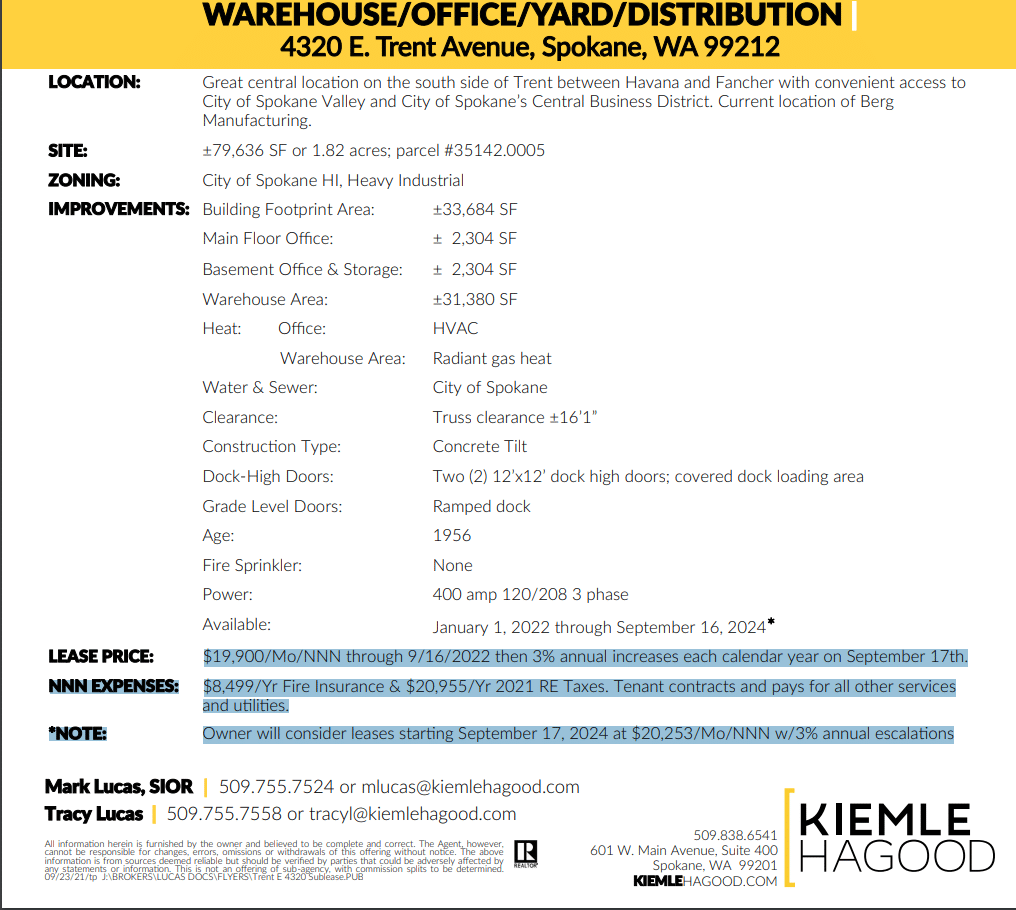
After Stone bought the building, the list price for the lease increased by more than $8,000 per month. When city council members toured the site on April 1, they were handed a Kiemle Hagood flier that was left over from the previous owners, according to then-City Council President Breean Beggs in an interview earlier this year. The old flier listed the lease price around $20,000 per month. After buying the property, Stone listed the building for just over $28,000 per month. The eventual base rate for the lease was $26,100.

Investing in improvements
In her presentation yesterday, Wallace called out investments by private partners in the building as a reason Stone’s lease agreement was a public-private partnership. But, as far as RANGE can tell, the improvements made to the building by Stone, which included insulation and handicap accessible ramps, were spelled out in Exhibit B of the lease agreement signed by the city.
Council Member Zack Zappone said that around the time the final lease was signed in mid-July of 2022 he was given the impression that funding for the building improvements would be donated by Hello For Good, a local community organization which includes Stone on the Steering Committee. Later, Katy Bruya of Washington Trust Bank, who is also on the Hello For Good Steering Committee told Zappone that Stone would be paying for the improvements himself.
An email obtained by RANGE from Bruya to Zappone reads in part, “Mr. Stone graciously offered to pay for the tenant improvements himself, so we redirected our investment fund to other priorities.”
A day later, Perkins, the city administrator, wrote in an email to council members: “The tenant improvements have begun, private investment secured and will be used to complete tenant improvements.”
That these investments have been described as a donation, was confounding to interim City Council President Kinnear. “That was part of a negotiation for the lease — it wasn’t special,” Kinnear said. “I’m puzzled as to how this is different than any other lease.”
RANGE has repeatedly requested interviews with Perkins, who city sources indicate knows the most about the details of the negotiations. Perkins never agreed to an interview despite telling RANGE multiple times that he would.
One way this is clearly different from most leases is that the city is paying nearly $1.5 million of taxpayer money to improve the property.
The reliance of TRAC on portable bathrooms, sinks and shower trailers has created inhumane conditions at the shelter — portable toilets have overflowed and sinks have frozen, leaving guests with no water to wash hands amid communicable disease outbreaks. The portable bathroom facilities are also very expensive to operate, which means replacing them could lead to savings in the future. In order to address these conditions, the city is installing indoor showers and bathrooms in Stone’s building. These are largely infrastructure investments that mostly can not be removed if the city ceases occupying the building, meaning taxpayers are making permanent investments in a privately-owned property.
Council members have expressed their frustration with the arrangement, but said that ultimately the benefit to the guests outweighs the annoyance of spending public money on a private property owner’s building.
As it currently stands, the city is spending millions of public dollars on a shelter that has had significant operational issues and may not remain a shelter in future years. The future of the Trent Shelter, and both Stone and the city’s investment in the property, could especially be in jeopardy if Lisa Brown becomes mayor. Brown has been a frequent critic of the shelter and its financial impact on the city. “The Trent Shelter lease was not a good decision and is not a good decision for the city,” Brown told RANGE. “It’s essentially a money pit.”
The taxpayer dollars flowing into that pit are going to Stone, one of Spokane’s wealthiest and most politically active residents, who’s already heavily invested in the Woodward re-election campaign and the continued public-private partnership at TRAC.
Editor's Note: This story has been updated to clarify that Hello For Good is not a nonprofit.


