

The traffic cone came out of nowhere, tumbling into the lane just a couple of cars in front of the Spokane Fire Department’s Behavioral Response Unit as the team made its way toward an emergency call.
The woman who kicked it walked back to the roadside, unfazed by the honking.
Less than half an hour later, she would once again stroll into oncoming traffic, prompting an emergency call to be made about her as well.
By the time the response unit returned to help her, a car had already clipped her and disappeared. She was still standing, wandering, yelling, with road rash and swelling across her leg.
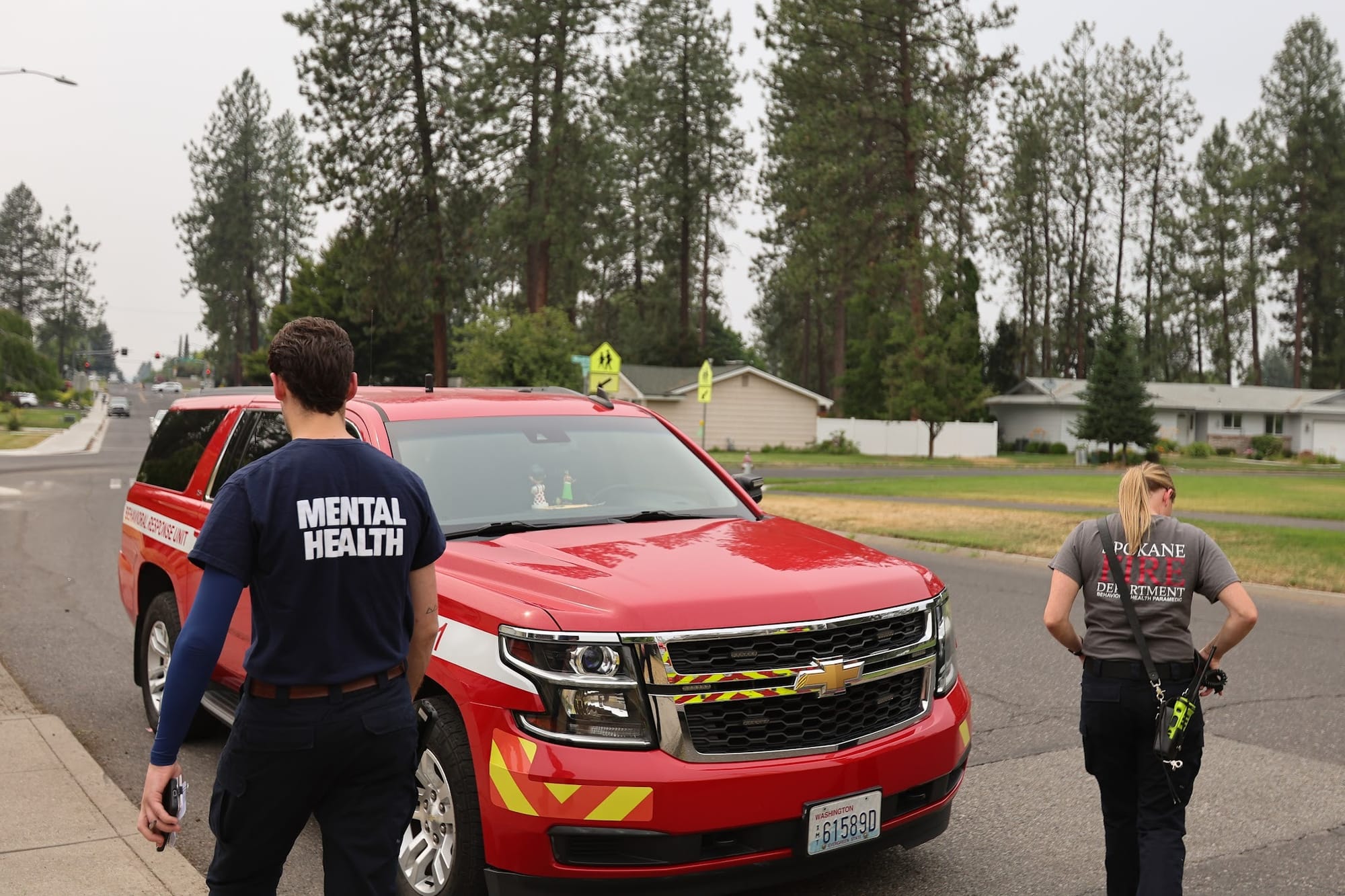
For paramedic Haley Karnitz and mental health professional Joshua Griffin, this is nothing out of the ordinary. They are part of the BRU, a joint program between the fire department and Frontier Behavioral Health dispatched only through 911 to handle behavioral or overdose calls. On July 20, RANGE rode along for their 12-hour shift.
By the day’s end, the team would respond to five calls — with two ending in involuntary transports to the hospital.
A new kind of first responder
Growing up, all Karnitz ever wanted to be was a paramedic.
She realized that dream in 2010 when she started working with Spokane’s American Medical Response. But by this year, she said, she was feeling burnt out in a traditional paramedic role and had seen the need for specialists in the city.
In June, Karnitz became one of the first two paramedics in the fire department hired solely for behavioral health response, which covers everything from mental health crises to substance use disorders. Although she’s technically still on her probationary period, Karnitz is far from new to the game, coming in with over 15 years of first-responder experience.
“These are medical crises for psychiatric patients, and so sometimes they require a lot more attention to detail — and a lot more patience and a lot more time,” Karnitz said.
Griffin, her partner on shift, hopes to eventually become a licensed therapist for first responders, and sees his time on the response unit as preparation for that. He said calls are roughly split between overdoses and behavioral health crises — although lately, he’s seen more of the latter.
The fire department announced an expansion of their joint Behavioral Response Unit program on July 7, adding a mental health professional and the two dedicated paramedics.
According to the press release, the expansion is funded by Spokane County’s mental health sales tax. In 2025, the response unit significantly increased its hours of operation and responded to 979 calls for service. The unit has grown from operating for ten hours five days a week, to now operating six days a week, Monday through Saturday, 9 am to 9 pm.
The unit sees anywhere from six to eight calls a day on average, lasting around half an hour to 45 minutes, Karnitz said, with the eventual goal being 24/7 coverage.
Spokane County Health Officer Francisco Velazquez said the program’s goal of providing other treatment pathways helps alleviate pressure on emergency rooms.
Spokane has seen “a significant increase” in the number of overdoses and emergency medical responses to mental health crises and substance-related disorders, he added.
On the dashboard of the response unit truck, a Big Boy bobblehead nods along with the road. Behind it sits a chart littered with orange stickers, tracking the number of diversions from the emergency room credited to the program. As of that morning, the program’s lifetime total stood at 884.
Prior to the creation of this unit, most of these cases wound up in the emergency room, Velazquez said. However, that was less than ideal, given that there was “no direct tie-in into long-term services” like substance use disorder facilities and other social services.
Diversion placements are smaller facilities, Griffin said, such as Spokane Treatment and Recovery Services or the Spokane Regional Stabilization Center. Diversion placements can mean more individualized attention — other times, it can just be a better environment for a patient, given the sometimes “overwhelming” nature of a hospital setting, he said.
“Especially if someone's already struggling with some mental health or substance use stuff, it has the potential to just really change the experience,” Griffin said. “It can just make them a little bit more receptive to help in the future.”
In Griffin’s opinion, it can change “the overall trajectory of their future.”
How the system decides
If a patient is of sound mind, they have the right to refuse care, Karnitz said. However, that’s not always the case.
“If they are not of sound judgment, are not capable of making a decision for themselves, then we go ahead and make the decision for them,” she said. “And usually, if they can’t make a decision for themselves, the hospital is the right choice because there’s obviously something else going on.”
That authority comes from Washington’s Involuntary Treatment Act.
The law which allows designated crisis responders to detain someone for involuntary treatment if a mental health or substance use disorder makes them a likelihood of harm to themselves, to others or to property — or leaves them “gravely disabled” and unable or unwilling to accept a less restrictive alternative.
“With certain things, law enforcement can issue a transport order, which just means they're required to go to the hospital,” Griffin said. “The hospital then does an in-depth assessment to determine if there's enough there to keep them involuntarily.”
Two of the five calls that the unit tackled on Monday ended that way.
Opening up the truck
Alongside standard medical equipment, the response unit vehicle carries an assortment of unexpected items for patients, including snacks, undergarments and an envelope containing $100 in cash for patients in need.
That money can be used to pay for a patient’s ride somewhere, gas or groceries.
The BRU is one of two teams in the city authorized to give out Suboxone — a combination of buprenorphine and naloxone used to treat opioid addiction — as a strip that goes under the tongue. To Griffin’s knowledge, only the BRU and one other unit in the fire department carry Suboxone, as they need specialized training to administer it.
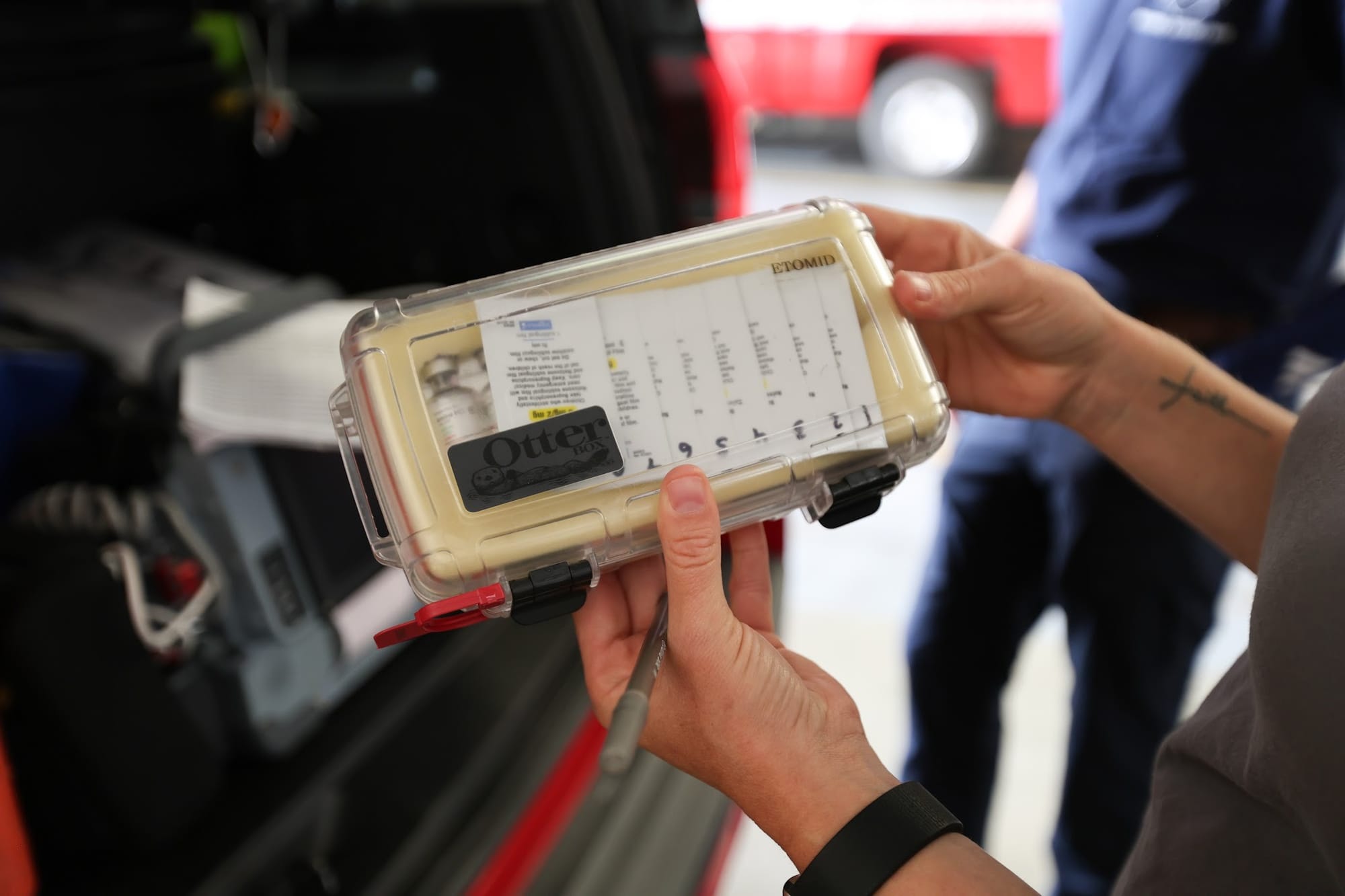
After overdose patients are given Narcan, a drug reversing the effects of an opioid emergency, they often go into withdrawal.
“They usually want to do anything possible to feel better and get the help that they need, so we will offer the Suboxone,” Karnitz said. “What it does is it takes away some of the feelings of the withdrawal because it still has a little bit of that opiate in it, but it also binds closer to those receptors, so it keeps them from overdosing.”
Fire department battalion chief Anne Raven emphasized that the use of Suboxone is not just for post-overdose.
If a person has an opioid disorder and is trying to quit or a patient is suffering withdrawal symptoms with no opioids available to them, the BRU remains a resource.
“They can reach out to 911, and the BRU will come out to treat them for that and will give them the Suboxone," Raven said.
In the time Karnitz has spent at the fire department, she has given out Suboxone twice. Griffin said he has administered it eight times since he joined in late 2025.
Call and response
The first call of the day found a young woman lingering outside a Safeway in a black hoodie, a cut roughly two inches across her cheek and another on her arm. She had given the store her mother’s number. Her mother then called Frontier, who told her to dial 911 for a faster response, Griffin said.
The response unit relieved a fire crew already on scene. The woman declined further help. She told Griffin she had her own plan to meet a Frontier team in the afternoon at the downtown library.
Later in the day, Griffin learned that the patient showed up as promised.
Because there’s only one Behavioral Response Unit in the fire department to serve the entire city, it isn’t always first on scene. However, its goal is to relieve other crews so they can get back into service.
As the unit sat down to family-style lunch at the station with firefighters, utensils halfway to their mouths, the alert sounded again. They didn’t sit back down to their now-cold bowls of chicken and rice until three hours later, after three back-to-back calls.
This time, it was a man dancing, naked. Paramedics and a police officer were already on scene by the time the response unit made it there. When asked his name, the man shouted obscenities instead of answering and was taken to Sacred Heart.
It was on the response unit’s way to this case that it passed the woman throwing a traffic cone, who was eventually involuntarily transported to Deaconess Hospital, given the state of her leg. She resisted cooperating with paramedics, as well as the police, requiring them to handcuff and secure her to an ambulance cot.
Karnitz accompanied the patient in the ambulance because the patient seemed to be willing to develop a rapport and communicate with Karnitz, Griffin noted. The reason they were able to involuntarily transport her, he explained, was because her mental health was precluding her from going and seeking care.
“Not to mention, she’s kind of an imminent danger to herself because she’s running out into the street and seemed like she was doing it intentionally,” Griffin said. “So between those two concerns, they’re able to involuntarily make her go up to the hospital.”
Before the unit headed back to the fire station, it responded to one more call — a young man at an adult group home.
The response unit had crossed paths with this patient before. The week prior, he had called 911 for himself for a heart issue and had thrown his phone at a fire department vehicle hard enough to crack the windshield. The Fire Department requested the BRU after his behavior escalated.
This time, the staff at the group home had called for him, and the BRU was added to the call just in case.
Eventually, he was voluntarily transported to the hospital by a fire crew already on scene.
Shortly after, another call came in — an overdose near Shadle Park. En route, they learned that an off-duty police officer was already on scene and had administered Narcan. The call was canceled.
That most likely meant the patient was refusing further or alternative treatment, or was already being taken to a hospital, Griffin said.
Raven said a key contribution of the Behavioral Response Unit is the ability to keep firefighters and ambulances in service for responding to more typical 911 emergencies. Additionally, the response unit can set patients up with more long-term care, as their training enables them to better address specific behavioral situations.
In her 30 years of being a paramedic, Raven said, she hadn’t realized how long these kinds of calls take, or the amount of conversation and rapport-building that’s involved — unusual for the situations firefighters or paramedics are typically trained to respond to.
“We’re used to moving quickly and making decisions really quickly, and that’s not what these calls need,” Raven said.
A familiar case
The last call of the day, Griffin recognized as soon as he heard the description — his sixth time responding to this particular woman, he estimated. She has a history of self-harm and suicidal ideation documented by Frontier, he said. Just two days earlier, on Saturday, she had threatened suicide by overdose and self-inflicted stabbing.
By the time the BRU reached the food court at River Park North, a paramedic was waiting at the top of the escalator, unable to locate her. Griffin told Karnitz he would be able to spot her in five seconds.
He found her in less.
Griffin immediately spotted the patient in a booth. She had taken a larger dose of her anxiety medication than prescribed, then called Frontier, who dialed 911 for her. She was soon voluntarily transported to the hospital, as she was having trouble staying awake.
The most difficult kind of calls to deal with, Griffin said, are the ones where it’s hard to determine whether the patient actually wants the help. Cases involving children or those who’ve been through treatment services before and are “scared to go through it and have bad experiences again” stand out to him in particular.
“When you see someone again and again and again, but then you maybe run out of other options to try, sometimes you’re stuck with doing the same thing and things aren’t necessarily changing,” he said. “It’s a question of: Is it us? Is it them? What needs to change for them to actually improve?”


