

Nearly a week after the fires roared through northwest Spokane on August 1, Justin De Ruyter’s lungs still hurt. Every time he comes back from fighting the Spokane fires, his eyes water. His clothes stink. His skin and hair are caked in an oily residue.
“I'm sweating profusely every night, like waking up five, six times,” said De Ruyter, “I can't sleep because these toxins are just flushing.”
De Ruyter, the public information officer for the Spokane Fire Department, was one of many local firefighters trying to stop the Spokane Complex fires from spreading last week.
“I've never been in a situation where I had hours and hours of having to think about survival and work at the same time,” De Ruyter said. "These kind of fires that we had Saturday, you know, less than 1% of firefighters will ever experience an event like that. I don't need another one. I am good. If I never see another one again, I am so fucking good."
Fighting forest fires is one thing. When the woods burn, it’s wood that burns. But when a fire sweeps through neighborhoods, devouring houses, the smoke is “so much fucking worse than just a forest fire,” De Ruyter said.
“What's in there? Who knows what's in there, dude?” De Ruyter said. “We don't even know all the gases that are in there.”
Homes are covered with plastic siding and filled with heavy metals. Their garages may have electric cars with lithium batteries. All these materials give off horrible gases when they burn. And even after the smoke is gone, the “nasty, nasty” dust remains.
“If we could test it and show people under a microscope what's in there, like, you wouldn't go in there without a hazmat suit,” De Ruyter said.
De Ruyter is proud of his part in saving part of his city. But he also knows he might be paying the cost for a very long time. Firefighters are significantly more likely to die of cancer.
“I just watched a bunch of my buddies die of cancer and battle cancer,” De Ruyter said. “Young guys too.”
But a shot at treatment arrived on Sunday, intended to try to dull the impact of carcinogenic toxins and reduce cancer risk.
That morning, the air remained thick and acrid outside the Spokane Complex Fire Command center in the Spokane fairgrounds. Amid the hundreds of tents providing shelter for hundreds of firefighters, a white medical tent houses a California-based crew with the Volunteer Firefighter Foundation and the Integrative Healing Action Network.
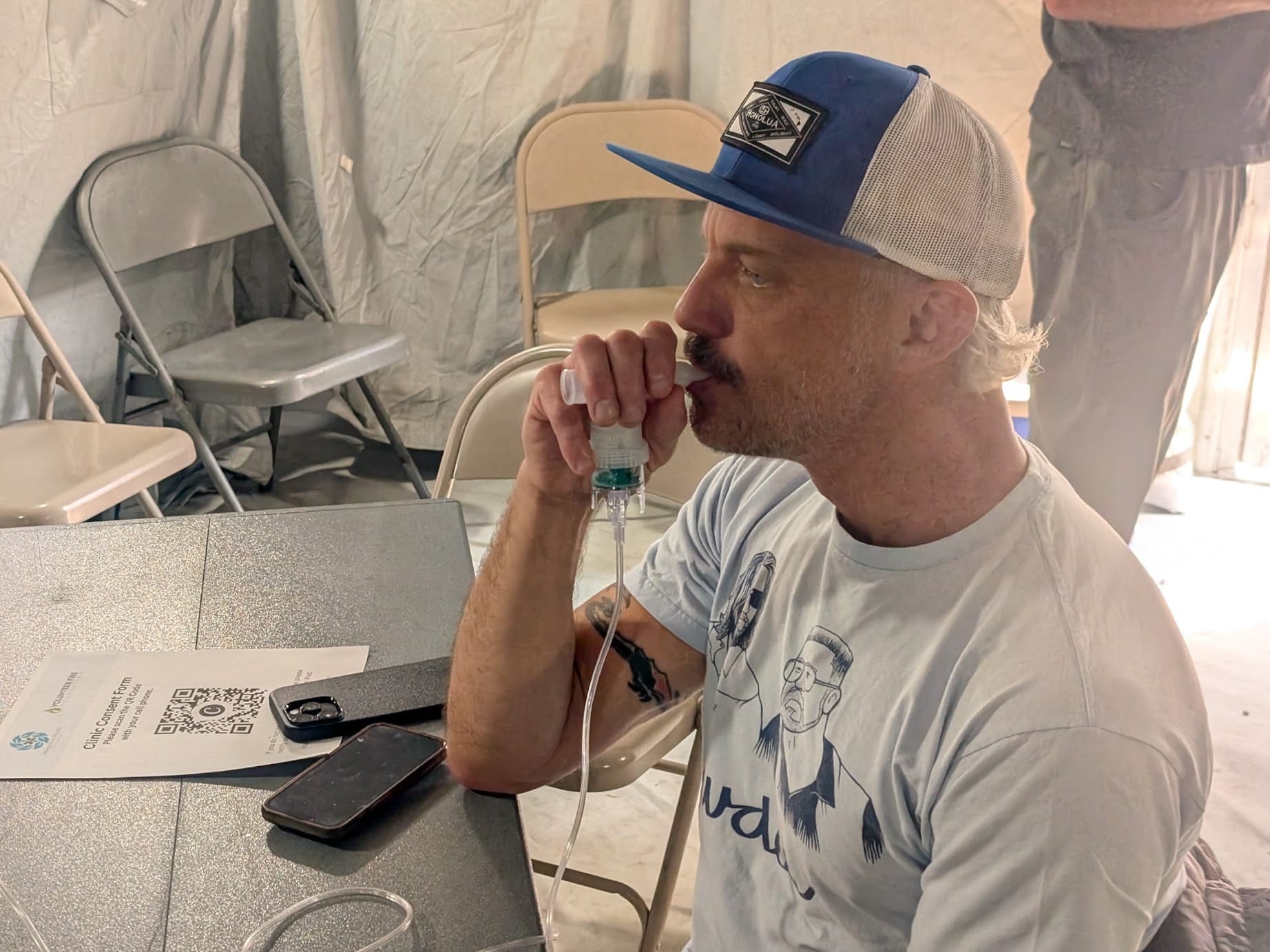
Inside, De Ruyter was breathing a potential treatment through a nebulizer, a device that looks like a medical version of a hookah. The treatment starts with acupuncture, before moving onto a nebulization of glutathione, a chemical naturally produced by the liver that protects blood cells and flushes out toxins. The nebulization targets the lungs, while the firefighters get IV injections of glutathione to treat the rest of the body.
There remains debate over how well this works — even staunch advocates readily say that their “groundbreaking” treatment needs more clinical research to prove its effectiveness — but firefighters like De Ruyter are eager to try anything with a decent shot at making them feel better.
“I feel hijacked,” De Ruyter said. “I want it out. I want this out. I want it out of my system so bad.”
Forged in fire
To some on the California Interagency Incident Management Team, the national squad of federal, state and firefighters who have been leading the battle against Spokane’s fires, this kind of detox protocol isn’t new.
Jaqui Jorgensen, the director of the Volunteer Firefighter Foundation, says they’ve treated both the medical lead and the incident commander in the wake of the California fires in Pasadena and Santa Rosa.
“They saw their brothers and sisters out there getting treated and feeling better,” Jorgensen said. “For them, it's like, ‘it's a no-brainer.’"
The Volunteer Firefighter Foundation and the Integrative Healers Action Network formed in response to the series of fires that swept through Sonoma County in California between 2017 and 2020.
"Tragedy has this sneaky way of galvanizing people," Jorgensen said.
Naturopathic oncologist Chris Holder, director of research at Integrative Healers, said they “had a fire rip through our town, thousands of houses burning, very similar to this one,” and showed up to help provide a wide variety of treatments.
Their organization got two years of funding through the Red Cross, Holder said, to continue treating people in the community. In Spokane, they’re focusing first on getting glutathione injections and nebulizations for the front-line firefighters who were exposed to the nastiest stuff.
“We believe that the faster we get this into them and not have [toxins from the fire] settle in their fat for a long time, we can mitigate some of the cancer risk,” said Holder. “Obviously, one treatment or two treatments is not enough with fire this size. .. but the earlier we intervene the better.”
Spokane Fire Chief Tom Williams was among the crop of firefighters breathing in glutathione Sunday morning. He isn’t requiring anyone to participate — and is leaving big decisions around it to the fire union. But he said he wanted to demonstrate that he was willing to try it.
“I hope it helps our folks get healthy. I honestly don't know much about it,” Williams told RANGE. “But leaving this stuff in your system has been proven to not be good."

Further study needed
But there’s a lingering question: does it work?
“I know there's some resistance with some in the International Association of Firefighters,” said Williams. “Some of that might be because it’s new.”
Firefighters can be skeptical when it comes to medical procedures. In 2021, 25 Spokane firefighters were fired for refusing to get a COVID vaccine.
On the one hand, the kind of procedure that De Ruyter and Williams got has been used by naturopaths for decades. There’s plenty of research that suggests promise for this protocol to treat conditions like farmer's lung and cigarette smoking.
Jorgensen said their own internal study produced incredible results, with “significant decreases in every category of toxins.” But it wasn’t the kind of robust scientific study that compared people who did get the treatment with people who didn’t.
“We don't have the millions of dollars it costs to even do a phase one clinical trial,” Jorgensen said. “For us to be able to create real change and a new standard of care for firefighters, clinical research with a university research partner is non-negotiable.”
She says their team hopes to get a partnership to pull off that kind of study. The additional evidence could mean a world of difference: it would mean that glutathione treatments would be covered by more insurance companies and firefighter worker comp plans.
In California, at least, firefighters have fought tooth and nail against proposed pharmacy regulations that would have cut off affordable access to glutathione treatments, arguing that it was vital for their health.
When Mandy Rosenbach, De Ruyter’s wife, learned that the detox team was coming to Spokane, she reached out specifically to make sure they could fit in her husband.
“It’s like you know when an oil spill happens and they come in with the Dove soap and clean the birds,” Rosenbach said.
Watching her husband get treated is a “total relief,” she said. She noted that a healthy long term-care strategy includes mental health support.
“Trauma is a big buzzword in the culture today, but this is truly life and death," Rosenbach said. “One [fire] alone can be traumatic, but seeing it on this level, your brain almost can't comprehend it.”


