

“When I moved up here to Spokane, I had never been exposed to transgender women or people, at all,” Crystal Marché says, telling a bit of her own story of moving to Spokane in the early 2000s as we survey hundreds of years of local queer history.
“We were really poor, and five drag queens slept in one house. So we would go to Molly's, and Molly's was really inexpensive to eat at at the time,” she says. That relative poverty was a bit of fate for Marché and her friends, because it was there they met their people. “And Thursdays, every week, a group of transgender women would meet there. They just wanted to meet up and have camaraderie.”
Marché is the head curator of The Pride History and Remembrance Project — a project she worked on with exhibit archivist Bethany Laird — to connect the camaraderie she felt when she first moved to Spokane with joy on display at this past weekends pride and back to a history that predates the colonization of the Americas.
Prior to working on the project, both organizers had learned bits and pieces of recent 2SLGBTQIA+ history from members of the local community, but it often came without a comprehensive, historical look at queer life in the city.
For Marché, these informal history lessons looked like meals with local transgender women at downtown diners, where food was inexpensive and served with a side of advice. Laird’s education, on the other hand, took the form of what they called, “all the queer extracurriculars,” from Queer Comedy Nights to “Queer Craft Club meet-ups.
Marché, a local drag performer, found that elders within the queer community imparted their lived experiences to her and others as kernels of knowledge that not only bonded a community, but also educated young people.
She realized, though, that these histories could only travel so far when whispered over a dinner table. She wanted to take those stories and weave them into a more formal historical narrative.
“My elders tell stories. And so I’ve learned all of these deeply nuanced stories from all these wonderful people,” Marché said. “They can tell you about things that many of us never even knew about the struggles and what it was like to take up space in a time when we really didn’t take up space.”
As Marche and other organizers assembled the exhibit, they began to view each poster, ball gown and photograph as heirlooms passed down from relatives and friends in the local queer community. The displayed objects represented a familial connection to Marché that queer folks often can’t access elsewhere.
“Our queer community becomes our families,” Marché said. “Heteronormative people can do genealogy all the time. We can’t. And that’s what this is ultimately about.”
Finding a way to articulate the nuance of Spokane’s queer history in an exhibit intended for a general audience was not easy. Marché said she felt “trepidation” when considering questions about who should collect and display this history.
“This project has been started five times before, and it’s never been finished because it’s so nuanced,” Marché said. With every event they added to the timeline and every table they decorated with treasured objects, Marché and Laird unearthed stories that fleshed out their understanding of what queer life in Spokane had looked like. Many challenged their expectations.
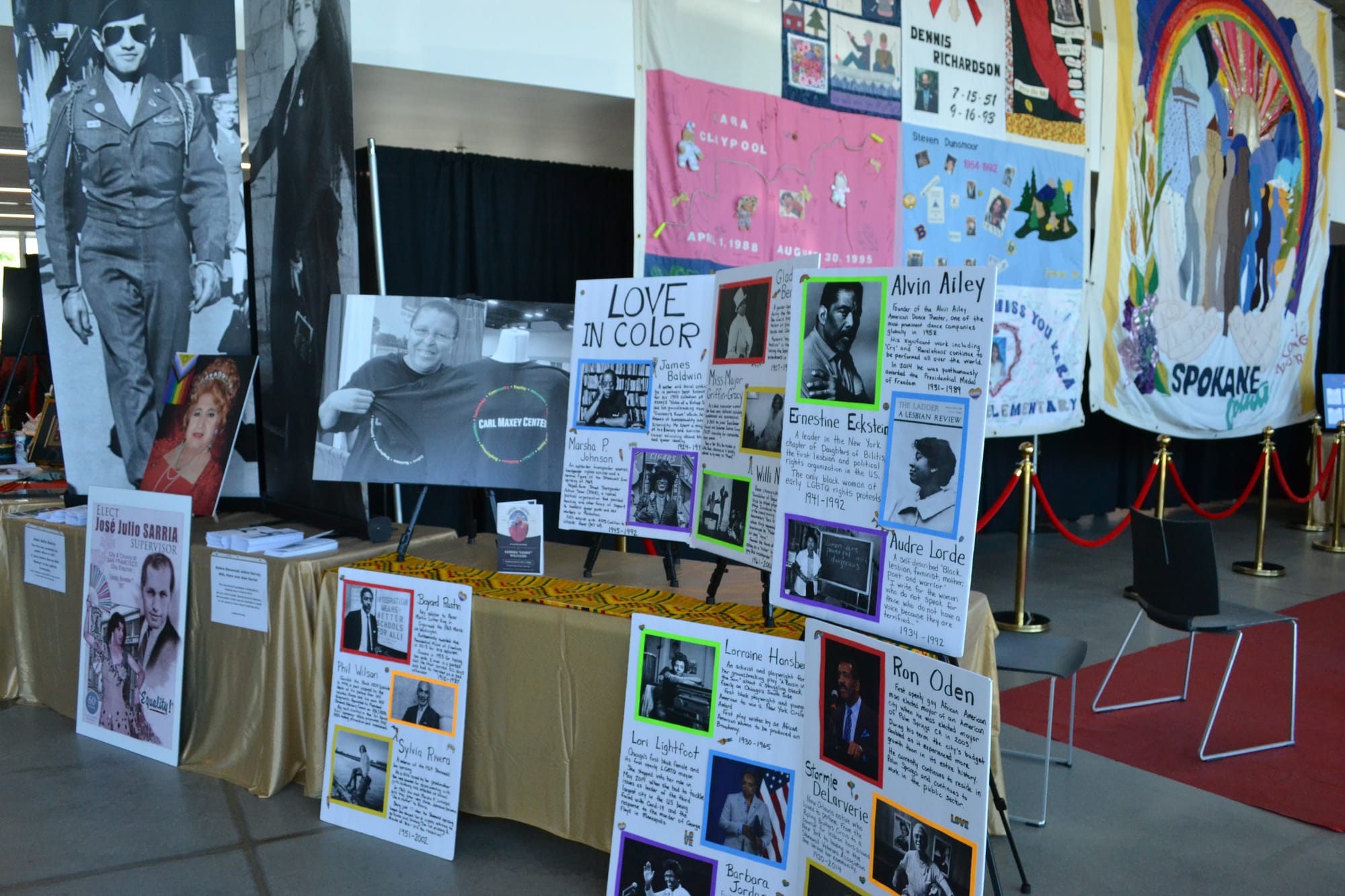
“I was just surprised every day by what I was finding because I was under the impression that the queer community was relatively new. And that’s just not the fact,” Laird, who recently came out, said. “We had a robust queer community in the early 2000s, and five gay bars and tons of clubs and gay parenting support groups and churches that were openly accepting. I was surprised to see the wide acceptance.”
But there were bitter notes to uncovering this broad history. Laird and Marché were frustrated by the feeling that queer people’s lived experience was struck from the historical record of the Inland Northwest.
“Spokane history has been told, but not in this comprehensive way,” Laird said. “You can’t Google ‘trans legends in Spokane.’ Nothing comes up.”
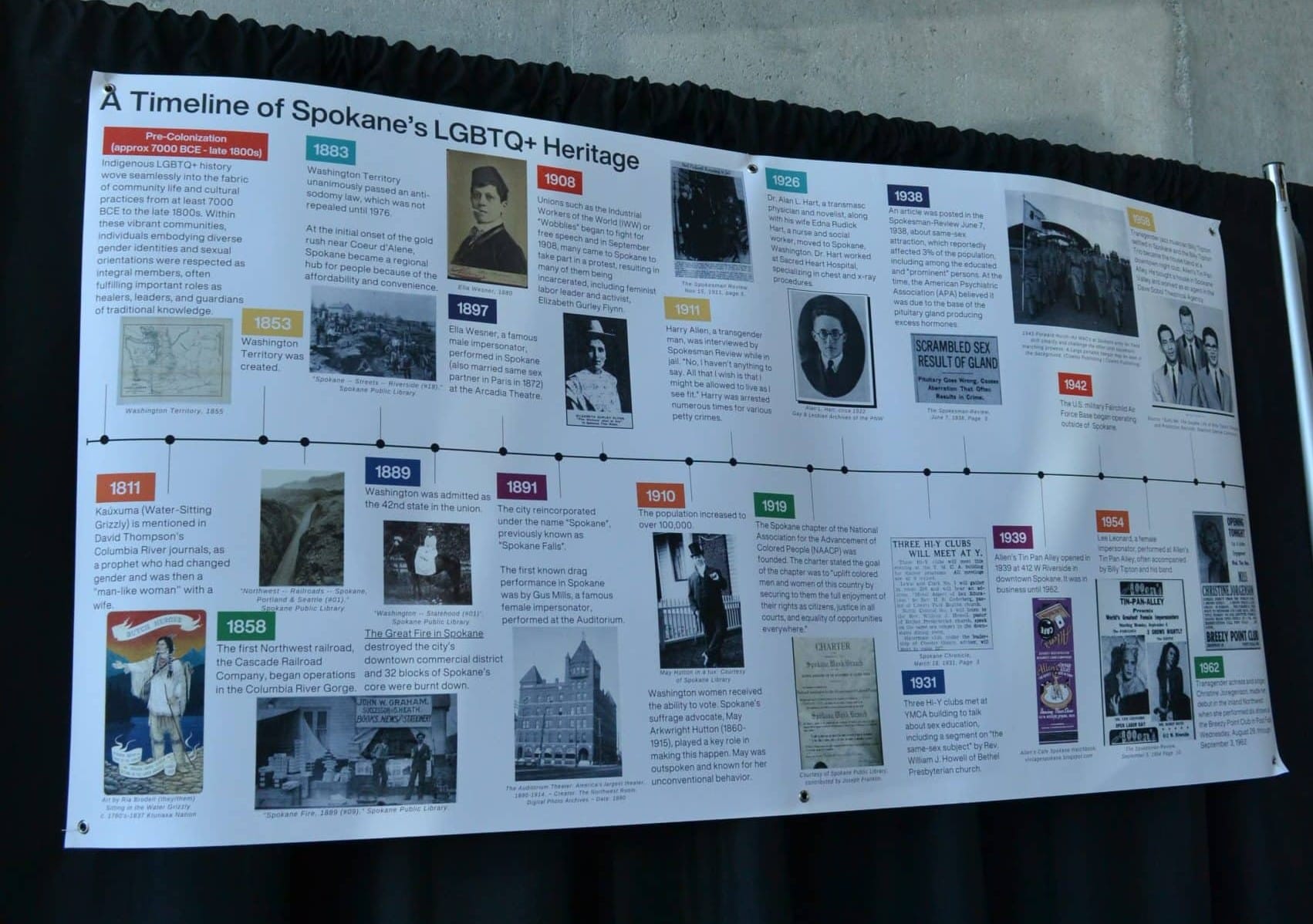
Laird hopes the exhibit, which includes a digital component, will help change that. Both Laird and Marché are optimistic that the project will create a good starting place for future generations to learn and record their own histories.
As Laird spoke with RANGE, a volunteer curator at the exhibit named Corey guided a woman through the exhibit. “We’re gonna start with the sad stuff and then we’ll move to the happy,” Corey said, as he pointed out panels of a quilt dedicated to local AIDS victims.
Laird had personally invited the woman, Annamarie Walsh, to tour the exhibit. Walsh, who is transgender, hoped the project would educate other community members and inspire pride among young, queer people.
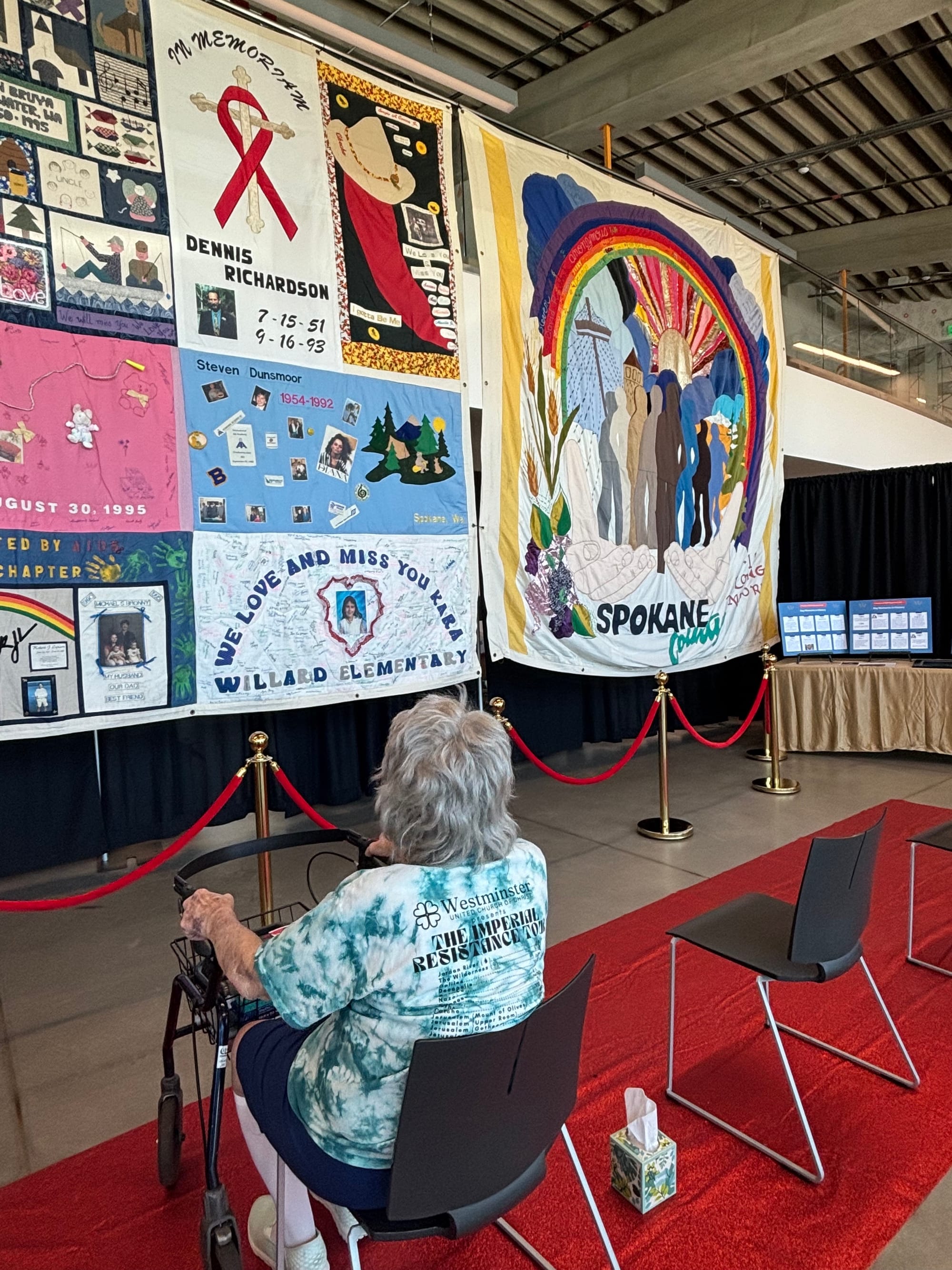
“The only way we can educate people is if we talk about our experiences and how we got started,” Walsh said. A Spokane resident for a dozen years, Walsh transitioned at the age of 55, and lived for decades without the comfort of a queer community to welcome and educate her. That does not stop the 81-year-old from holding herself with pride, though. “I walk down the street like I own it, and I don’t care what anybody else says,” Walsh said. “Words can’t hurt.”
Likewise, Walsh said she refuses to live less than a full life, including having a faith practice. “I’ve talked to people who I know are gay, but they’d always gone to church and been chastised for being gay or being trans, so they didn’t go to church,” she said. “So, I found a church that accepts everybody.” Walsh attends Westminster United Church of Christ on 4th and Washington in Spokane, whose large rose windows — which paint the inside with kaleidoscopic light — match the rainbow-colored sign outside that reads “Open and affirming.”
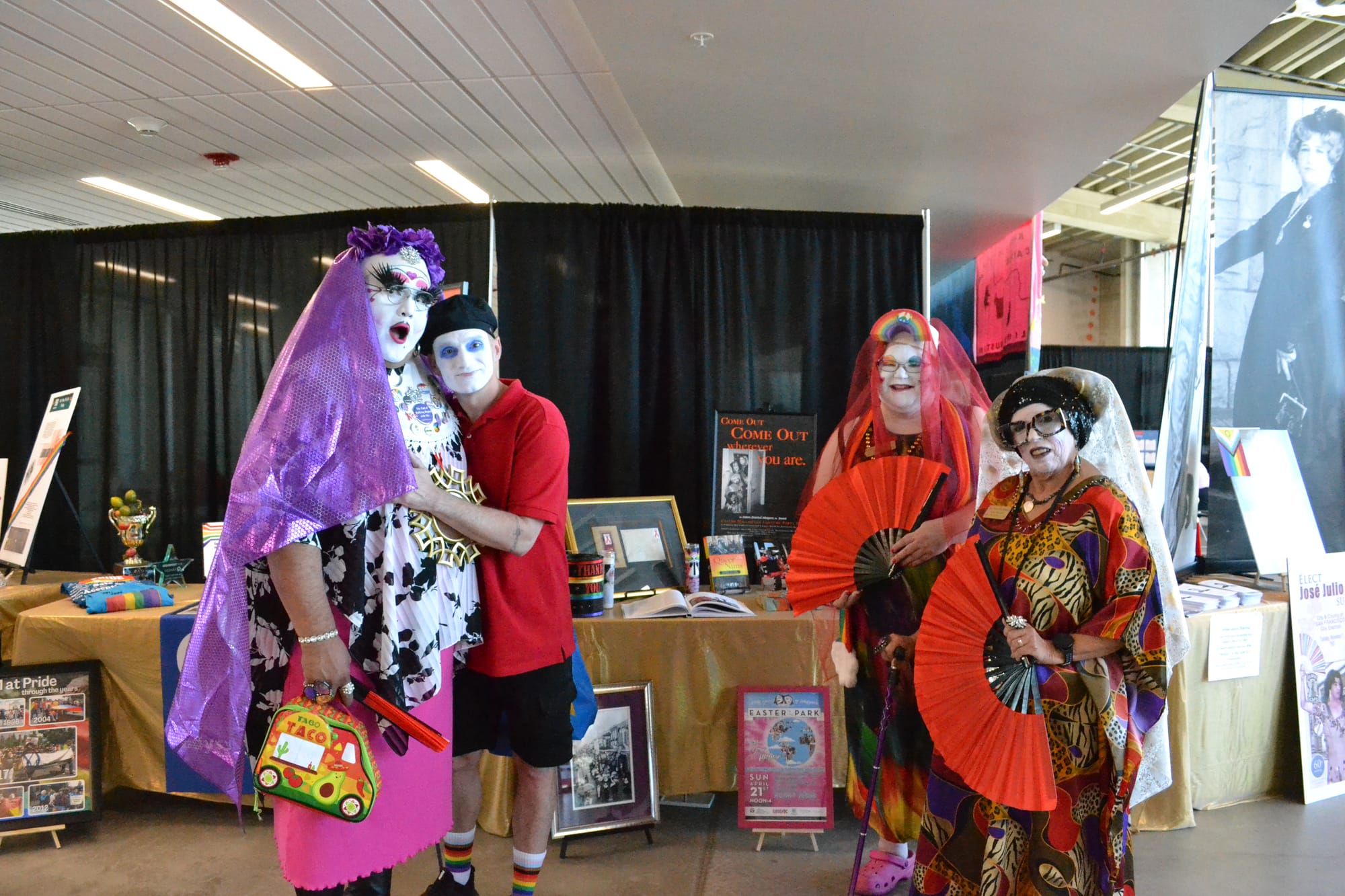
Walsh wasn’t the only visitor bringing a bit of religious pageantry to the Pride History and Remembrance Project when RANGE toured. Spokane’s newest nuns, the Spokane Falls Sisters of Perpetual Indulgence, had a table in the exhibit to showcase the organization’s history.
Sisters of Perpetual Indulgence began in San Francisco in 1979, and have since promoted their mission to “promulgate universal joy and expiate stigmatic guilt” to branches in the US and abroad. The Spokane sisters are among the newest converts. While they aren’t Catholic, they wear customary tulle habits. The sisterhood requires each new branch to complete a number of good deeds to create a local mission and qualify for abbey status. Helping establish this exhibit was one of those good deeds, and the Spokane Falls Sisters were granted their mission house status before opening Abbey of the Children of the Sun in March.
Unique to other SPI branches, Sisters Anita Selma Tacos, Reign BoDacious, Guard Duke Kendoit and Faegala Tina Pfischzoot have focused their outreach on recovery from drugs and alcohol, and volunteered to prepare the exhibit as part of their community service. The sisterhood of four aims to relieve some of the shame that Walsh has seen in queer people who feel rejected by major religions and contribute to the future of queer history in Spokane.
The Pride History and Remembrance Project has created a new historical record — one that recognizes the influence queer people had on Spokane’s past and cements 2SLGBTQIA+ voices in the city’s history. Marché and Laird also plan on adding to the collection in the future, and although the physical exhibit is now closed, neither see the project as complete.
“This project will last forever in perpetuity. I really love that word,” Marché said. “It means forever.”


