

Evan Burnette chose the name “Evan” for himself years before he told his family.
In sixth grade, he realized he didn’t like the name he was given at birth. He didn’t want to be a girl, he said. Being perceived that way made him uncomfortable. So he started writing the name “Evan” on all his school papers.
His teachers and peers kept his secret, giving him time to ease into his new self.
It ended up being a school paper that outed him anyway. Three years after he first signed his homework with a new name, Burnette’s uncle had noticed it on a piece of homework when the family gathered around the fire to burn old documents.
Having that extra few years though, was important. If his teachers had told his family immediately, Burnette said, “It would have deterred me from trying to figure out who I was.”
Though he said he finds the ballot language a little confusing and hard to parse, Burnette — a 17-year-old with Sharpie drawings on his arms and rubber bracelets stacked on his wrists — has concerns about Initiative Measure No. IL26-001.
Colloquially known as the Parent’s Bill of Rights, the measure would repeal Democrat-backed amendments to laws governing what medical and mental health information schools must disclose to parents. Millions of dollars have poured into the statewide debate, but while most high school students remain too young to vote, they are the ones who could lose some privacy should the measure pass.
What’s old is new again
In 2024, the Washington State Legislature passed a citizen initiative drafted by Let’s Go Washington — the conservative PAC sponsored by multimillionaire Brian Heywood — that required public schools to make materials like textbooks, curriculum and medical records more readily available to parents for review. The initiative also let parents opt their students out of assignments and activities that included questions about students’ sexuality, gender, political or moral beliefs.
The following year, the Legislature amended the text of that 2024 initiative, citing confusion from local school districts during the implementation and a need to close loopholes that could be interpreted as requiring teachers or counselors to out queer students to their parents.
Those amendments gave school districts more time to respond to requests for curriculum, added a few extra protections to allow parents to opt their students out of more types of activities and rolled back provisions in the initiative that could be interpreted as requiring teachers or counselors to out queer or trans students.
Proponents of the original citizen initiative quickly filed a lawsuit and gathered the signatures necessary to place a measure before voters that would repeal the changes and reinstate the 2024 version of the Parents Bill of Rights.
Here’s how the measure will appear on your ballot:
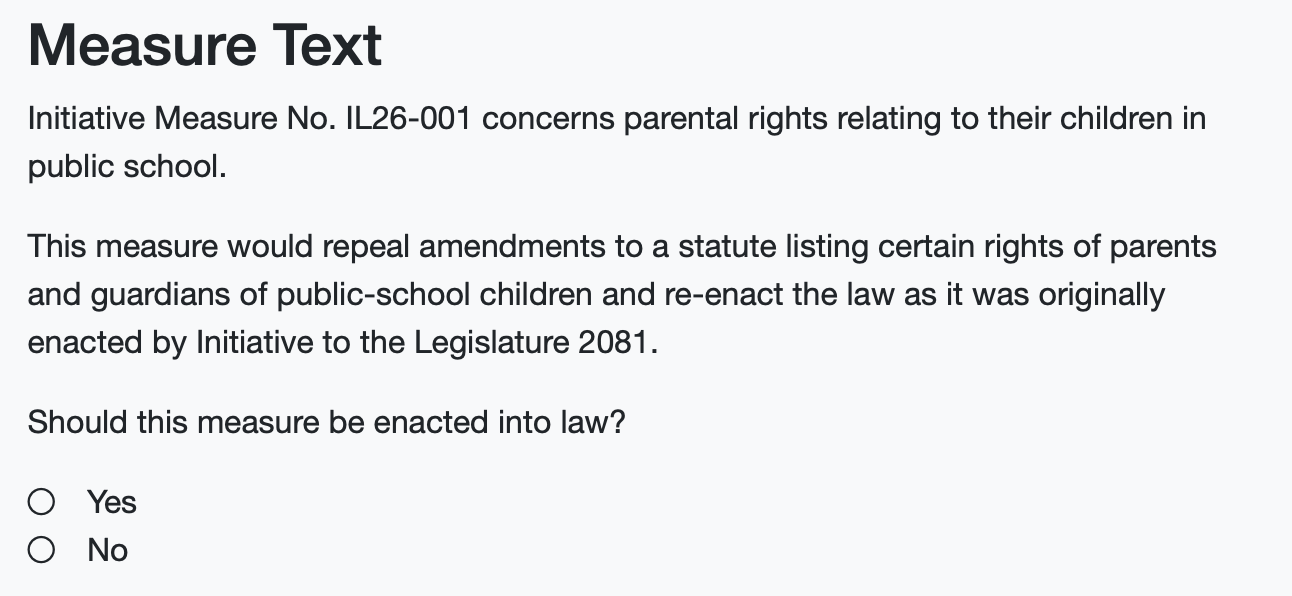
The sticking points
Both versions of the law — what we have now and what we would go back to if the measure passes — are pretty similar.
Both the conservative-backed citizen initiative and the Democrat-supported legislative replacement codified parents’ rights to access academic and attendance records. Both laws required school districts to allow parents to opt out of comprehensive sex education and educational assignments that ask questions about potentially controversial topics. Both laws required schools to notify parents if their students were the victim of crimes on campus.
But a bitter (and expensive) fight is raging over the details where the laws differ.
Proponents of the ballot measure argue that it would give parents broader and faster access to records, more curriculum transparency and more control over their kids’ education.
Opponents argue that if the measure passes, the restored law would discourage students from seeking mental health support, remove privacy protections for child abuse victims and force the the school district to out transgender and queer students.
While language on Let’s Go WA’s website claims the measure “does not require schools to notify parents simply because a student identifies as LGBTQ+,” the ballot statement drafted by six of its supporters implies otherwise, stating that the measure would “support families, not secrecy.”
“Current policies allow schools to withhold critical information when a child expresses a new gender identity at school,” their argument reads. “This undermines the vital parent-child relationship and denies families the opportunity to navigate consequential questions about health and well-being together.”
Conservatives have also argued that students socially transitioning — which can include going by a new name and/or pronouns and changing gender presentation through hair or clothing choices — is a form of medical or mental health care, which would have to be disclosed to their parents should the measure be passed.
The current law at risk of being overturned guarantees parents the rights only to “educational” information about their students, rather than the more broad “medical or health records” and “records of any mental health counseling,” to protect students who seek mental health counseling for exploration of their own gender or sexuality identities.
Key differences between the two versions of the law
What local teens want you to consider
Amidst the media firestorm and the millions of dollars flowing into the campaigns for and against the ballot measures, local students want voters to remember what it was like to be a teenager when they cast their ballots.
Joanne — an 18-year-old recent Mead High School graduate — had little she wanted to hide from her parents, who were very accepting. But now that she’s seeking to become an educator herself, Joanne, who asked to use her first name only to protect her career prospects, said she is thinking about trust.
She said she wants students to be able to confide in her if they are being abused at home. If they feel like she will call home or be required to disclose detailed notes to their parents, it could keep them from talking to her.
“It takes away that trust that students have in their teachers,” she said, “and for some students, that's all they have is their teachers.”
Teens test boundaries. They try things they shouldn’t and experiment to figure out who they are, Burnette said. But he thinks being able to do that in a relatively safe environment and have teachers or counselors to confide in is crucial to development.
“It’s very hard to not have someone respect your autonomy, especially in your teenage years, like early teenage years, because your parents are still trying to teach, treat you like a child, and you don't feel like a child because you're not really, you're not a little baby anymore,” he said. “You have to learn. You can't be sheltered. It feels like someone's looming over your shoulder constantly.”
Liam Hathaway, a 17-year-old whose dyed teal hair matches the color of his braces, said he wants voters to consider potential life-threatening consequences for transgender students who may be outed or feel like they have to go back into the closet, should the measure pass.
Like Burnette, Hathaway came out as trans at school before he came out to his parents. He tested a new name and pronouns with his peers, before bringing it up to his family. Ultimately, they were “very accepting and very supportive,” he said, but he could imagine that moment going differently if it had been initiated by his teachers or counselors.
“ For a lot of students, school is a safety net. It's a way for people to experiment of, ‘Is this something where this would even fit for me?’” Hathaway said. “ And sometimes it's nothing, and sometimes it blossoms into something, and I think if we were to enact this initiative, it might harm students and their ability to continue exploring and better understand themselves.”
Arthur — “like King Arthur,” he introduced himself — said that while he personally has never told a teacher or counselor something he didn’t want his parents to know, he’s still concerned about the measure.
“It’s a really big breach of privacy,” said Arthur, who asked to use his first name only. “ I understand that parents should be in their kids' lives, but this feels like going a step too far and basically asking the state to require kids to tell their parents a lot of things that they might not feel comfortable with or might not fully understand yet and are just trying out.”
At 17 years old, Arthur won’t be able to vote in the election either. He hopes that adults remember what it was like to be young and have their own secrets.
“People should try and put themselves in the kids' shoes,” Arthur said, “because I know for a fact almost every single one of the people who are saying ‘I should know, I'm their parent,’ are also people who withheld information from their parents because they weren't ready to tell them.”
 RANGE
RANGE
Find all our election coverage here!


