

On a cold Sunday morning, a group of volunteers in bright yellow vests set up a pop-up tent with condiments, napkins, burritos and signs in a downtown Spokane parking lot. As the sun peeked through the morning haze, the team descended with excitement on a silver SUV filled with fist-sized burritos wrapped in aluminum foil and sealed with the logo for Spokane Community Against Racism (SCAR).
Meeting every Sunday at 8 a.m., Burritos for the People is a volunteer-based program dedicated to making free breakfast burritos for the Spokane community, including a significant number of unhoused people.
Since 2020, the overall houseless population in the city has increased by 13%. In the 2022 annual Point-In-Time Snapshot, the city counted 1,757 people or 1,513 households as homeless. This marks the fifth year with an overall increase to the population.
Meeting the needs of the ever-growing unhoused population in Spokane has generated new enthusiasm for community aid while also creating new challenges for aid groups that formed early on in the pandemic. RANGE caught up with some local organizations that serve the community, especially unhoused people, to learn more about these opportunities and challenges and how more people can get involved.
Burritos for the People
SCAR launched Burritos for The People in May of 2021, drawing inspiration from the Black Panther Party’s Free Breakfast for Children. The program meets every Sunday at 8:30 a.m. at Compassionate Addition Treatment on 168 S Division St.
Burritos for the People is one of several programs serving Spokane’s unhoused population and downtown community.
Conceptualized by Scott Mueller, who works on SCAR’s steering committee, and coordinated by SCAR Operations Director Justice Forral, SCAR has made and distributed 25,000 burritos as of April 23.
“A lot of it is about engaging with the community, so having a few folks around just to talk to folks and say hi — that sort of thing,” Mueller said. “We get extremely good vibes from the community from everyone who participates — someone who drives by and lucks out on a morning where they maybe didn’t grab breakfast to the people who depend on it on a weekly basis.”
SCAR Operations Director Justice Forral said that they have seen personal growth within the volunteer community as they meet more unhoused community members. For the folks who come from privileged backgrounds, interacting and having conversations with unhoused individuals is a humanizing experience that creates a direct impact on both parties' lives, they said.
Volunteers help out by assisting in various tasks such as prepping, assembling and serving burritos, speaking to and building connections with community members, picking up trash in the area and waving signs.
SCAR’s Burritos for the People meets weekly on Sunday mornings. In addition to people volunteering, organizations can financially sponsor a weekend.
How to get involved
- Burritos for the People volunteers are needed on Sundays at 8 a.m.
- For more information on SCAR events, follow them on Twitter, Instagram and Facebook.
- Sign up for SCAR’s various programs, including Burritos for the People here.
- Donate to money to SCAR here.
Compassionate Addiction Treatment
After experiencing homelessness twice in her lifetime, Hallie Burchinal co-founded Compassionate Addiction Treatment (CAT). With over 70% of the team having experienced homelessness, members of CAT work as substance abuse disorder and certified peer counselors to assist individuals in any way they can, including addiction recovery, employment and housing case management, and medication assisted treatment — where certified peer counselors provide medications such as Suboxone, which reduces withdrawl symptoms and blocks some opioid effects, to assist in addiction recovery.
Burchinal says that systemic oppression has impacted unhoused people significantly, leading to a lack of trust.
“We created a process where there’s an opportunity to build trust, and trust leads to hope,” Burchinal said.
In addition to zero-barrier medical treatment, in-house meals and case management, CAT has also recently begun its Outreach, Advocacy, and Navigation Ignites Transformation (OAN IT) program. This is specifically dedicated to meeting with unhoused people in the county jail and partnering with case managers at the jail to help build trust with unhoused people currently at the county jail.
“We started learning more and more about our systems and gaps, shifting to trying to be really thoughtful and shifting into spaces that we really think we are relevant,” Burchinal said.
Currently, community members can assist CAT by providing tangible resources like simple foods, cooking ingredients, fruits, vegetables, musical instruments and seasonal survival gear (like sunblock in the summer and gloves in the winter).
How to get involved
- Reach out to Hallie Burchinal at HallieB@catspokane.org and Sandy Munck at sandy@catspokane.org to learn more about how to help.
- Resources needed include simple foods, fruits, vegetables, art supplies, musical instruments, sun screen, blankets and water bottles. They can be donated at CAT’s downtown location at 168 S Division St.
- Donate money to CAT here.
Gonzaga University’s Mutual Aid Club
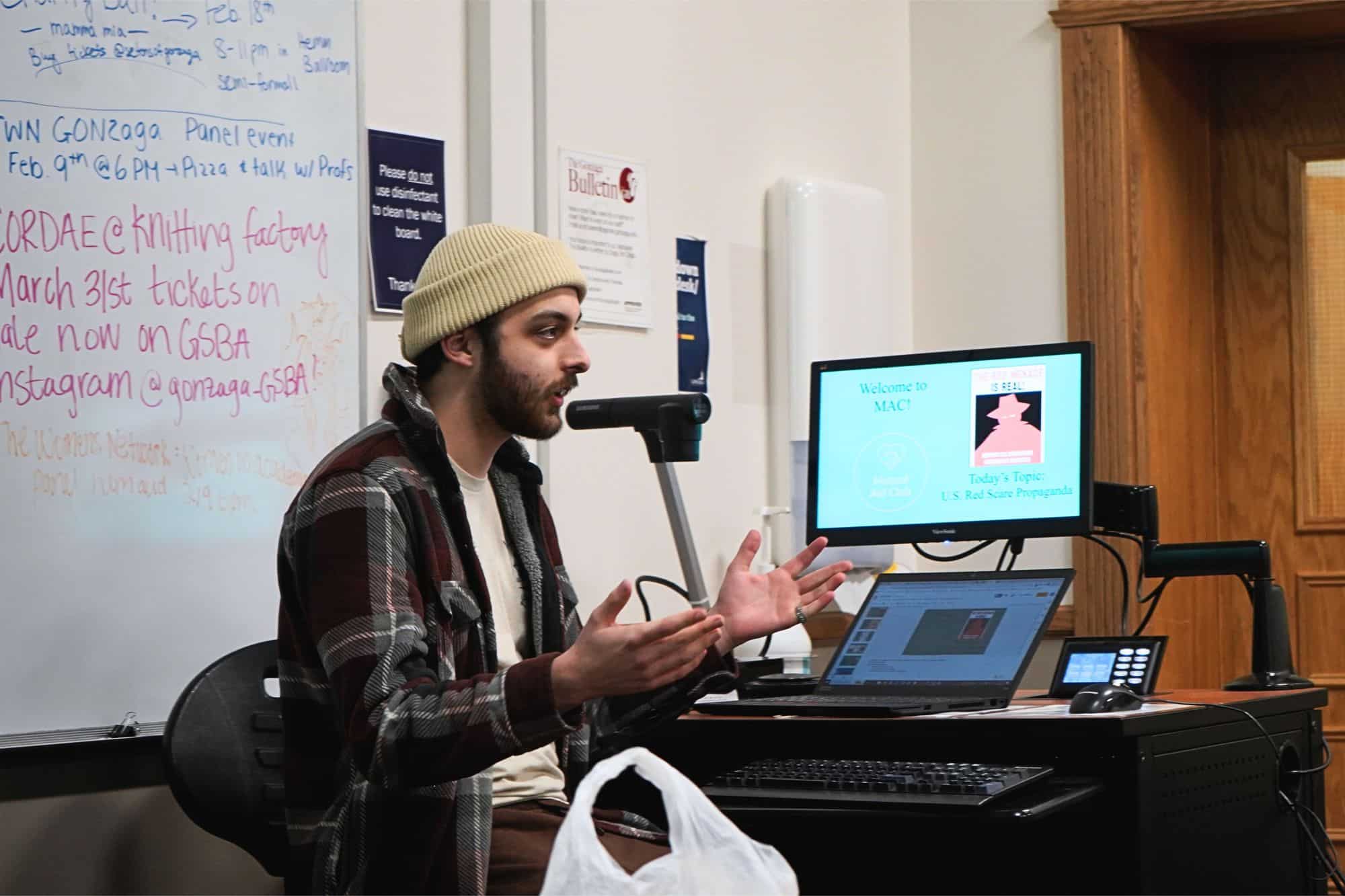
In the spring of 2022, Gonzaga Seniors Anthony Maucione and Haydon Ramirez formed their own Mutual Aid Club (MAC) at the University — the only student-run organization on campus dedicated to providing aid to the Spokane community’s houseless population.
During club meetings, the leaders of the club are focused on cultivating a space of conversation, according to Ramirez. Rather than holding an hour-long lecture, MAC calls attendees to engage with systemic issues and better understand how injustices — such as homelessness — are perpetuated through these systems. MAC tries to educate their members on issues that are not spoken about in the average political science and history lecture hall — such as the shortcomings of civil protest and the history of anti-communist violence in America.
“One thing we try to convey at MAC in our meetings and especially when we go out on outreach is how many of these things are interconnected,” Ramirez said. “We talked about how it’s kind of like a giant machine system — that there are so many interlocking, oppressive institutions and systems that can work together to create this kind of impersonal, soulless apparatus.”
The two became inspired to start their own mutual aid group after a frigid evening in December 2021 working with local aid group, Mutual Aid Survival Squad (MASS).
“I remember when we found a couple cars [with MASS] at various parks around Spokane, just trying to stay warm,” Maucione said. “One person was just talking to us as we’re giving out warm soup, warm cocoa and water to help them stay warm over the night. They were telling us how they did have some water on hand in the jugs, but it all froze over.”
This past winter, the club has been working on helping people during dangerously cold temperatures. Most recently, MAC held a spaghetti drive where students in and out of the club were invited to prepare batches of spaghetti to be delivered to houseless folks across the city.
“When we go out and do outreach, we don’t want it to be a faceless, impersonal transaction,” Ramirez said. “We want it to be a really human connection.”
How to get involved
Activism burnout and the power of joy
Each of these organizations, in their distinct way, works to build community and serve people living on the margins. This work brings common challenges, as volunteers and employees struggle with burnout and constantly fight to bring more resources to community members in need. There’s also common sources of strength that allow people to continue this work in the face of those challenges.
In the Spokane volunteer and activist community, burnout has become a major challenge for individuals and entire aid organizations. “Activism burnout” manifests as fatigue and it is brought on by factors such as overextending oneself and slow, minimal progress amid what can seem like endless structural barriers.
In a 2015 study for the Journal for Human Rights Activists, 68% of interviewees described one of the key factors to their burnout as hopelessness. From being overwhelmed by the issue itself, to lack in numbers, to stagnant progress, burned out activists eventually distanced themselves from their movements altogether to shield their own mental well-being. Fatigue presents a danger to progress because it drains volunteers and activists of necessary energy to participate in community assistance.
“When I’m starting to hit burnout, what I hear happening and see happening in my own behavior is compassion fatigue,” said Hadley Morrow, a Spokane consultant and coach for anti-oppression and belonging work. “I get bitter. I start to feel like, ‘Why am I the only one who is doing this?’ I focus more on my anger towards the city or those who are not acting than the joy of what we are creating and the relationships and mutual respect and love that we build out of this.”
Morrow said activists can prevent burnout by focusing on the joy of their work and seeking moments of happiness in activism that can help reinvigorate community-building and solidarity.
Forral also recommends wellness checks for volunteers to make sure they have someone to process hard moments with.
But beyond recovering from burnout, a way to prevent it is to simply have more hands on deck — whether it be with an already established organization or by meeting needs in your own community.
“What I believe is truly transformational or what really starts to lay the groundwork for more sustainable change is for one, what is your local community?” Morrow said. “‘What strengths do I have to support that local community?’ I often encourage people to start at the neighborhood level, so if you have no idea, start asking your neighbors.”
Forral says that there are many groups that are willing to give advice on where to get started.
“[SCAR] makes it easy to volunteer, join our community groups, and are a helpful resource to get started in activism,” Forral said. “The issues that might be impacting you are probably affecting those around you, sharing stories with your coworkers and classmates is a great way to see what problems you can tackle head-on, sending an email to the right person can get an issue addressed.”
Whether you want to engage in your community as full-time activist or occasional volunteer, Forral recommends building relationships and community with like-minded people in your own sphere of influence to foster support. And within that, have open, honest communication, accept criticism and celebrate small victories.


