

From 2003 to 2017, Spokane City Council Member Paul Dillon was a renter — most of his adult life.
His first apartment was a studio in Cliff Cannon he rented for $345 a month and as a full-time student who could only work part time, it fit his budget. Dillon’s second year on the lease, his rent went up just $5. In the third year, though, it jumped from $350 a month to $475.
“When you’re working part time as a student, having to go to a plasma bank to get extra cash to supplement your income, that is a massive increase,” Dillon said. He had to get another job and still decided to move after finding a cheaper place in Browne’s Addition.
Rents have only climbed since Dillon was in school almost 20 years ago. And with those raises, he told RANGE he has heard “countless stories” like his own — and not everyone was lucky enough to land on their feet like he did.
That experience, along with time Dillon has spent advocating for House Bill 2114 — the statewide rent stabilization bill in the Washington legislature that ultimately failed this past February — spurred him to sponsor a local ordinance that would require landlords to give tenants between 120 and 180 days notice before raising the rent, depending on the size of the increase.
Currently, Spokane landlords are required to give 60 days notice before raising rent — the term set out in state law. If the local ordinance passes, Spokane will be joining 10 other Washington cities in requiring a longer notice period. That list includes places you’d expect like Tacoma and Seattle, but it also includes small cities like Auburn and suburban municipalities like Burien.
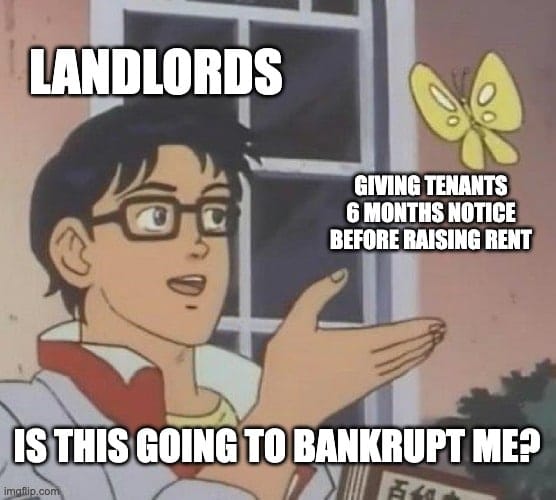
The ordinance will be up for a final vote at the April 29 city council meeting, and had its first reading this week, where it drew criticism from landlords in attendance. Some of that criticism seemed to stem from the belief that the ordinance would impose financial costs on so-called “mom and pop” landlords, a phrase the Spokane Landlord Association uses for landlords who only own a few properties. (Dillon believes the Landlord Association focuses on “mom and pop” landlords as a shield, or diversion to protect larger landlords from scrutiny.)
We were confused — from what RANGE could tell the proposed ordinance had no fees attached, just a required notification period. So we decided to break it down and give you the facts, the fiction and the fears.
What it does - facts
At the basic level, the law would require landlords to give residential tenants written notice 180 days, or six months, before any rent raise above 3% of the total rent, and 120 days, or four months, before any rent raise equal to or below 3%.
That means a landlord would have to give a tenant paying $1,000 a month in rent written, official notice of any rent increase of more than $30 at least six months before the increase became effective. The notice would have to:
- Specify the percentage of the rent increase
- Specify the dollar amount of the increased rent
- Be personally delivered in writing, pursuant to RCW 59.12.040
At Monday’s reading, the landlords who opposed it alleged the law created too much regulation in addition to financially hindering small landlords. Advanced notice goes both ways, though: if a renter knows they’ll have to leave in six months, the landlord has that same amount of time to line up a new tenant.
While the ordinance makes the most sense in the context of yearlong leases, Dillon said month-to-month and six-month leases would still be subject to the increased notice periods. Functionally, this would mean that on the same day a six-month lease was issued, a landlord would have to tell a tenant if they were planning on raising rent by more than 3% in six months. Those on month-to-month leases would also get that same heads-up.
The ordinance also guarantees tenants a “private right to action.” This means that if they believe their landlord has violated this ordinance, they can bring a civil suit against their landlord in Superior Court within three years of the alleged violation. The ordinance states that if they win their case, they “may be awarded reasonable attorneys’ fees and costs, and such other legal and equitable relief as appropriate to remedy the violation including, without limitation, the payment of compensatory damages, a penalty of up to $500, and injunctive relief.” If their landlord is found to be in violation, it also gives the tenant the right to terminate their lease.
What it doesn’t do - fiction
You might notice the above section is pretty slim — that’s because there’s a lot this ordinance doesn’t do. Here’s a speed run of some of the fiction we’ve heard floating around.
- It does not prevent landlords from raising rent. They just need to notify their tenants in the time outlined by the ordinance.
- It does not create a maximum cap for rent increases. Nothing in the ordinance stipulates how much a landlord can or cannot raise rent.
- It does not prevent landlords from setting rents on vacant apartments to whatever they want. So if a tenant vacates, the landlord can immediately advertise any rate they think they can get for that property.
- It does not change the rules for tenants living in subsidized housing where rent is based on a tenant’s income or other specific circumstances. Those leases are still subject to state law, and landlords offering subsidized housing would only need to give 30 days written notice prior to a rent increase of any amount.
- It does not limit the amount of money landlords can charge for security or pet deposits.
- It does not change zoning laws to allow for taller apartment buildings to be constructed (an alternative policy Andrew Rolwes of the Downtown Spokane Partnership proposed to create more housing.)
- It does not prevent landlords from renting to “riskier” tenants, although Steve Wareham from the Inland Northwest Landlord Association said during public comments at the council meeting that he personally would not be taking on “riskier” tenants if the ordinance passes.
- It does not create more housing. The city of Spokane has other policies in place designed to incentivize the creation of high density, low-income housing, like the Multi-Family Housing Tax Exemption.
- It does not violate any state laws about retaliation — at least according to Dillon — even though landlords who testified on Monday said that the section allowing tenants to sue did.
- It does not force “mom and pop” landlords to sell their homes. No language in the ordinance requires that landlords must sell their homes, and doesn’t create new fees that might hinder their ability to maintain profitability. It only requires longer notification times.
What it could do - fears (or threats?)
The boundaries of the ordinance are pretty clear, but how landlords choose to react and how it could impact the housing market are a little murkier.
In the hypothetical future where the ordinance passes, landlords spoke of a fear of financial unpredictability that they’d address by choosing to raise rents whether they needed to or not — they didn’t want to be stuck in a lease where they were losing money for six months. They feared that more “red tape” and increased regulation would incentivize landlords who own fewer properties to sell to corporations who would then jack rent way up anyways. Some of the landlords hypothesized that folks wanting to get around the spirit of the ordinance would simply charge exorbitant deposit fees, since those wouldn’t be subject to regulation.
Tenant advocates have called this kind of concern more of a threat than a fear, like Dream, who spoke at Monday’s city council meeting: “We have heard from a lot of landlords tonight about how this policy and other regulations will force them to hurt renters.”
The takeaway from landlords was that, for whatever reason, they would have to sell some of the properties they owned. Dillon said this could be a reality, but not necessarily a bad one. He said that, after similar legislation went into effect in Seattle, the city saw an increase in home ownership — meaning former renters were able to start building some of the wealth that landlords (and anyone else with a mortgage) benefits from.
On the flipside, tenants at the city council meeting spoke about their current reality: rent is already being raised regularly, and without advance notification those raises are nearly impossible to prepare for. They fear landlords continuing to raise rent, and they too, could be correct. And though home ownership in Seattle has increased since their notification policy in 2021, so have rent prices.
Those rent increases disproportionately impact renters of color. Terri Anderson, Director of the Spokane office of the Tenants Union of Washington, and Interim Director of the whole organization, said at the Monday meeting that, “Renters in Spokane are disproportionately Black and Brown, so it is our communities of color who suffer the most with huge rent increases.”
No one can say for sure what the future holds, but we can definitively say what the current ordinance does and what it doesn’t do.


