

We’re already waist-deep in slop, but the garbage water just keeps rising.
Human writing is, possibly for the first time in more than 5,000 years, facing a genuine threat. In less than a half-decade, generative AI has brought a Gutenberg-sized blow to the way that people write, read and even talk. Distinct voices are merging together into a kind of gray slurry: plodding and stodgy, phony and desperate.
Universal ethical standards have yet to be settled. In the classroom or a newsroom, undisclosed AI writing might result in a flunking or a firing. In the boardroom, failure to use AI in your writing could get you in trouble. Hypocrisy abounds. Some who once righteously decried plagiarism now happily take credit for words they never wrote. Professors who punish students for cheating with AI writing now quietly submit op-eds using AI.
Generative AI hit the mainstream over three years ago, but it’s just in the past year that the amount of AI-generated writing on some areas of the internet risks surpassing the amount written by humans.
It’s not that people necessarily want to read AI writing: In one recent survey across six countries, only about a third of respondents said they’d be okay with AI-written newspaper articles.
The trouble is, few people actually come straight out and admit that they’re using AI as a ghost writer or co-author.
Enter Pangram: marketed as the best AI detector on the market. Pangram goes much deeper than counting an overuse of em-dashes or “it's not x, it's y” constructions. By ferreting out a whole myriad of subtle AI tells with style, word choice and formatting, it can tell the difference between the words of a human and AI writing.
To really understand the ethics of AI writing, we had to understand how it was being used — and how pervasive it had become. So we put Spokane to the test: shoveling roughly a million words of op-eds, newspaper articles, campaign questionnaires and press releases into Pangram’s maw.
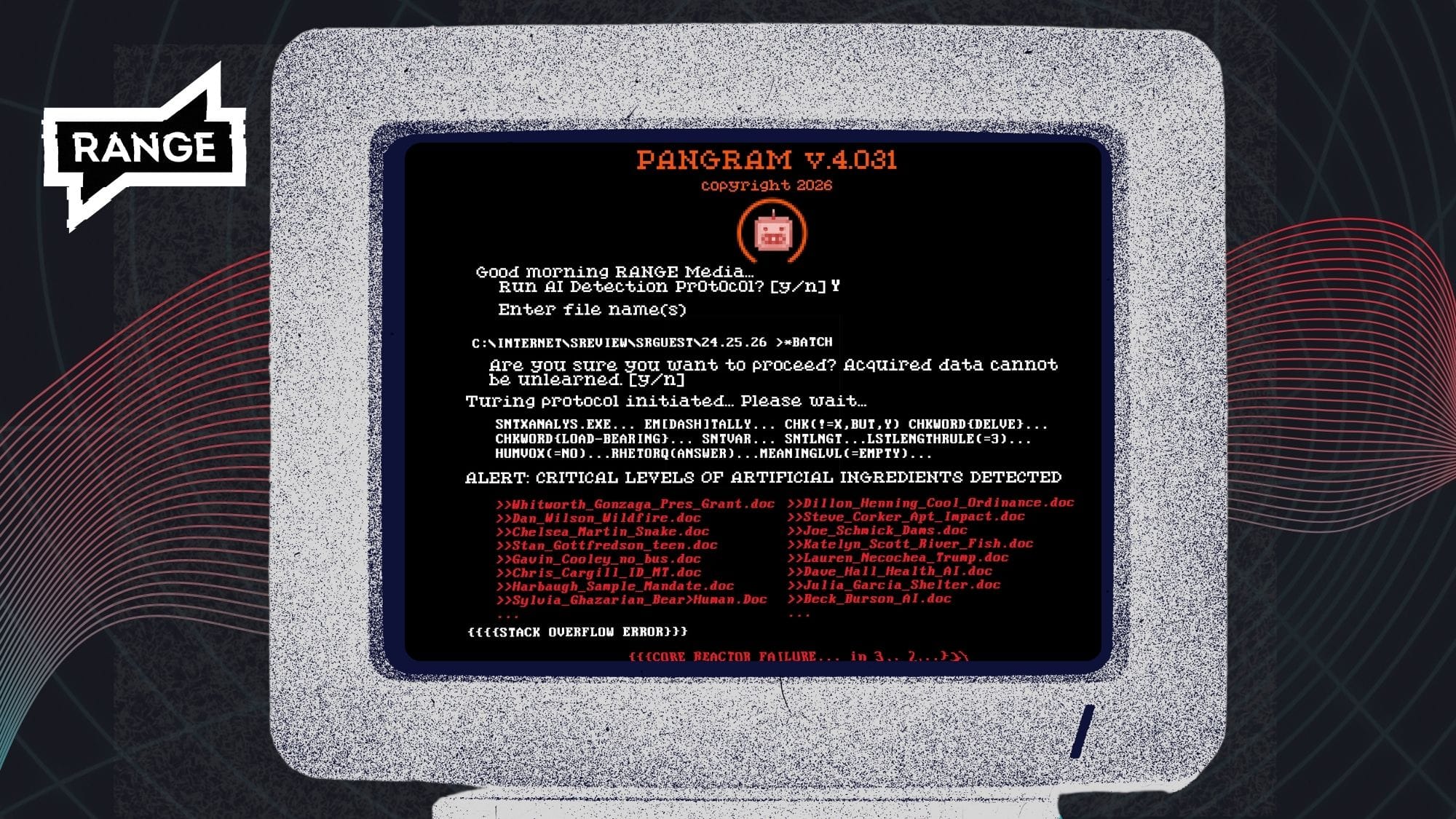
The results were startling. To start with: Pangram suggested that half of the Spokesman-Review guest columns in the past two months were infested with AI writing. It also revealed multiple political candidates appeared to have sent a slew of AI-assisted answers into a RANGE questionnaire — and even more were publishing AI-written paragraphs on their campaign websites. And that’s just the tip of a truly titanic iceberg.
But whether that means anything, of course, depends on whether Pangram actually works. The company talks a big game. Pangram has long claimed that they mistake fully human work for AI once in every 10,000 documents. With their latest model, they upped that number to one in 24,000.
Independent research backed up their claims: A 2025 University of Chicago study, for example, found its accuracy was nearly perfect. Another found it was 97.5% accurate at detecting AI-written essays, with zero false positives. In The Atlantic, a biology professor said that after he used Pangram to catch 60 AI-written student papers, every student but one eventually admitted to using AI.
Most of the people RANGE contacted about Pangram flagging their AI use claimed they only used it for minor edits.
We’re skeptical. In our experience, Pangram typically doesn’t label a light AI copy edit as AI at all.
We tested the tool ourselves. We fed it plenty of our own writing — filled with exactly the kind of overreliance on em-dashes that might trip overly sensitive AI detectors — and we repeatedly came up as human. (For the record, our editors have accused us of overusing em-dashes long before AI was invented). At one moment, a piece by Aaron Hedge on the Spokane Police Department wearing masks set off Pangram’s AI alarm bells — but explicitly only the section that embedded an email from Kevin Hall, Spokane’s police chief.
We then took a few pieces, like a column from RANGE columnist Lauren Pangborn, a recent investigation by Erin Sellers and a 2009-era Daniel Walters rough draft for the Inlander’s College Guide, and gave them AI surgery to see what happened to their Pangram ratings when we let AI mess with them.
But the mild AI revisions, like fixing typos, cutting a few hundred words, or even light rewrites, only budged the detected AI percentage slightly. In some cases, it accurately concluded that part of the document was AI edited, but not “AI generated.”
When we straight-up inserted several-hundred-word AI-written chunks into an article, it flagged the bulk of those chunks as written by AI, but decided the rest of the story was human-written.
Finally, we asked ChatGPT to clean up and complete a messy, half-written version of this intro. It doubled the length, reorganized, rewrote numerous sentences, and added awful passages like “Pangram isn't detecting a magical substance called AI. It is detecting patterns."
But even then Pangram only concluded that 60% of ChatGPT’s version of this piece was AI written.
In order to get to a rating of 100% AI-generated writing, in other words, it’s likely that authors would have had to start with an AI-written draft or let AI do truly radical revisions to remove the humanity.
"Many people who use AI to write … are utterly self-deluded about how much of the work is due to them, and how much to AI," Seth Lazar, leader of the Machine Intelligence and Normative Theory Lab at Johns Hopkins University, wrote recently on social media.
Pangram’s founder is confident enough in his product that he sometimes offers a bounty for false positives: if you can prove you did NOT use AI when Pangram says you did, he’ll pay you $100.
Now, we here at RANGE are canonically opposed to paying $100 if we don’t have to. But if you can prove you used no artificial intelligence for something we reported that Pangram flagged as fully AI-generated, Daniel Walters or Erin Sellers will give you something even more rare and precious: a written apology from a journalist (and an update to the story).
So go ahead, show us your Google Docs version history. We promise to write our apology ourselves. No slop.
*One significant caveat: Pangram relies a lot on the surrounding context, so it’s less reliable when it comes to short passages. If the passage is too short, you can occasionally get very strange results, where slight shifts in formatting, punctuation and even line breaks can spark inaccuracies.
For example, if you check exactly the first two paragraphs — not one, not three — of A Tale of Two Cities, Pangram will incorrectly flag it as partly AI generated, but only if the text doesn’t include spaces between the em-dash. This kind of thing is rare, but it meant that we sought to test longer passages and, ideally, multiple passages from the same author, before jumping to any conclusions.
For more coverage of AI-generated content in your Spokane feeds, click the link below.


