

In a guest column in the Washington State Standard and the Inlander, Gonzaga University president Katia Passerini had a lot to say about how “profoundly AI is reshaping higher education.”
She wrote that Jesuit universities were “uniquely positioned” to meet the “AI-era,” about how the university’s role was “to prepare students not only to build AI systems, but to shape them responsibly.”
“AI is not simply a new productivity tool,” she wrote. “It is a system of encoded human decisions.”
But there was one thing that Passerini didn’t write in her column: that she used AI to help write it for her.
According to Pangram, the best AI detection software on the market, the president of Spokane’s largest private university had submitted “100%” AI-infused writing as her own.
If true, it’s a blatant violation of the Washington State Standard’s prohibition on “stories or commentaries generated by AI.”
It’s not the first time Passerini had published an op-ed rife with AI signals this year: Pangram detected 86% AI writing in the Spokesman-Review column she co-wrote in January with Whitworth president Scott McQuilkin — and Whitworth said the AI didn’t come from them. Gonzaga declined an interview with RANGE. In a human-written statement, the University denied either column from Passerini — “a leader in this new era of AI” — was “AI generated” but acknowledged both were written with help from a “professional writer, who used modern communications tools, including AI tools” to help edit and organize the pieces. Pangram CEO Max Spero told RANGE in a social media reply that a 100% rating means you can fairly say the piece was “largely AI-generated" or, “if you want to be really lenient, ‘significantly AI-assisted’ or ‘contains significant amounts of AI-generated text.’” The tool isn’t perfect, of course. Once in every 10,000 cases, Pangram cautions, it might mistake fully human writing for AI writing. But it keeps improving. The company says the latest version has whittled that number down to one in every 24,000 cases.
So, to be thorough, RANGE ran Passerini’s State Standard column through a slew of weaker AI detectors. WinstonAI, HumaLingo, OriginalityAI and GPTZero. Each detected sprawling amounts of AI prose. TurnItIn, the AI detector embedded into Gonzaga’s course management software, rated the column as over 84% AI. If she had turned it into one of Gonzaga’s classes as a student, it would have violated the university’s own Academic Integrity Policy against undisclosed AI use. The Gonzaga statement insists the university administration's AI use does not “diminish the human thought and creativity of our writers.”
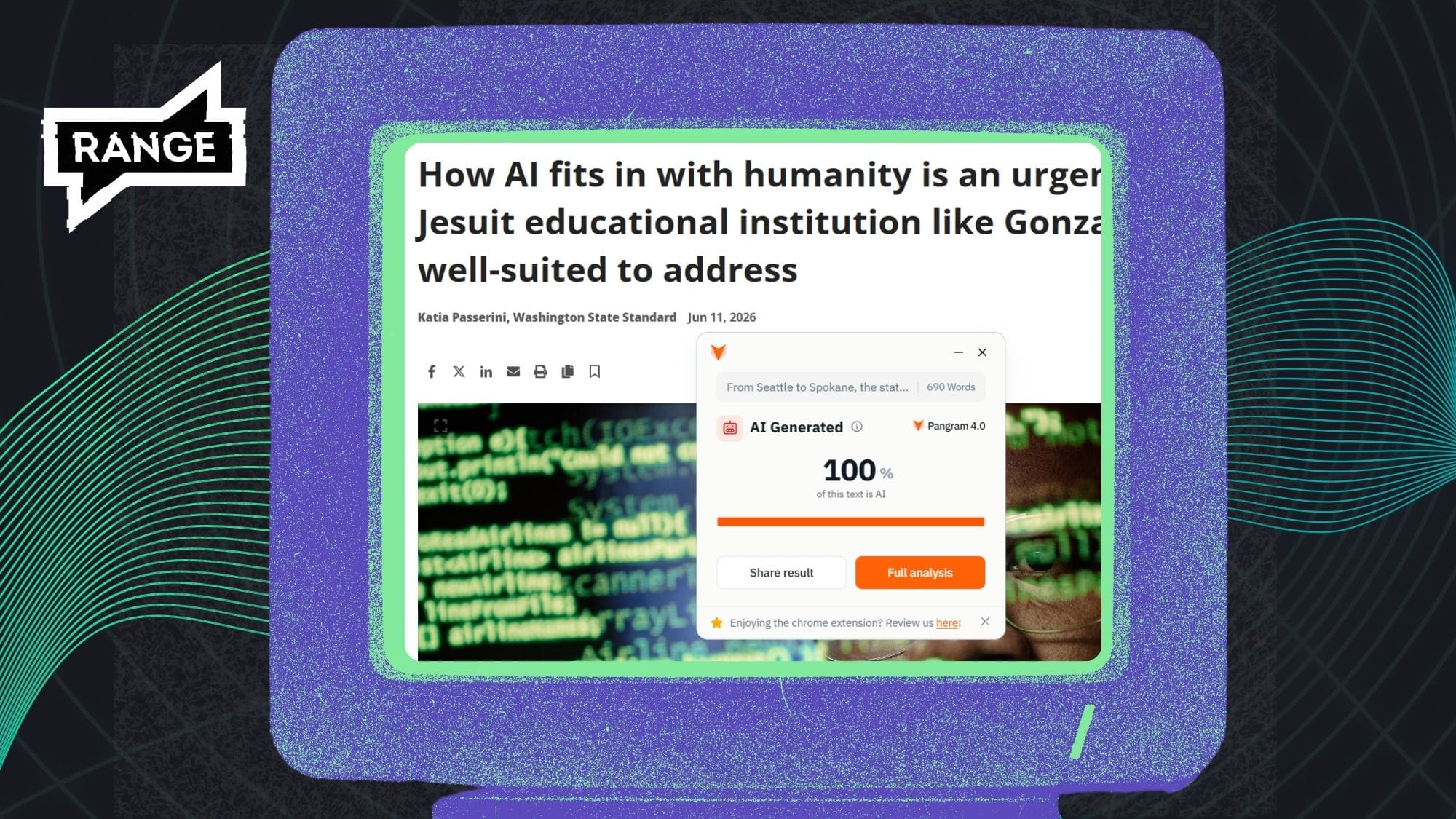
Gonzaga is just part of a larger trend. This month, the Dartmouth student paper exposed a university provost for using the same kind of AI ghostwriting as Gonzaga’s president.
On campus, this is quickly becoming an old kind of controversy.
AI use has already ripped through academia, with some universities taking drastic measures to stop students from delegating every essay to ChatGPT, while others — like Gonzaga and even Harvard — are eagerly embracing machine learning.
Now, AI is rapidly encroaching on new territory: the op-ed page.
The op-ed page has long been a place where guest writers are invited to express their opinions on the pages of daily newspapers. To understand AI writing’s incursion into everyday life, it’s a revealing place to start.
Over the past two weeks, RANGE sent over a million words through Pangram — including every guest column in The Spokesman-Review since 2024 — tracking the rapid rise of AI-written rhetoric. The results are stark: In 2024, The Spokesman’s guest op-ed page was almost untouched by AI. Pangram only flagged two significant incidents of widespread AI use in a column. One of them was from Premera Blue Cross executive David Condon, better known as the former mayor of Spokane.
By 2025, the number of columns containing AI writing had risen to 34. This year there have been 58, and we still have three months to go. As of September 20, roughly half of all Spokesman guest op-eds in the past two months have all shown signs of significant swaths of AI writing.
AI use has rapidly increased on the Spokesman-Review Op-Ed Page.

Data is through September 20, 2026. Columns that Pangram flagged as less than 20% human are categorized as “AI,” while columns between 20% and 80% human are labeled “mixed. Tap or mouseover each bar or search for a specific column to check which category it falls into.
[Tableau interactive data visualization by Daniel Walters]
You can see every AI-assisted column we identified since January 2025 here. These were columns written under bylines of executives, psychologists, politicians, non-profit leaders, doctors and a former two-term mayor. These include AI-riddled columns praising propane school buses, the Snake River dams, HVAC reform and former Vice President Mike Pence. There were AI-infused columns arguing against moving a controversial statue, slashing food stamps, using high-potency 7-hydroxymitragynine products and killing sea lions.
A triple-bylined op-ed announcing the completion of a report for Spokane’s Safe and Healthy Spokane Task Force was rated as fully AI. When RANGE sent the report itself through Pangram, it came back striped with dozens of apparently AI-written passages alternating with dozens of human-written passages.
Three-quarters of the 15 columns written about the Spokane Complex Fires showed signs of being largely written by AI. So did every column with the word “AI” in the headline. The author of a column about why some women trust bears more than men apparently trusted AI enough to help write her column.
And chances are, Pangram probably missed at least one AI-written column amid the pile RANGE fed through it: the company says its software incorrectly labels AI-written documents as human about once in every 300 times.
Many of the authors RANGE contacted downplayed their AI use — sure they had used AI, but it wasn’t fair to call the column “AI-generated.” These were their ideas, after all, they said. The AI just helped them with the structure or the editing or the organization or the writing or the ideas. Some said they wrote the first draft and had AI spruce it up, while others said they had AI synthesize their thoughts and then tweaked the language. Some argued it was a way to level the playing field for disadvantaged writers. Nobody, however, denied that they had used AI at all. The Spokesman’s contributors hadn’t broken any official rules. Unlike the State Standard, The Spokesman lacks an explicit prohibition on AI-generated columns.
Until this week, RANGE had no published standard either, and paid the price: After we ran the candidate questionnaire answers we published during the primary election through Pangram, we found multiple candidates had used AI to craft their answers. (Read our article on that here.)
Both the Inlander and The Spokesman said their own writers aren’t allowed to use text generated by AI, and each paper has been talking internally about putting those prohibitions officially in writing. Spokesman managing editor Lindsey Treffry said that they are looking at establishing AI rules to the guest opinion section as well.
“We are happily considering an AI policy for our guest opinions section, especially after hearing the concerns that RANGE brought to our attention,” Treffry said.
Read RANGE's newly-developed AI policy at the link below.
From one angle, Pangram reveals just how deeply AI-written work has already penetrated into local discourse in Spokane.
But for those worried about this trend, who want to believe that humans can’t — or shouldn’t — be replaced by AI columnists, Pangram offered a way to push back, Spero argued on the Plain English podcast.
“We are trying to save the written word,” Spero said.
More machine than man, now
A few years ago, writers had to actively seek AI out if they wanted extra assistance. Now, temptation is embedded everywhere. AI features pop up in Microsoft Word and Gmail. Grammarly, a spelling and grammar checker, expanded to offer sweeping AI editing advice. A Google search automatically serves up results in AI prose, ready to be copy-and-pasted.
Since late November of 2022, when ChatGPT was officially released, savvy readers began to notice signs of an emerging AI dialect slipping into pieces that had supposedly been written by humans. A flurry of “—” em-dashes: Countless sentences structured like “it’s not x, it’s y.” A strange fondness for the word “delve.”
But since plenty of genuine human writers used “delve” and em-dashes, any accused writer could claim “it’s not AI — it’s my style,” and it was hard to disprove that. AI detector software was prone to making wild errors, like claiming documents written in, say, 1776, were AI-generated.
But then came Pangram. Pangram weaponized AI against itself: It took a massive trove of text written by humans, and then prompted a slew of different AI programs to imitate those texts in their own computer-generated words. It allowed Pangram to delve into the infinite infinitesimal differences between human writing and AI — sentence length, structure, spacing and punctuation, and the frequency of certain words. Alone, no single indicator was absolute proof. But by combining all those subtle whispers together across hundreds of words, Pangram could predict, with startling accuracy, how thoroughly AI had been used to create a piece.
To the delight of some and horror of others, the facade had been yanked away. It was a little like the kingdom from The Emperor’s New Clothes had just gotten a nudity detector. Pangram’s research revealed that over 40% of the long posts on LinkedIn had AI writing, and nearly half of all press releases.
Authors, journalists and newspaper columnists were exposed as having put their name on work they didn’t write. When a column by billionaire Stanley Druckenmiller in The Wall Street Journal was revealed as AI, the billionaire was unapologetic.
"There's a reason I moved from an English major to being an economics major,” he said. The newspaper rose to his defense. “AI is a fact of modern life," Wall Street Journal opinion editor Paul Gigot wrote in a statement. "The question for us is whether what we publish from contributors reflects an author's original argument, and if the author has the standing and credibility to make it."
Yet many traditional reporters were aghast: National Public Radio media correspondent David Folkenflik argued that one way to ruin the Journal’s sterling reputation “pretty quickly is to suggest any piece could have been generated by the same algorithms that create unicorn pictures on WhatsApp's AI.”
When a writer for Semafor ran the op-eds in prestigious publications like The New York Times and The Washington Post through Pangram, it flagged roughly 10% of the op-eds. But the percentages at a local paper like The Spokesman — which typically have fewer resources to scrutinize guest columnists than a large national paper — are likely to be far higher.

AI prose on The Spokesman op-ed page is two-and-a-half times more common this year than it was last year, and it keeps growing. The first four months of 2026 only had three columns with apparent AI assistance. The most recent four months had 25.
To Treffry, The Spokesman’s managing editor, that’s a problem.
“The point of an opinion page is to get the opinions of people in our community,” she said. “If AI is producing an opinion for a member of our community, I don’t think that’s genuine.”
Spokane City Council Member Paul Dillon argued that a declaration that you’re not submitting columns written by artificial intelligence “has to be the norm for any newspaper in this country.”
ChatGPT-written prose, he said, flattens distinctions between voices, leading to “much blander, less personal, detached content.”
“If you are a subscriber to the Spokesman-Review and you're paying for those words, that's an issue,” Dillon said.
Et tu, GPT?
Dillon has a deep philosophical opposition to AI.
“Every day we're under the deluge of some new warning about AI, some 25-year-old tech bro going, ‘it's actually worse than you think,’” Dillon said. “It's just overwhelming … this feeling of losing the grip on humanity.”
As a former columnist himself, Dillon finds AI writing particularly offensive.
“The idea of putting anything on paper that did not come directly from my heart, my brain, my hand” is a line he refuses to cross, he said.
Plenty of Dillon’s political critics, however, appear to have embraced the tool. When he introduced an ordinance to mandate landlords provide “adequate cooling” to tenants, former Spokane City Council Member Steve Corker wrote a column that “an ordinance that shrinks housing availability does not protect vulnerable residents — it displaces them.” But AI did most of Corker’s writing, according to Pangram.
Pangram came to a similar conclusion about another column critiquing the ordinance from Black Realty Management president Kim Sample and Downtown Spokane Partnership board chair Dana Harbaugh in The Spokesman: 94% of the piece contained AI writing, Pangram concluded.
And yet, Dillon’s own op-ed on the issue, co-written with Gonzaga environmental studies professor Brian Henning, was also completely AI, Pangram determined. Dillon swore up and down it wasn’t him, and provided the document editing history to prove it. The bulk of the column came from his co-author.
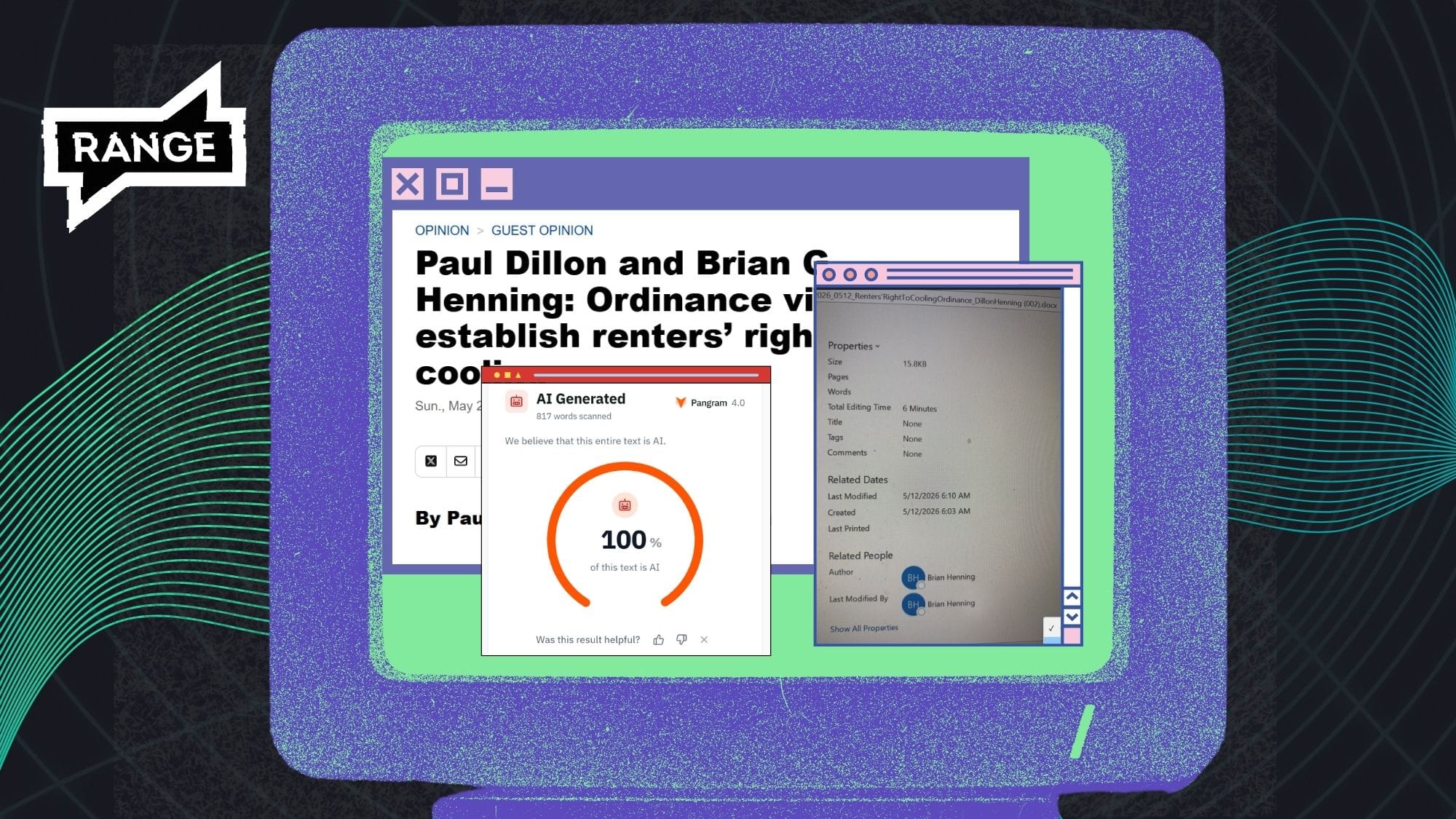
When he inspected the Microsoft Word file that Henning had sent him as the first draft, it showed that Henning had apparently started and finished his draft in only six minutes.
“I asked him very directly if he used AI when he sent that column over to me. There was a long pause,” Dillon said. “And he said, ‘Yes, I did.’”
Dillon said Henning confessed he’d had AI synthesize Henning’s previous writing with the cooling ordinance to generate the column, and apologized profusely. Henning, who teaches three courses on ethics at Gonzaga, did not respond to repeated interview requests from RANGE.
“It’s a very unmoored feeling to catch a stray in this situation,” Dillon said. “Those words being questioned, reality itself being questioned, is really dystopian and depressing to me.”
Impersonal Assistant
Several of the columnists RANGE contacted suggested AI was used to level the playing field, that it allowed inexperienced writers or disadvantaged columnists to compete with everyone else.
“I’m not a professional writer. Other people are,” said Dan Wilson, a back-country advocate who used ChatGPT to assist with his column advocating for protecting roadless wild spaces. “I don’t have a bevy of editors at my disposal to work on the writing.”
Spokane chiropractor Barney Roca, who wrote a column about struggling family farms, said AI was important to compensate for his dyslexia. He uses Grammarly to help catch typos, ChatGPT to record interview notes and help him summarize, and the AI features on Apple’s Writing Tools to help with the prose.
He scoffed at the notion of sanctimoniously rejecting a useful technology, comparing AI to a calculator or a spell check.
“I could have used a pen and paper and scribbled something and sent it off to The Spokesman and hoped that it would be published, or I could use the tools that are available to me,” Roca said. And yet many — even most — of the AI-riddled columns RANGE identified weren’t from disadvantaged or neophyte writers. Many of them were from powerful people with decades of experience. Passerini is a PhD who published over 100 peer-reviewed articles before ChatGPT even existed. She’s perfectly capable of writing — her op-ed in the State Standard was partly based on a much longer piece she’d written without AI at her prior university.
Mountain States Policy Center president Chris Cargill, meanwhile, spent a decade as a TV news producer, and has published opinion pieces for over 15 years. Yet Pangram detected AI prose infused throughout the bulk of his last three columns in The Spokesman.
Premera Blue Cross, a health insurance company for over 2 million customers, has a professional comms team. But that team used AI to help the company’s chief medical officer Romilla Batra write a Spokesman op-ed.
“Dr. Batra, she had a lot of opinions on the subject. What we used AI for was to bring all those ideas together, to not necessarily start with just a blank page,” said Premera spokesperson Eric Trott. “There’s a lot of complexity within healthcare and within the storytelling of healthcare. If we can get it to be clear and simple, then we can take advantage of that.”
With similar reasoning, Zeke Smith, president of the Waters Meet Foundation, processed the draft of his Spokesman op-ed about “Housing First” through ChatGPT. He was trying to get it under the maximum word count. But also, in a way, he wanted to remove some of the humanity from it.
“I wanted to make sure my emotions didn’t get in the way of what I was trying to say,” he said. But he, like several others we talked to, wondered if he should have divulged his use of AI to The Spokesman.
“Would that be a place to say, ‘hey, I used AI writing this, and here's what I did?’”
“We’re wrestling with this inside of our organization — how much are people using AI, and when is it important to disclose it?” he said.
Like Humans Do
Spokane psychiatrist Rebecca Burson has been thinking a lot about what it means to be human in the age of AI, about the kinds of connections and meaning that can’t be computer-generated.
"I actually think that is the central question for the next decade," she told RANGE. She sat on a stool at The Grain Shed, as a live band played in the background, exactly the kind of art that she argues can’t be replaced by artificial intelligence.
That’s why she wrote a Spokesman op-ed about the topic back in April.
When RANGE told her that Pangram concluded that most of her editorial had been written with AI, she acknowledged she used it toward the end of the writing process. She talked about bouncing drafts back and forth between ChatGPT and Claude, about using the AI to refine her thoughts and make the writing faster. She said she didn’t want to look stupid. She felt AI could help her with the “syntax, pacing and word choice.” AI would help her say it better, more concisely. It helped her with what she called “the donkey work.”
If it hadn’t been for AI, she said, it may have taken her five to seven hours longer — and that may have been the difference between publishing and not publishing.
And yet, her husband felt the AI made the article worse. He knew what her writing was really like, she said, and felt the changes sucked away her voice.
It’s exactly the kind of internal battle so many professionals are waging: what part of themselves will they give over to AI?
Burson has her own hard lines, her own sacred spaces where she refuses to invite AI in. She would never want to recommend AI to help with mental health — she’s had too many patients who know parents who’ve lost their children to bots. She wouldn’t want to use AI to transcribe her sessions.
"I feel like there's a sacred act, bearing witness to somebody's story,” Burson said. “To have AI be listening to that creeps me out."
Maybe, if she could go back in time, and do the article all over again, she said, she wouldn’t have used AI.
“If that was my artistic calling, I would want to only write for a place that wouldn't use AI,” she admitted.
Still, she’s deeply proud of parts of what she did write. She said her yoga teacher sent her an email saying that one line in particular made her cry: a phrase about “durable tenderness that can hold pain without turning away.” The AI kept trying to get it to change it. But she held firm.
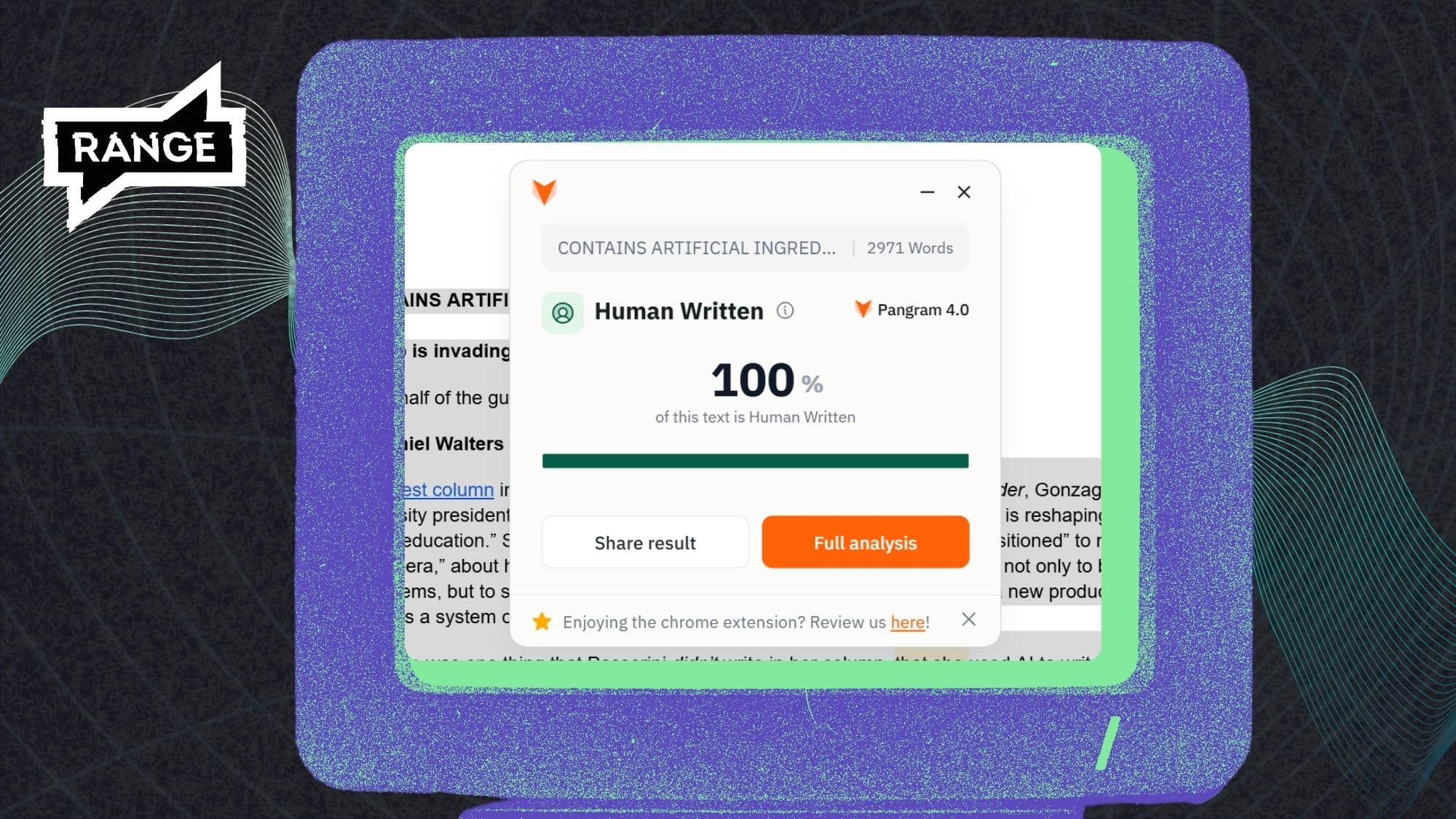
The line was written by her, she said. A 100% human.
For more coverage of AI-generated content in your Spokane feeds, click the link below.


