

This was supposed to be Spokane’s summer of soccer.
But just as the global spotlight of the World Cup passed briefly over Spokane — with crowds gathering at watch parties and the Egyptian national team training for the World Cup at Gonzaga University’s Luger Field — the lights had already gone out on the city’s own professional women’s soccer team.
In May, Spokane Zephyr FC announced it would not return for another season. The team, owned by Aequus Sports — which also runs the Division III men’s team Spokane Velocity FC — had played its inaugural match less than two years earlier in Aug. 2024. The Zephyr wrapped up their regular season on May 16 against Brooklyn FC, falling one point short of making a postseason appearance.
In a locker room meeting on May 18, the Monday after that final game, club co-owners Ryan and Katie Harnetiaux informed players that the club was ceasing operations. They read from a piece of paper, players recalled, and when the team asked them to answer questions, the owners declined and left to meet with the men’s team over breakfast.
Five former Zephyr players told RANGE that the club failed its athletes, from undercounting their hours to providing inadequate resources for staffing and medical needs.
One player, who requested anonymity for fear of retaliation, said she flew across the country for two games in February. But her club’s records claim she worked a total of just 16 hours for the two weeks during which she traveled.
She said that number falls drastically short of what she actually worked.
With prior professional league experience, she’s now signed with another club in the USL Super League — officially known as the Gainbridge Super League — the newest Division I professional women’s soccer league in the country. Reflecting on her time in Spokane, the now-signed player said many aspects of the program “weren’t up to par for professional women’s soccer.”
In an email to RANGE, Aequus Sports co-owner Ryan Harnetiaux declined to comment on the Zephyr’s closure and did not respond to a follow-up request about the hours dispute.
Misreported hours
Washington requires workers to have logged at least 680 hours over the first four of the previous five calendar quarters to qualify for unemployment benefits.
Connor Tobin, executive director of the USL Players Association — the union representing professional soccer players in the league — said the organization requested records from the club after learning players were having trouble filing for unemployment.
The union found that no Zephyr player topped 321 hours for the entire season. That’s less than half the state’s threshold.
“To give you a sense of how potentially far off this is, most players’ average hours worked per pay cycle run, which would be a biweekly period, is somewhere between the range of 11 and 15 hours. That’s over a two-week period,” Tobin said, calling the reported numbers “highly dubious.”
Players were paid their full salaries during the season regardless of how their hours were logged. But this discrepancy matters because of Washington’s minimum hours worked requirement to file for unemployment benefits.
Former Zephyr defender Madelyn Desiano said this situation shows how many people at the club “failed the players,” regardless of whether they knew the program was shutting down.
Desiano, who always intended to retire from professional soccer once her contract ended this season, is now an assistant coach at Pepperdine University. She said she at least understood the decision to fold the team, as ”business is business.”
“I would rather have that go down than another year of questions and doubts and non-answers and ghosting and lack of resources,” she said. “I’d rather have them just be upfront and honest.”
But Desiano felt the club could have been more transparent along the way, slamming the lack of communication to players.
The hours had to be approved by a series of different people, she said, questioning why those involved weren’t being “held accountable.”
The now-signed player said she received a sheet of paper that suggested she should apply for unemployment, only to call the state and learn that she was ineligible. She said the club’s records showed she had worked fewer than 300 hours in the last 18 months.
“I was like, ‘What? No I haven’t. There’s no way,’” the player said. “That’s when we found out that it was being recorded like that.”
According to club records, the player logged just 16 hours from Feb. 1 to Feb. 14, 2026 — a period that included cross-country travel for two away games at Sporting Club Jacksonville on Feb. 11 and Carolina Ascent on Feb. 14.
She sent RANGE screenshots of her calendar, featuring event titles like “BEAT Sporting Jacksonville!”
The team reported to the club at 7:30 am on Feb. 10, then left for Spokane International Airport at 10:30 that morning. From there, the team flew three hours to Denver and connected to a five-hour flight to Jacksonville, Florida, finally arriving at their hotel around 12 hours after their day began.
The next day’s schedule featured a 9 am breakfast, followed by a meeting, a walk and treatment before leaving for the stadium at 5 pm. They took the field at 7 pm and they didn’t return to the hotel until 10 pm.
On Feb. 12, the players continued to work — attending treatment and recovery sessions, training and another flight, this time a shorter hop to Charlotte, North Carolina, where the team reached its hotel at around 6 pm. The following day, the team had breakfast and training in the afternoon. On Feb. 14, the team played: a pre-match meal, a team meeting, a 2 pm kickoff with Carolina Ascent and a post-match meal.
The team left for the airport just after 5 am the next morning to return to Spokane.
The player estimated she worked around 70 hours over those two weeks, including travel time — more than four times what the club’s records show.
She said she didn’t ultimately file for unemployment since she had signed with a new team. But she knew teammates who did not have a professional next step yet, and she wanted to understand the process so she could help them.
According to the U.S. Department of Labor’s Wage and Hour Division, travel that keeps an employee away from home overnight generally counts as work time when it overlaps with the employee’s normal working hours.
Hope Hisey, a two-time Super League Goalkeeper of the Year, set a single-season save record with 86 stops during her second year with the Zephyr.
In a pay stub obtained by RANGE, the club also only logged 16 hours for Hisey across those same two weeks in February.
She said the hours logged throughout the season were “clearly flubbed.”
“There’s days where we’re clearly on the field more than that's being reported, and that doesn’t even account for all the other things that we did,” Hisey said.
Another player who hasn’t found a new team is working three jobs back home — coaching youth soccer and two others tied to her degree — while she looks for her next club. She also requested anonymity for fear of retaliation.
She told RANGE that, during the season, she could survive on her player's salary and a remote part-time job. After the team folded, she had to take more hours at the remote gig and find two more, all while training and looking for another team. This schedule has been “incredibly stressful,” she wrote in an email.
The club recorded fewer than 280 hours for her over the course of a year. She wrote that she sat on the phone with the state unemployment office for three hours, but her application was still denied for insufficient hours worked.
She detailed a daily schedule that included mandatory report time an hour before the first team activity, team meetings, training and mandatory weightlifting. She estimated an average of six mandatory working hours on a training day, excluding recovery, showering and equipment care.
On home game days, the player with three jobs estimated players worked a minimum of four and a half to five hours, and travel added significantly more. On average, she estimated players worked six days a week.
“Some of us were thrust into a situation where we were out of a job, housing, and financial stability indefinitely, all in the blink of an eye, and without any support,” she wrote in an email to RANGE.
Another player, who also requested anonymity for fear of retaliation, is training with a new team but remains uncontracted. She had several years of prior professional experience, both domestic and international, before coming to Spokane.
After the team folded, she filed for unemployment benefits in mid-July, hoping to receive around $1,200 in total benefits but was denied. She’s now planning on appealing the decision.
In a screenshot obtained by RANGE, the uncontracted player texted Carrie Taylor, the club’s vice president of soccer operations, asking for the hours to be fixed.
Taylor thanked her for reaching out but asked her to go through the Players Association instead — “just want to follow the proper channels,” Taylor wrote.
“But if you have the power to adjust those hours, that is the correct thing to do,” the player wrote in her response.
Taylor did not respond to RANGE’s interview request.
Employers generally push back on unemployment claims because payouts can raise their unemployment tax rate, Gonzaga law professor Dallan Flake said. Unlike factory workers who clock in and out, athletes rarely have a formal system for tracking hours, he added.
“What about travel time and all of the different things that go into being a professional athlete outside of practice and actual game time?” Flake said. “Unfortunately, there’s a ton of gray when it comes to what hours the athlete worked for you.”
That uncertainty includes activities like reviewing game film alone at home or showing up to a “voluntary” workout that might not really be optional, he said.
‘Spokane is not a market’
Hisey has since started the next chapter of her career at another Super League team, Carolina Ascent FC. She credited the “robustness” of Carolina’s technical and business staff as a step up from Spokane. Her new team is treated “like a business with potential,” she said.
Hisey was one of 11-year-old Izzy Tolley’s favorite players.
Izzy Tolley owns two Zephyr jerseys, one in neon pink and one in lilac. Hisey signed both. When the young fan heard the team was shutting down, she was surprised.
“It was also really sad because this is our first ladies team on this level, and that’s just kind of important to me,” she said.
Her father, Community Assembly administration chair Luke Tolley, said watching Zephyr became a bonding ritual for the two of them.
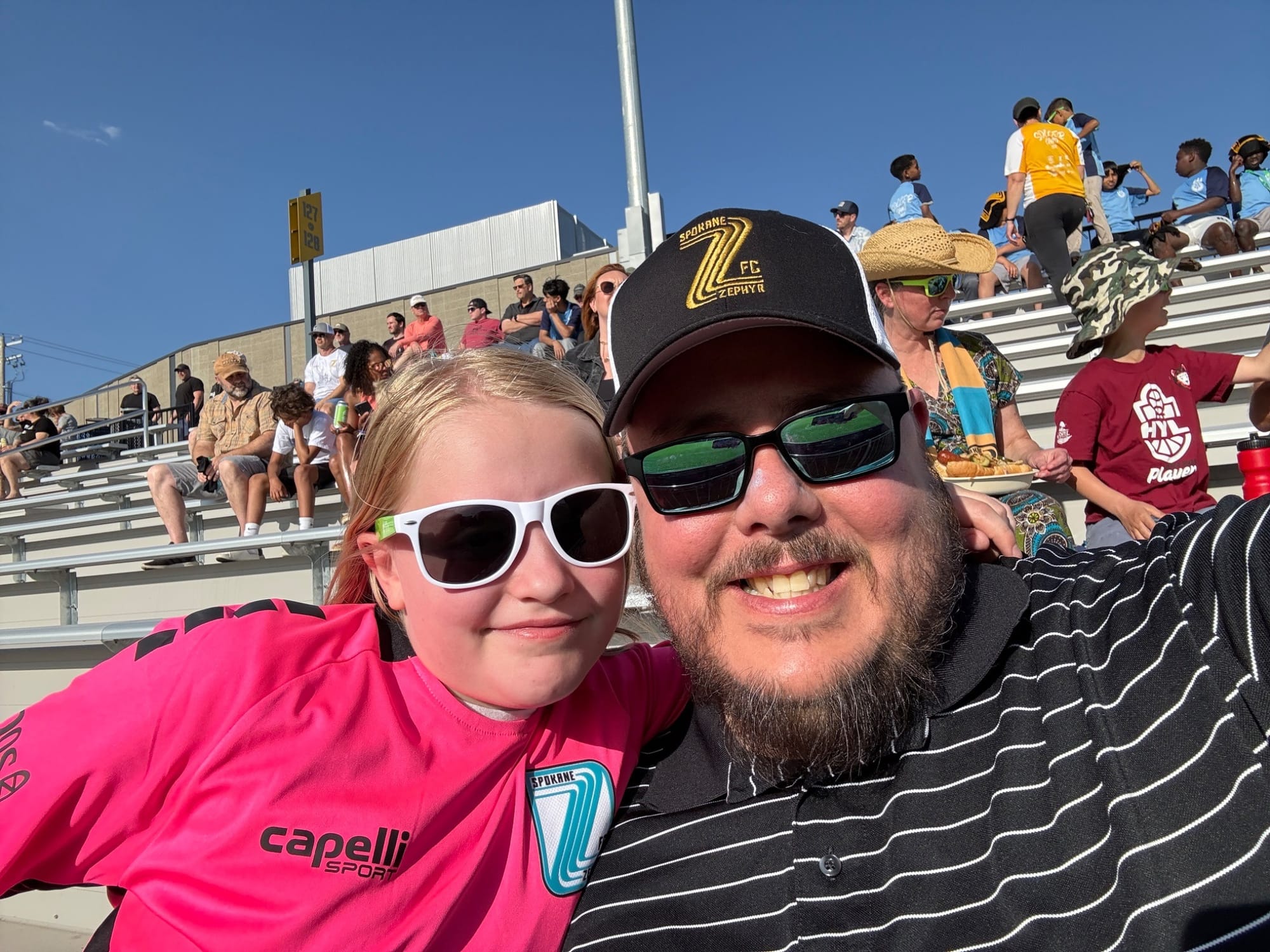
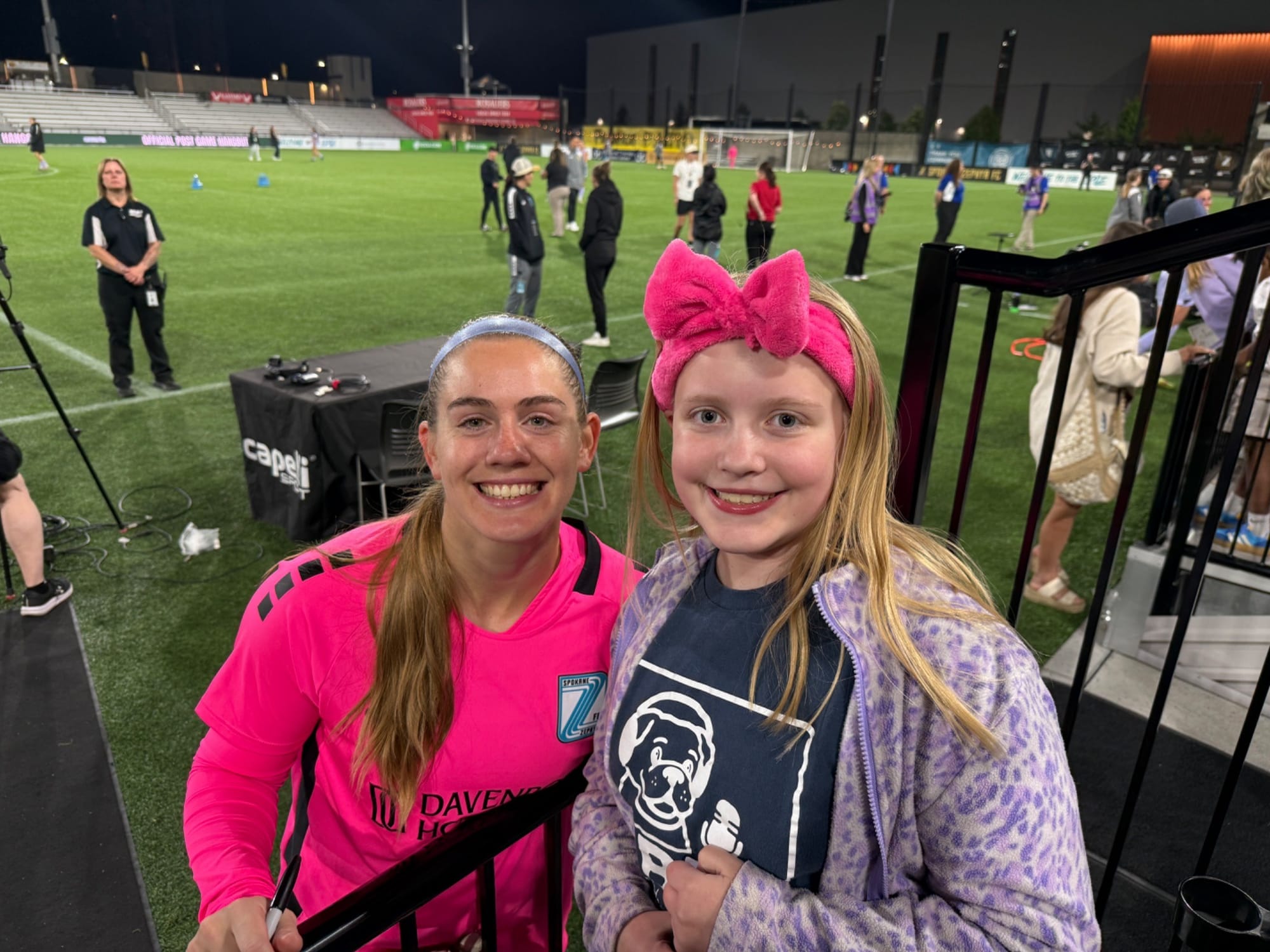
They started watching in the fall of 2024, drawn to a team that "really put their nose to the grindstone.” Before the end of the 2025-26 season, the Tolley family brought home a haul of Zephyr merch — a flag, stickers, jerseys and even a hat for their baby son.
Luke Tolley said the team would spend time individually with fans on the sidelines post-game, commending players’ kindness and generosity. Those moments made his daughter “glow,” he said.
To him, the worst part of the closure was that team ownership blamed the community.
“That’s not how this works. You have to actively promote and get out in the community and let people know who you are and work with your fans to amplify that,” Luke Tolley said.
According to independent soccer outlet Backheeled, the Zephyr’s second season averaged a little over 1,500 attendees per game in a stadium that seats approximately 5,000 — a nearly 40% decrease from its inaugural season’s average of 2,500 fans.
There was some marketing during Spokane’s first year in the form of billboards and Instagram ads, the now-signed player recalled. But by the second year, the player said she no longer saw that kind of promotion. To her, that was “the biggest sign” that club ownership didn’t have a plan.
“The day we were told that the team was folding, the owners had blamed the community and said, ‘Spokane is not a market for a DI professional women’s soccer team,’” she said.
That was frustrating to hear, the now-signed player said, given that Spokane was expecting a World Cup team over the summer.
Short-staffed, lacking resources
Players said the club ran the Division I program with scant staffing. The team churned through three head coaches in two seasons: Jo Johnson, then interim head coach Josh McAllister, then Nicole Lukic.
The Zephyr went without a goalkeeper coach for roughly the first half of its second season, Hisey said, which she called a “standard” staff member for a professional team.
The club split an equipment manager with the Velocity for the entire second season, Hisey added. Three players said that the manager was allegedly fired this spring for working too many hours.
She also said that the team had just one full-time trainer, and one split with the men’s team, neither of whom were given the resources to provide sufficient care. She pointed out the roster racked up five ACL injuries across its two seasons, a pattern of injuries she attributed to “mismanagement of player load.”
Johnson declined to comment on this story. Neither Lukic nor McAllister replied to requests for comment.
The uncontracted player said the club seemed invested in the team her first year, bringing in experienced soccer staff. But by the second year, that energy appeared to drop off.
“That was when I feel like all the other clubs in the league took two steps forward and made things better,” she said. “Our club was kind of the only one who took three steps back.”
She said that the club lacked support for rehabilitating athletes into play post-injury and that the physical therapy clinic affiliated with the club provided insufficient care, prompting players to seek treatment elsewhere.
At first, the club only allowed players to visit the outside clinic twice a week — the maximum covered under Washington’s Labor and Industries program, she said. Otherwise, the club would have to pay. After players spent around two months pushing back against the state, that increased to three visits a week.
“3x isn’t enough,” the uncontracted player wrote to RANGE in a text message. “It should be every day.”
Because the Velocity’s season started earlier, the men’s team got priority scheduling for the shared field and medical resources, Hisey said, despite being Division III to the women’s Division I.
Similarly, she said although the women’s team was fed two or three times a week — as often as the men — other Division I women’s teams are fed every day with a training session or a game.
“Treating us equal to a Division III men’s team is actually not equitable, even if on the surface it’s equal,” Hisey said. “It’s like comparing apples to oranges.”
The Zephyr also lacked equipment that Hisey said was standard elsewhere, like a machine to drain swelling and a portable ultrasound for muscle strains. If players wanted to be properly diagnosed for an injury, they had to make an appointment with the team doctor, a process Hisey said the club treated reluctantly, which she believed was due to cost.
To Hisey, these issues stemmed from “incompetence and misunderstanding” at the ownership level of what professional athletes needed.
“In Spokane, they hired the least amount of people possible to do multiple jobs,” Hisey said. “Yet their competency didn’t even rise to the level of one of the jobs that they were given.”
Stuck in limbo
Desiano criticized the club’s limited communication with players prior to the closure.
Unlike leagues with formal transfer windows, Super League players are generally free to negotiate with new clubs once they become free agents, Desiano said. But according to Desiano, players on “option” contracts — where the club decides whether to retain them each season — aren’t permitted to actively seek out other teams without the club’s permission.
Desiano said that many of Spokane’s former players were on such contracts and received no communication from the club in the months before the closure, leaving them unable to explore other teams even as the season wound down.
“You can make a decision that's best for the league and best for the players involved,” Desiano said. “But then you also have to support the players and make sure that they're going to find new homes.”
Hisey said teammates were left confused when the club didn’t offer players with expiring contracts new ones. According to Hisey, the head coach emailed ownership several weeks before the closure, urging them to start signing players to new deals.
“What they told her was, ‘We have a good relationship with those players, so we’re not worried about it,’” Hisey said.
By that point, Hisey added, the club ownership already knew the team wouldn’t continue for the following season. She said she later discovered that word reached personnel at other clubs about a week before Spokane’s own players found out.
Up until that locker room meeting, she knew teammates who were still “holding out” for new contracts, Hisey said.
The uncontracted player said she had known she did not want to stay at the club since the beginning of the year. But with Spokane gone and the league down to eight teams, she doesn’t expect to land a new contract this year because most squads are already set.
To her, one fewer team means less opportunity overall in the US, pushing her to look toward other fields in Mexico, Canada or Europe.
“I am someone who deserves to keep playing,” she said. “We want to keep playing. We love the game. This is all we have done for years, and we can’t find anything.”
Left to figure it out
For some, distance from Spokane has brought clarity to players’ perspectives as they reflect on their time with the Zephyr — some in new jobs, some still searching for their next step.
Hisey said the experience taught her and her teammates to expect more from the environments they play in now. What seems like “rays of sunshine” at their new clubs should be the norm, she said.
Nobody from the league’s office reached out to players after the closure, Desiano said. She said she contacted league president Amanda Vandervort directly and did not hear back.
The league’s lack of response felt especially “disheartening” to Desiano, given the current era of women’s sports. Support after the club’s closure mostly came from teammates, players said — organizing group chats to share information on next steps, particularly for younger athletes who might not know their rights.
In late July, the Players Association and the league reached a tentative agreement on key terms for the first collective bargaining agreement for the league, which would include minimum $37,200 salaries, two athletic trainers per team and leave protocols.
In the wake of the Zephyr’s closure, Desiano said she wants people to celebrate what she and her teammates have achieved, despite the club’s failures. Many of her teammates have managed to find new teams or new careers, she said, and their resilience deserved recognition too.
“This shitty thing happened to us," Desiano said. “And despite having no support from the league, no support from the people that signed us and paid us, no support from the state of Washington because of this whole unemployment thing, we were still able to do X, Y and Z.”


