It was winter at the beginning of one of the most difficult of President Barack Obama’s years in office, and a crisis was brewing in the streets of Lahore, Pakistan. Raymond Davis, a former US Army soldier working as a CIA contractor, was stopped at a red light on January 25, 2011, he said, when two men approached his vehicle on a motorcycle. He later said he thought he was being robbed, that one of the men brandished a gun. Davis shot them dead with 10 rounds — five through his windshield and five after he exited the car — from a pistol. A US rescue vehicle also struck and killed a third man while responding to recover Davis.
The person in charge of the US embassy in the city was a diplomat from Eastern Washington named Carmela Conroy.
“I got a call from my regional security officer,” Conroy told RANGE, “and he said, ‘We've killed three Pakistanis, and I need you to stay put until we can figure out how to get you safely back to the official residence.’”
She was later the first person to visit Davis in Pakistani jail, and she appeared at a hearing where Davis refused to sign a charge sheet for two murders. The US later paid the families of the people Davis killed $2.4 million in blood money. It was an intense international controversy swirling around angst over American military activity in the Middle East, but Conroy experienced it viscerally.
The phrase “we’ve killed” resonated with Conroy, she said. It left her feeling like bait hung out on the long fishing line that “the mothership” of US foreign policy dangles into the world.
Her time as a diplomat — present for crises like the Davis incident along with environmental cleanups and relations with warlords — remains a strong influence on her thinking as the Democrat seeks to unseat US Rep. Michael Baumgartner, the Republican who represents Eastern Washington’s 5th Congressional District.
It’s not Conroy’s only leadership experience in jobs marked with high levels of stress and conflict — she’s also served a stint as chair of the Spokane County Democratic Party.
Now in her second campaign against Baumgartner after losing the open race to replace former Rep. Cathy McMorris Rodgers in 2024, Conroy said the region has weathered many new challenges under the Trump administration’s domestic and foreign policy. She said she recently met with lentil farmers on the Palouse struggling with chaotic tariffs and other trade disruptions.
“They lost 20% of their market when USAID was shuttered,” Conroy said. “I know from my experience as a refugee coordinator for the State Department that lentils are the gold standard of famine relief.”
She describes Baumgartner’s support for Trump’s gutting of federal agencies as being particularly bad for the regional economy, which is largely agricultural and depends on strong international relationships that the president’s trade wars are eroding.
This is emblematic of her tactics in running for the seat in Congress: Say what she knows is bad, attribute it to her opponent and promise to restore things to the way they were. She’s campaigning to end tariffs, undo cuts to public education and healthcare programs, boost the federal minimum wage and roll back spending on the Department of Homeland Security, which oversees federal immigration enforcement.
In interviews, she often positions herself in juxtaposition to Baumgartner, whom she tries to pin down as a toady for President Donald Trump. The logic of this calculus is obvious: Trump is more unpopular than he’s ever been, and a significant percentage of 5th District voters who elected Baumgartner to his first term in 2024 did not vote for Trump for president during the same election.
But keeping the spotlight on her political opponents doesn’t spell out who Conroy is or, really, how she’d be different from Baumgartner. Some of that contrast can be drawn from the tea leaves of campaign finance reports, her public statements and multiple interviews she did this campaign season with RANGE, as well as from her campaign website. These artifacts tell the story of a relatively conservative Democrat dedicated to the way things were before the second Trump administration.
 Daniel Walters

The platform, the opportunity
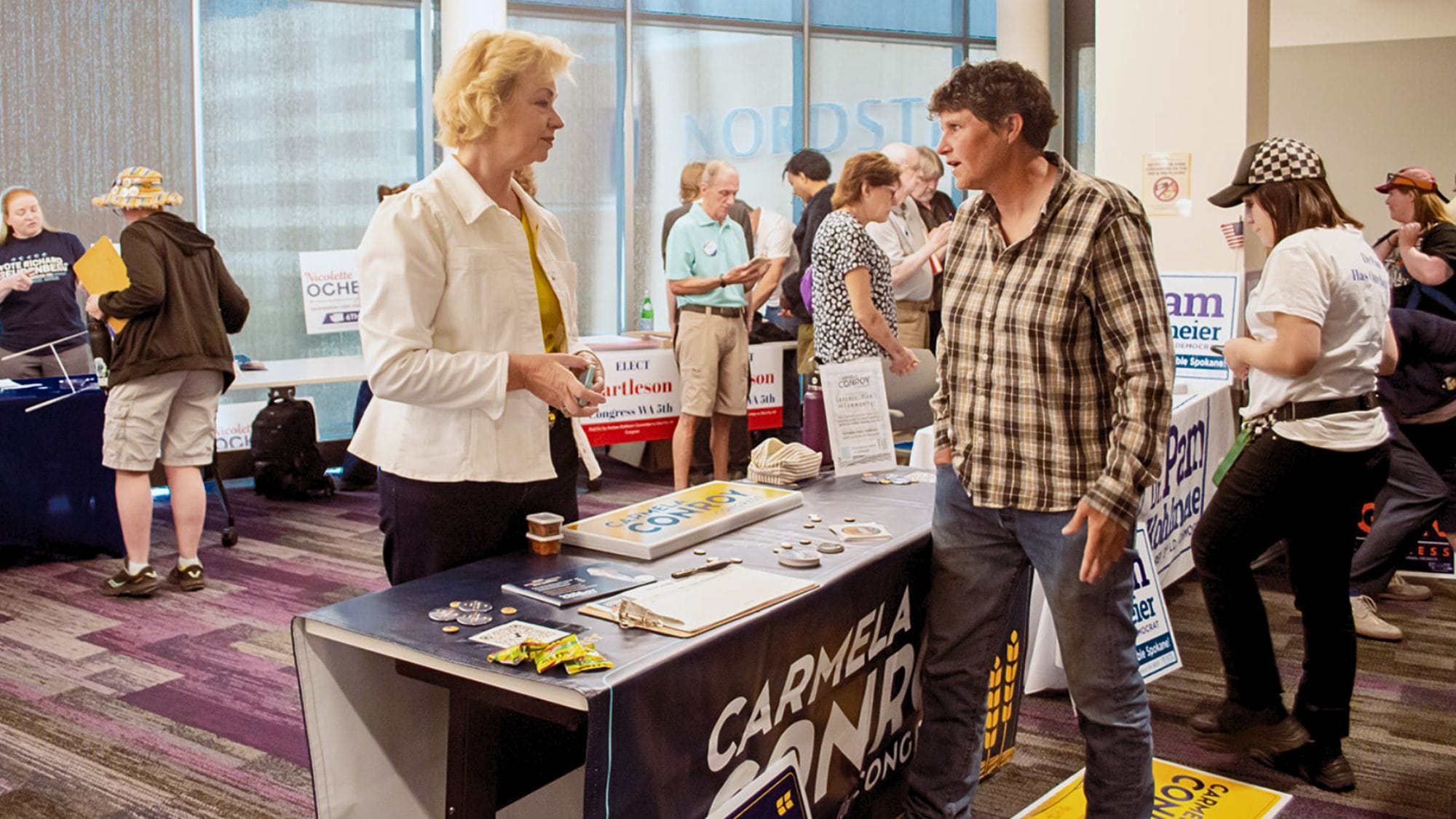
Before she was a diplomat, Conroy, who has Juris Doctorate from the University of Washington, worked as a deputy prosecutor in Spokane and corporate lawyer for the carmaker Nissan. She has stacked up a list of prominent endorsements from liberal organizations, including the Spokane County Democrats, the Alliance for Gun Responsibility, the Spokane Regional Labor Council and the Washington State Stonewall Democrats.
“I’m not delusional,” she told RANGE. “It's really difficult to unseat an incumbent, and Michael Baumgartner is the incumbent and he's fallen in line with the Republican Party.”
Incumbency is not the only problem she faces. She probably will also need the support of leftist voters who are skeptical of what they see as her being too soft on the cresting political issue of data centers and whether Israel’s war on Palestine amounts to a genocide. (Her position is that it’s not useful to employ the label.)
Still, if the previous election for this seat and current political climate are indicators, she has something going for her. Election results show Baumgartner outperformed Trump by about 10 points in 2024. Baumgartner has since mostly supported the president through a tumultuous raft of political controversies and an unpopular, entrenched war in the Middle East.
Both candidates have run on the idea that foreign policy often impacts quality of life in a state with large ports and a strong agricultural industry that depends on international trade.
Conroy thinks she has the more legitimate bona fides as far as foreign policy goes. Though Baumgartner also served a dangerous post working for the State Department in Afghanistan, she often points out that she is formally educated in diplomacy while Baumgartner is not. Conroy is a graduate of the Henry M. Jackson School of International Studies at the University of Washington and a master’s degree from the Naval War College.
They also split on the traditional central topics that divide Republicans and Democrats: Conroy wants to restore funding to Medicaid that the Trump administration cut; restore rights to healthcare, including reproductive and gender-affirming care; and rein in Immigration and Customs Enforcement from indiscriminately targeting people for deportation.
Conroy said she is running to restore liberal values and basic rights — many of them hard won over centuries — to the American public square.
“I was a child when a lot of that was going on, but having studied law, which is a sort of specialized version of history, I understand the struggle to gain those,” she said. “I'm horrified at how quickly the ratchet can go back the other way.”
Taxes and trade
Baumgartner enthusiastically supported the most prominent piece of legislation enacted during Trump’s second term: the so-called One Big Beautiful Bill, which extended the large tax cuts Trump implemented during his first term, cut Medicaid and expanded federal immigration enforcement so much that it’s larger than some nations’ militaries. The bill increases federal spending by hundreds of billions of dollars.
Conroy has said that the bill, along with Trump’s other economic policies like tariffs, has hurt the American economy. The Medicaid cuts in particular seemed to disturb Conroy, who pointed out that some rural hospitals in Washington could lose 25% of their budgets due the cuts.
Medicaid pays the medical bills of people who can’t afford healthcare. It’s a streamlined system that many hospitals, especially in rural areas like Eastern Washington, rely on to serve their patients.
Conroy has voiced support for making that program available to everyone, which would ostensibly cut out the middlemen of the insurance industry, itself a vast and expensive bureaucracy.
“What I've heard from healthcare providers across the district — big ones here in Spokane, as well as a little but vital ones in Dayton — is that Medicaid is their favorite form of payment,” Conroy told RANGE. “It is the most seamless. They submit their bills, and they get it paid.”
Conroy said Trump’s tariffs have also upended the state’s bread basket.
The lentil farmer is not the only kind of agriculturalist Conroy says she has spoken with during this year’s campaign, and the demise of USAID is not the only policy she is attacking. She also points to how Trump’s trade wars have impacted the booze industry.
She said she met a winemaker who lost 40% of their market when Canada began levying tariffs against American wine and spirits after Trump levied indiscriminate tariffs in September on Canadian steel, aluminum and cars. It’s also a year when Washington grape growers had a large crop.
“That meant that a lot of grape farmers were scrambling to figure out what to do with a really good crop of grapes that they all of a sudden didn't have anybody buying from them,” Conroy said.
Data centers
Data centers — the energy-intensive facilities that process every keystroke you send across the internet — have become a flashpoint in local, state and national elections. RANGE has covered the issue extensively because of the environmental and public health impacts caused by some large data centers across the country. And it’s growing as an issue in Spokane County after activists exposed county officials’ secret conversations with data center developers.
So what’s the difference between Conroy and Baumgartner on data centers?
Conroy points to Baumgartner’s support for the One Big Beautiful Bill he voted for, which exempted data center developers — including tech behemoths like Meta, Azure and Amazon — from federal taxes that would otherwise apply to data center buildouts. (The tax breaks apply to a range of projects in addition to data centers.)
"It's clear those companies don't need incentives to build data centers," Conroy said. "It cut their effective tax rate from about 20% to like 2% to 4% and that is outrageous."
In addition to his vote for that bill, though, Baumgartner did introduce a bill to regulate data centers on the federal level. The rules he wanted to set up — requiring developers to pay for their own infrastructure and barring them from jacking up electricity rates — echo the sentiments of local Republican lawmakers who want to develop data centers in Spokane County.
But the bill also does a lot to encourage data centers, framing them as a national security issue, and seeks to restrict local governments from imposing their own rules.
Section 3 of the bill reads: “The United States should pursue an all-of-the-above strategy to develop the energy and water infrastructure required to maintain global leadership in artificial intelligence. The United States should address demonstrated and localized infrastructure impacts through targeted, evidence-based measures rather than broad restrictions, blanket moratoria, or policies that impede responsible development.”
“It's all well and good for him to say, ‘Well, you've gotta make sure that … local tax rate payers don't take the hit.’” Conroy said. “But he's basically incentivized the building of data centers with his vote” for the One Big Beautiful Bill.
And yet, Conroy has all but ruled out support for stronger federal regulations on the data center industry, saying the facilities should be regulated at the local level.
“Most of us are protective of local decision-makers,” she told RANGE. She supports local moratoriums for data centers — which temporarily stop governments from approving new developments — but confirmed with RANGE the pauses she supports are only that: local.
Other Democrats angling for seats to represent similarly conservative places in November have been bolder on data centers. Sen. Jon Ossoff, D-Georgia, has proposed investigating data center developers, and Gov. Kathy Hochul, D-New York, signed the first statewide moratorium on approvals for new data centers in the nation in July.
Baumgartner and Conroy are both being challenged on a long-shot write-in ticket by Brittany Anderson, a home-schooling mom, who has recently made a name for herself challenging local lawmakers on their behind-the-scenes conversations with data centers.
Anderson said she is drafting a proposal for a federal law that would require baseline water and soil contamination studies to be done at potential data center sites. The idea is that people would be able to track whether a data center contaminated the local environment.
“Michael and Carmela do not have good stances on this issue,” Anderson said. “Carmela wants to leave it up to the cities and counties, and that's not good enough.”
The police state
Before she was a diplomat, Conroy worked for long-serving Spokane County Prosecutor Don Brockett in the 1990s and said the office dynamic was different: Caseloads were manageable and the office generally had a positive relationship with police.
This was before the influx of military equipment into police inventories.
She said she witnessed extensive debate at the Naval War College, where she completed a master’s degree in 2004, over concerns about how widespread militarization might change local law enforcement as returning veterans also surged in the ranks of local departments.
“We've got all sorts of military equipment that the military no longer wants to be responsible for maintaining and holding being dumped into local communities, into the hands of people who spent time in a war zone,” she said. “I wish we could come up with a way to pound those swords into plowshares.”
Some of her proposed platform could be the start of that work on the federal level. She wants to defund the military operations — such as the strike on unidentified boats in the Caribbean Sea and the war against Iran — of the Trump administration and Homeland Security, channeling the funds instead to federal emergency management.
In one of the larger rhetorically-driven controversies of the campaign, Conroy said Congress should “dismantle and behead” the Department of Homeland Security, which Baumbertner seized on, saying there was an “undercurrent of bloodlust in her campaign. She said she simply meant the agency should be dramatically remade. “She doesn’t even own a machete,” her campaign manager told RANGE.
Most of her donations seem to come from more liberal places such as ActBlue, the nonprofit political action committee that supports Democrats. As of the July filing deadline for campaign finance reports, Conroy has drawn about $400,000 in donations, compared with Baumgartner’s more than $2 million, which he reported at the end of September.
Daniel Walters contributed this report.
 RANGE