
Hi Range Readers,
Elissa here. This is a sad week for people who have to follow and report the news (us journalists) and even sadder for those directly affected by it. We started the week with another dose of Spokane-is-getting-national-attention-for-negative-reasons with Conor Dougherty’s “The Next Affordable City Is Already Too Expensive” New York Times piece which said “home prices jumped 60 percent in the past two years” here. Uh yeah, we’ve noticed.
Then came a string of Spokane law enforcement and jail stories (we’ll fill you in shortly), followed by governmental threats to transgender youth and their families in Texas as well as chilling anti-LGBTQ+ legislation gaining speed elsewhere. On Tuesday Ellensburg-born musician Mark Lanegan of Screaming Trees died. Then, on a break at one of my three jobs on Wedneaday, as I was browsing black-and-white photos of NYC’s early hip hop scene, my bar manager walked over to inform me that Putin’s troops had officially invaded Ukraine.
Oh, and the U.N. reported that risks of future “extraordinary landscape fires” are actually worse than we thought, due to the climate crisis and land-use policies. NOAA also released alarmingly dire calculations about future flooding and rise of sea levels over the next 30 years. Plus Covid-19 is still very much in the air.
So if you’re feeling overwhelmed, angry, or sorrowful now: You’re not alone. We’ll do our best to sift, slice, and arrange the week’s stories for you, providing action items and at least a pinch of good news.
—Elissa
A NOTE ON UKRAINE
Finding reliable, accurate and up-to-date information on what’s happening in Ukraine can be hard. Here’s some sources we’re reading:
- The Guardian has a nearly up-to-the-minute live blog as well as a visual explainer of how we got here.
- The BBC also has a good live blog.
- NPR has a deep explainer series on the history of the countries too.
- The Kyiv Independent is english-language journalism in Ukraine.
- And here is a Twitter list of journalists covering the crisis.
—Valerie
The Very Model of a Modern Standard General
Early Tuesday, a gaggle of business press outlets all raced to announce that TEGNA — the local news conglomerate — had been gobbled up for $5.4 billion in cash and another $2ish billion in debt by a group of private equity firms, led by the blandly-named-yet-still-dystopian-sounding Standard General.
The coverage was … breathless. Here’s a taste:

TEGNA owned at least one outlet in every major northwest media market (sorry, Tri-Cities), and two in Spokane — KREM and KSKN.

Local station manager RJ Merritt declined to comment in a subsequent Spokesman story by Amy Edelin, and the piece mostly rehashed the business headlines and got a response from incoming CEO, Deb McDermott. Before joining Standard General to lead this transition, McDermot had previously worked at Standard Media and Media General. That is not a joke. Those are real names of actual companies.
McDermott told Edelin:
“We have a proven track record of working closely with employees to get the best out of an organization, and we are grounded in and passionate about the importance of strong, objective journalism and community service, built on a foundation of doing the right thing. … Tegna shares this commitment and we will continue to serve Tegna’s viewers, customers, and communities with professionalism and integrity upon close.”
Hmmmmm, so viewers, customers and communities will be “served.” Employees will be “worked closely with.” It’s too soon to know whether McDermott’s word choice was corporate boilerplate or dramatic, Machiavellian foreshadowing, but we can make an educated guess.
When the Poynter Institute covered the acquisition, it dug beneath the eye-watering dollar amounts to unearth years of bad blood between TEGNA and Standard General. Standard General has been TEGNA’s largest shareholder since at least April 2020, and has been critical of TEGNA leadership basically the entire time.
In an April 2020 SEC proxy statement, Standard General gave TEGNA the extremely backhanded compliment of saying they had the best market placements in America:

And that they were squandering it, specifically calling out how many more employees TEGNA had than their closest rivals and how much lower EBITDA Margins it had.

In short: too many people, not enough moolah. Standard General had tried to add four people — including McDermott! — to TEGNA’s board, but that effort failed. It’s all extremely Succession-y.

TEGNA had strenuously objected to those criticisms, saying their business was great, actually, but that doesn’t really matter any more. Standard General decided to go to war and they won. KREM, KSKN and 62 other local stations are under their complete control.
We asked around to see how KREM employees and alums are feeling this week. Perhaps unsurprisingly, we only got one response:

We’re hoping for the best, but Brandon’s take seems like a safe bet.
—Luke
LAW & DISORDER
In last week’s Twitter edition of Additional Context (while our site was under construction), we mentioned Spokane County Sheriff’s Office getting a sick (in the throw-up sense) new ride with the purchase of a ~$400,000 BearCat armored vehicle, the county possibly losing supported release grant funding, and how the resignation of Spokane Regional Law and Justice Administrator Maggie Yates may further complicate that funding.
This week though, County commissioners gave Sheriff Ozzie Knezovich the OK to run a supported release pilot program through a third-party vendor. The proposed program is modeled after New York City’s supervised release program. It would allow judges to release nonviolent defendants and connect them with resources while they await trial, rather than hold them in jail on a low bond.
However, Knezovich appears apprehensive at best about this type of program, as he warned commissioners to be careful of “what we’re ready to do to our community.”
"Knezovich, who in early February told The Spokesman-Review he’d never heard of supported release, spent most of his presentation talking about how the program is based on Marxist ideas, probably won’t work, is unnecessary and could hurt public safety,” Colin Tieran wrote in The Spokesman Review.
The sheriff’s plan for now is to have a pilot running by April and to collect data through 2022 and into 2023 to see if the program works.
Knezovich is also in the news because he fired longtime deputy Craig Chamberlin, who had recently announced he was running for sheriff. Knezovich is planning to retire at the end of the year and he insists the decision to fire Chamberlin was not a political one, but he had previously endorsed Chamberlin’s rival in the race, Undersheriff John Nowels.
“Knezovich says the firing stems from Chamberlin writing a character reference for his daughter’s volleyball coach, who was under investigation by another agency for possessing child pornography,” KXLY reports.
Emma Epperly at the Spokesman reports that Chamberlin was accused of lying to investigators about what he knew of the accusations against the coach. He is also accused of violating several department policies including failing to notify his supervisor that he had been requested to provide a statement on behalf of the defense and violating sick and administrative leave policies.
Some other law and order news that may have flown under your radar: Spokane County hired jail manager Mike Sparber to be the new senior director of law and justice. Along with managing detention services, pretrial services, the public defender’s office, the regional law and justice administrator’s office and the medical examiner’s office, Sparber will be taking on some of Maggie Yates’ job, which includes implementing the above-mentioned supported release pilot program. He also gets to determine if Yates will be replaced at all.
Sparber’s new gig might also be the catalyst that reignites the debate around constructing a new county jail.
–Valerie
RELATED EVENT:
Speaking of incarceration issues, Michelle Alexander — author of The New Jim Crow: Mass Incarceration in the Age of Colorblindness — will deliver a free online speaking presentation hosted by Gonzaga University this Monday, Feb. 28 from 6 - 7:30 p.m. Register by noon on Monday.
RANGE is a reader-supported publication. Help us grow by becoming a paid subscriber.
REGIONAL NEWS ROUNDUP
SEATTLE | The King County Board of Health just rolled back helmet requirements for bicyclists, citing data that show it was enforced disproportionately against houseless people and people of color.
“A separate analysis from Central Seattle Greenways, a safe streets advocacy group, found that Black cyclists were almost four times as likely to receive a citation for violating the helmet requirement as white cyclists. Native American cyclists were just over twice as likely to receive one as white cyclists,” the New York Times reported.
While critics alleged the move would discourage helmet use, others applauded it, arguing that times have changed: helmet use was not widespread when the law was first enacted in 1993. Now, helmet use is generally high.
The Seattle PD had already announced it would no longer use helmet infractions and some other low-risk violations as primary reasons for traffic stops last month. Seventeen other King County jurisdictions outside have their own mandates requiring helmet use and won’t be affected by the vote.
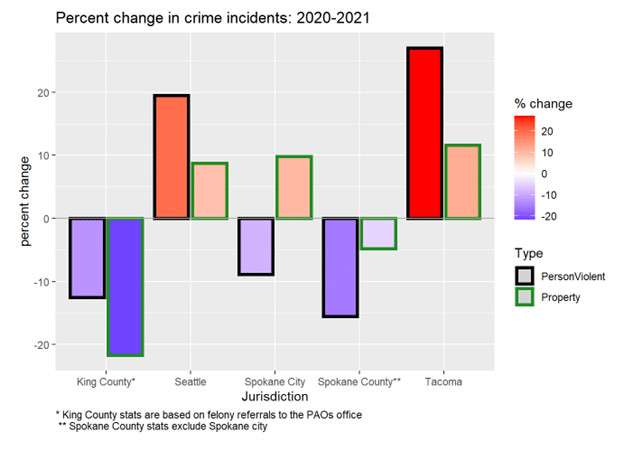
WASHINGTON STATE | Statewide data for 2021 is still incomplete, but the ACLU says the evidence we do have doesn’t support police assertions that crime is rising after police reforms took effect last July. Some jurisdictions saw an increase in crime, while others saw a decrease, the report says.
One of the jurisdictions that saw a decrease? Good ol’ Spokane County. Meanwhile, Spokane City saw a 10% decrease in violent crime and a roughly 10% increase in property crime.
Read more here.
Earlier this morning, the #WaLeg Senate Law and Justice committee heard HB 2037, which aims to expand law enforcement’s use of physical force. WCPA is opposed to the bill because it rolls back the reforms we passed in 2021.
— Washington Coalition for Police Accountability (@wcforpa) February 22, 2022
WASHINGTON STATE | Last time, we talked about a few pieces of legislation we’re keeping an eye on this year. It’s now halfway through Washington’s legislative session, and already a few of our faves are dead. Laurel Demkovich at The Spokesman-Review did a handy round-up, but here are a few that stuck out:
- “Middle housing” bills that would’ve required cities to allow duplexes, triplexes and town homes on land zoned for single-family homes.
- A bill that would’ve allowed legislative staff to unionize and collectively bargain.
- A proposal that would’ve allowed cities and counties to adopt ranked-choice voting.
- A bill that would’ve allowed anyone 21 and older to access psychedelic mushrooms at health clinics. (RIP to our cool mushroom illustration)
–Valerie
NATIONAL NEWS ROUNDUP
THREATS TO LGBTQ+ YOUTH | On Monday, Texas Attorney General Ken Paxton issued a non-binding opinion that parents supporting gender-affirming health care for their kids — with puberty blockers and hormone replacement therapy (minors aren’t even candidates for genital surgery) — constitutes “child abuse.” The next day, Texas Governor Greg Abbott tweeted, “The Texas Dept. of Family & Protective Services will enforce this ruling and investigate & refer for prosecution any such abuse.”
Abbott is talking about forced child separation. He’s pressuring educators, caregivers, and Texan residents with a “duty to report” details about trans kids or face legal consequences. It’s similar to the way Texas’ recent anti-choice legislation deputizes citizens to snitch. Melissa Gira Grant — writing for The New Republic — lays out the larger context:
“The danger this move by Paxton poses to trans children in Texas is life-altering. It is also part of a broader national campaign, led primarily by the Christian right and allied Republicans, claiming a ‘parental right’ to essentially forbid a child from being trans or even learning about trans people.”
This is happening as Florida’s “don’t-say-gay” bill continues to advance. These mushrooming legal threats are sobering reminders that hard-fought LGBTQ+ civil rights are not guaranteed – but rather exceptionally vulnerable. The slogan “It gets better!” just isn’t accurate.
These are the latest moves by conservative state lawmakers to build upon and leapfrog each other in the denial of rights for LGBTQ+ people, and go beyond laws passed in Idaho that, just two years ago, Forbes called “the Nation’s most anti-transgender.”
For more trans justice news, follow Melissa on Twitter, and follow Chase Strangio too:

BLACK FARMERS CAN’T ACCESS PROMISED DEBT RELIEF | Alan Rappeport for The New York Times reports that the stimulus package President Biden signed over a year ago included a provision that promised “$4 billion of debt forgiveness for Black and other ‘socially disadvantaged’ farmers.” However, it appears aid is not coming. The initiative, writes Rappeport, “has been stymied amid lawsuits from white farmers and groups representing them that questioned whether the government could offer debt relief based on race." About 15,000 farmers are suffering the effects of the White House’s broken promise and some are facing foreclosure.
SO LOW LIFESTYLE | A Business Insider piece by Hillary Hoffower titled “Single women are losing in today's economy” lays out statistics that are both infuriating and validating for us unpartnered earners. From housing to healthcare to utility bills to vacations to tax codes, the hidden costs of singledom really add up.
Hoffower writes:
“While costs are higher for singles, they also tend to earn less on average than their partnered counterparts. Plus, women, who already earn less than men on average, are even further behind if they are Black or Hispanic. That disparity becomes even more problematic as millennials weather yet another economic woe: 40-year-high inflation.”
CREEPY TECH | Speaking of taxes, this week the Internal Revenue Service walked back a controversial requirement that would have had taxpayers verify their identities with mandatory facial recognition technology facilitated by the third-party service ID.me. The IRS received widespread criticism by privacy experts and politicians alike for the proposal to gather biometric data. Now taxpayers will be able to authenticate their identity with other methods, such as a live interview. As Jack Morse writes for Mashable, “Activism, it turns out, still gets results.”
The fight against invasive tech is far from over, though. Abby Lee Hood at The Byte reports that Apple retail store employees — frustrated by wage stagnation from a multi-trillion-dollar company that profited $34.6 billion in the last quarter of 2021 — are quietly attempting to organize. About eight stores so far are preparing to file paperwork with the National Labor Relations Board (NLRB).
Here’s where things get creepy. Rob Thubron at Techspot writes that:
“Employees have been meeting in secret and communicating using encrypted messaging services to avoid detection by managers. They sometimes use phones with operating systems from iOS rival Android, rather than their iPhones, to prevent the possibility that Apple might somehow be monitoring the devices.”
While Apple insists it respects privacy, just last year the company faced allegations by fired employee whistleblower Ashley Gjøvik who said Apple has “an internal culture of surveillance, intimidation, and alienation” and that “employees are closely monitored and our data hoarded in the name of secrecy and quality.” So they’re not completely paranoid.
—Elissa
ICYMI:
OUR NEW WEBSITE WORKS and we’re really happy about it.

GOOD NEWS, AS A TREAT

If you’re even mildly involved with Spokane’s art world — visual, literary, or musical — you probably already recognize multidisciplinary artist Shantell Jackson (and her rad collection of colorful sneakers). Not only is Shantell the Program Director of Spokane Arts, but as Amber D. Dodd reports for The Spokesman-Review, Jackson is also “Activist in Residence” for EWU’s Gender, Women and Sexuality Studies program. Though the five-part Activist in Residence workshop series is wrapping up, you can still catch Jackson’s March 2 session via Zoom.
—Elissa