

CONTENT WARNING: This story contains descriptions of police violence.
On the chilly afternoon of January 7, several people held signs outside the Spokane County courthouse displaying the names and faces of loved ones whose lives were ended in recent years by Spokane police and sheriff’s deputies — David Novak, Bjorn Manycolors, Robert Bradley, Don Hegel.
They do this each month to demand accountability from local police who consistently rank among the most deadly in the nation.
On the seventh day of every month, they gather for Novak.
On the fourth day of every month, for Manycolors.
On the 29th day, for Hegel.
(There are no dedicated gatherings yet for Bradley, whose family is still engaged in a lawsuit with Spokane seeking damages for his death.)
The signs the protesters carried displayed phrases like “Robert should be alive today,” “PROSECUTE POLICE WHO KILL” and “Justice for David.”
Bradley’s killing “didn't have to happen,” said Monica Beckett, the grandmother of Bradley’s children, who was at the protest. “It didn't have to happen this way. They need to own up to what they did, and they know they were wrong.”
Responding to a neighbor’s complaint that Bradley was carrying an AR-15 rifle in September 2022, police approached a van Bradley was unloading from a camping trip and ordered him to show his hands. Because Bradley was in the van, it’s unclear from the body camera footage whether he raised his hands, but in less than two seconds, the police officers opened fire.
Bradley died later in the hospital.
Spokane County Prosecutor Larry Haskell had declined to prosecute, saying the killing was justified.
As of press time, the Spokane Police Department (SPD) was the third-most-deadly city police force per capita in the nation, behind the St. Louis Metropolitan Police Department and the Albuquerque Police Department, according to the police accountability organization Mapping Police Violence, which tracks killings by city police in the 100 largest cities in the United States.
Some local activists and watchdogs believe one aspect of local police violence is attributable to a school of thought that believes force that nearly kills civilians is a legitimate way to neutralize — or “deescalate” — dangerous situations.
That sentiment was articulated during an internal SPD review of a police action that injured a person who was trying to flee police in 2023, according to a December report by Spokane’s Office of Police Ombuds (OPO).
“Can anyone have any doubt why Spokane PD is currently ranked as #3 for the entire country for deaths at the hands of police?” Debbie Novak, David Novak’s mother, who organizes the monthly protests for David, wrote on Facebook.
These kinds of reviews are performed by SPD’s Use of Force Review Board, which was created to “evaluate training, equipment needs, and policy and standard operating procedures in place or practiced departmentwide,” according to the policy governing the board.
Many organizations put together methodologies and principles for deescalation of tense or dangerous situations in policing. A report by the International Association of Chiefs of Police says deescalation is thought of as “taking action or communicating verbally or nonverbally during a potential force encounter in an attempt to stabilize the situation and reduce the immediacy of the threat so that more time, options, and resources can be called upon to resolve the situation without the use of force or with a reduction in the force necessary.”
The OPO report on the internal SPD review board meeting during which a member stated “up to lethal force can be deescalation” caused a stir at the December meeting of the OPO Commission, a civilian body that votes on reforms suggested in the report. The OPO report was written by the head Ombuds Bart Logue and Deputy Ombuds Luvimae Omana.
“ I think that those review boards are not going to be trusted by the community,” said OPO Commissioner Amy McColm at the December meeting after Logue presented the report.
In interviews, Omana and Logue declined to identify the person on the Use of Force Review Board who brought up the notion that force can equate to deescalation, citing both policy and a desire to work in good faith with the department to improve policy.
“In our reports, I absolutely am not allowed to identify a bargaining member,” Logue said, meaning a member of the police union. “When it comes to outside of the report, it’s more vague. It doesn’t really govern what I say. But then I have to go with, what are the confidential proceedings within a police department, and do I own the information?”
He said review boards, though not strictly classified, are “not open to the public.” The reason for that, Logue said, is so that review board members — almost always police officers with a few exceptions — can have “open and honest conversations.”
Logue added that the identity of the person who made the statement was sort of a moot point; the majority of the board agreed with the idea that deadly force should be considered a deescalation tactic.
Spokane Police Chief Kevin Hall was hired in August after a lengthy community input process as Mayor Lisa Brown’s replacement for former Chief Craig Meidl. Hall is widely regarded as wanting to reduce police violence in the city, and credited state police reforms as reducing the number of SPD’s use-of-force incidents.
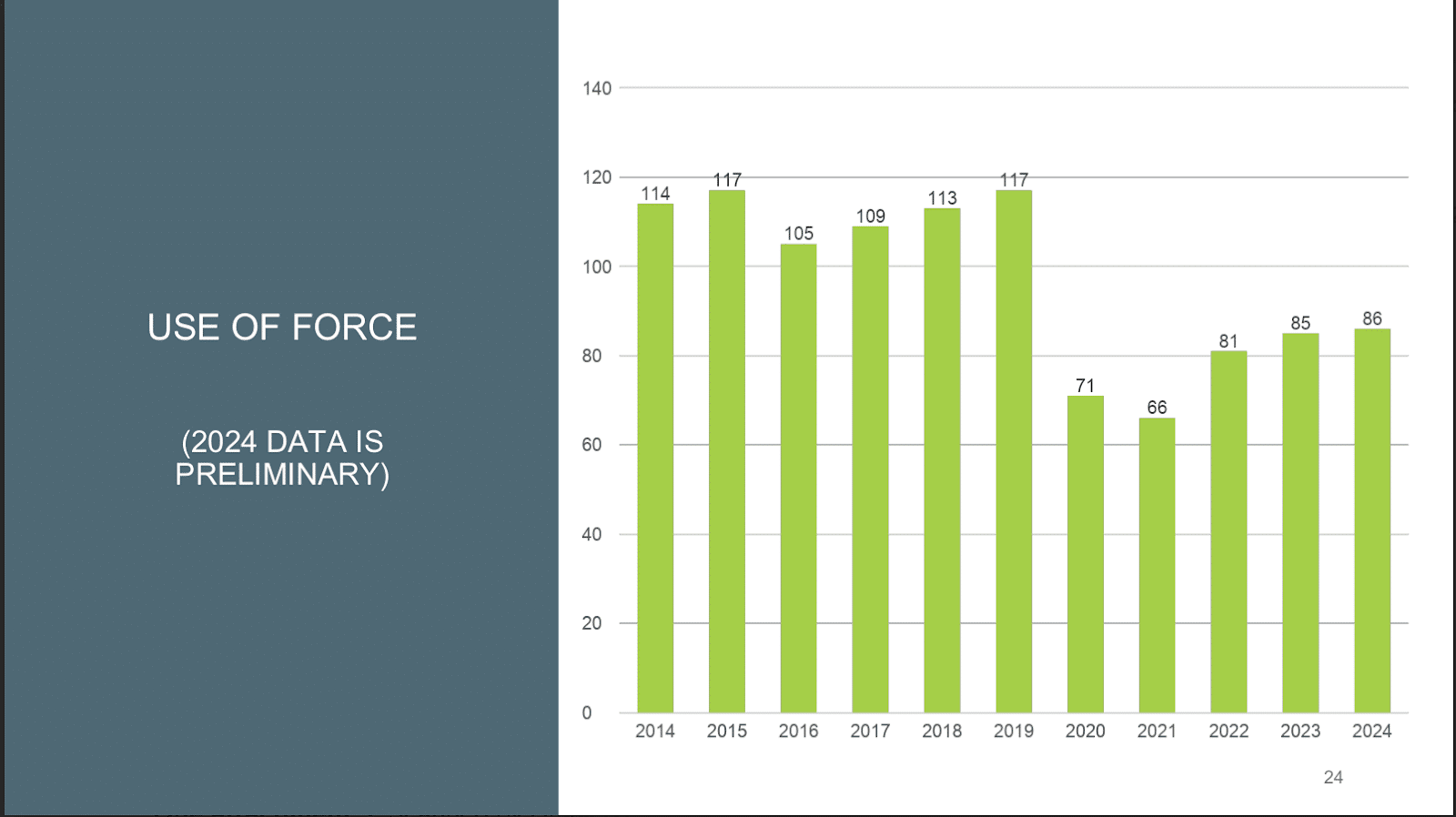
A slide showing use of force incident data presented by Hall at the January 6 Public Safety Committee meeting.
Hall told RANGE he is exploring possible reforms to the review board. Any changes would largely be dictated by the powerful police union, but Hall supports potential changes to the makeup and culture of the Use of Force Review Board.
“We have to hold people accountable for their actions that they take, good, bad or indifferent, but we also need to learn from these and be better moving forward,” Hall said.
The Use of Force Review Board is a standing 10- or 12-person group that meets monthly and is oriented toward policy reform, rather than on wagging fingers at individual officers. There is also a Deadly Force Review Board and a Pursuit and Collision Review Board.
David Dunkin, president of the Spokane Police Guild, the union that represents SPD employees, said he has not talked to Hall about reforms and wasn’t aware of any specific proposals in the works, but was open to the possibility.
In the December OPO report, Logue recommended that “review board members should receive specific guidance on force analysis and review board expectations. Greater emphasis should be placed on alternatives to force and deescalation.”
The OPO Commission unanimously approved the recommendation, but that does not mean SPD has to adopt them. The recommendations are sent to the police chief who reviews and decides whether the department will adopt them. If the department does accept a recommendation, the Ombuds can later audit its implementation, Logue said.
‘Up to lethal force can be deescalation.’
The December OPO report describes an incident that occurred on September 21, 2023, including the following series of events: A Spokane police officer was en route to a call for a reported assault and saw someone riding a bicycle and carrying a pair of crutches. The officer knew the person who was assaulted had crutches and, pulling up alongside the person and cracking the driver-side door of their cruiser, asked the person to pull over.
According to the OPO report, the person refused to stop, fleeing to a nearby construction site that was blocked off by concrete barricades. The person tried to slide between two of the barricades and escape, but the officer, now on foot, caught up and tackled the person to the ground.
The person’s legs were “tangled” in the bike and the crutches, according to the report, and the officer put their knee on the person’s back, handcuffing them.
According to the report, the person said they couldn’t breathe, echoing the words of victims of police violence that in recent years had become a nationwide rallying cry for police accountability advocates.
The officer arrested the person, whose femur was fractured, possibly an aggravation of an existing injury caused by the officer’s use of force. The person had a warrant out for their arrest.
The officer detangled the person from the bike and the crutches.
“The subject was still in great pain unable to sit up straight, they groaned and complained of pain in their leg and back,” the OPO report says.
The officer took the person to the hospital, according to the report.
A review by SPD found the officer had not violated any policy, the OPO report said. But as with many instances in which Spokane police officers use physical force against civilians in the field, this case was also reviewed by the Use of Force Review Board, on March 12, 2024.
“At the review board, a question was asked if there were any other steps the officer could have taken prior to using force,” the report says. “One member stated that we could have used lethal force. … One member even stated, up to lethal force can be deescalation.’”
“That's exactly opposite of what I would like our review boards to be doing,” Logue told the OPO Commission. “I don't want us to be justifying force by saying we could have done something greater.”
Dunkin, the president of the police union, emphasized that different people have different definitions of deescalation and wished that everyone could agree on what it is.
”Deescalation can include all kinds of different things,” Dunkin told RANGE. “It's just what is our definition going to be? If somebody's armed with a knife and we shoot them with a bean bag round and they drop the knife, have we stopped them from harming themselves or others? Yeah. Is that deescalation? Well, I shot him with a bean bag round. That sounds pretty harmful. But we've stopped this incident from getting worse.”
Hall told RANGE deescalation means “slowing things down, providing distance if possible, gaining cover and then using your critical decision-making skills to determine a path forward, if possible, without using force.”
When the SPD chain of command reviewed the case of the person with the crutches, the report notes, one reviewing officer said, “Absent any claimed injury or other extenuating circumstance, this level of force would not typically be considered a reviewable use of force.”
“Some of the chain of command review comments were more troubling,” Logue told the OPO Commission. “They focus on the fact that had that person not complained of being injured, we wouldn't even have to review this.”
In his report, Logue recommended that “review boards should also provide an analysis of the supervisory review; and provide recommendations when supervisory reviews fall short.”
The spectrum of views on police deescalation
The sentiment that up to lethal force can constitute deescalation is at odds with how many citizens, Logue and police accountability advocates across the United States, Washington and Spokane see deescalation.
Jim Leighty, a police accountability advocate who was at the January 7 protest, said when average civilians think of deescalation, they do not think it includes actions up to lethal force.
“They're not gonna think that deescalation also includes a bullet to the head,” Leighty said. “That's insane.”
Chief Hall told RANGE that while force is sometimes necessary, he does not consider use of force — lethal or otherwise — to be deescalation. “Deescalation is the antithesis of force,” he said.
If both police accountability advocates and Spokane’s top cop feel the same way — that use of force is not deescalation — why the disconnect with the review board?
Logue told RANGE the idea that force can equate to deescalation exists in policing across the country, a statement that’s evidenced by reporting in the New York Times that showed some officers believe force is required to make people comply with police orders. One article quoted a Seattle police officer as saying, “Last week, there was a guy in a car who wouldn’t show me his hands. I pulled my gun out and stuck it right in his nose, and I go, ‘Show me your hands now!’ That’s deescalation.”
Dunkin told RANGE that this philosophy — that force is a form of deescalation — is not universal in policing and is not a prevailing opinion at SPD.
The idea that “shooting someone is a form of deescalation, that’s not a conversation, that's not a topic, that's not a sentiment around the department,” Dunkin said.
But families of people killed by police find this hard to trust. Debbie Novak said there’s not enough transparency, both in the department in general and on the review boards.
”You gotta remember that poor Bart, our ombudsman, has so many restrictions,” Debbie Novak told RANGE. For a time, Logue “couldn't even get public records. And the police guild has a say on whether he gets to keep his job or not.”
She was referring to the guild contract, which says if Logue is found to be operating in bad faith, based on potential legal interpretations of the contract that can arise through arbitration, he can be removed from his position, which forces Logue to be extremely careful in what he discloses and to whom.
Luc Jasmin III, who chaired the OPO Commission when Logue presented his December report, echoed Novak’s comments.
“ The secrecy around it contributes to the violence,” Jasmin told RANGE. “As an observer, I think when there isn't a light somewhere people can do things they don't necessarily want other people knowing about.”
According to SPD policy, Use of Force Review Board members are appointed by the board Chairperson, SPD Training Director, Lieutenant Kurt Reese. Other prominent members include the SPD’s Director of Strategic Initiatives Jaquelyn McConnell and Internal Affairs Lieutenant Sean Wheeler. The review board is oriented toward policy reform rather than discipline.
“The purpose of a review board isn't to determine whether something was permissible under policy,” Omana said. “We're supposed to be critical in that we look for ways to improve police practices and policies, so that you don't use force on people if you don't absolutely have to.”
The board is staffed entirely by SPD employees, with the exception of one Ombuds representative — normally Omana, who is independent of the department.
“It's important to have different perspectives because let's say a subject matter expert in force — these people teach force for the department,” Omana said. “The way they tend to think about force is through law and policy.” But Omana is the only person who attends the meetings who does not have a professional background in policing, she said.
RANGE reached out to the review board chair Reese through SPD spokesperson Daniel Strassenberg Thursday morning but Strassenberg did not return a call by press time. We will update this story with Reese’s comments if the department responds.
Hall told RANGE one of the reforms he may support is a Use of Force Review Board where members have more diverse backgrounds.
The police accountability advocate Leighty, told RANGE it needs to go further than that. He believes the public should be able to look inside the review board and know who says what. For Leighty, it’s not just an issue of police accountability, but one of public safety.
“When we have a Use of Force Review Board who's saying things like, ‘Up to you killing somebody is deescalation,’ that needs to be told to everyone because the public needs to be aware for safety reasons that the police are viewing death as a deescalation technique,” Leighty said. “Why are we keeping that a secret?”
‘We can’t afford not to get better’
This Monday, the city of Spokane settled a wrongful death lawsuit with Sarah McLaughlin, Bradley’s fiance, for half a million dollars.
It was the sixth anniversary of Novak’s death at the hands of Spokane police officer Brandon Rankin during a house call after neighbors had reported Novak was shooting a gun in 2019.
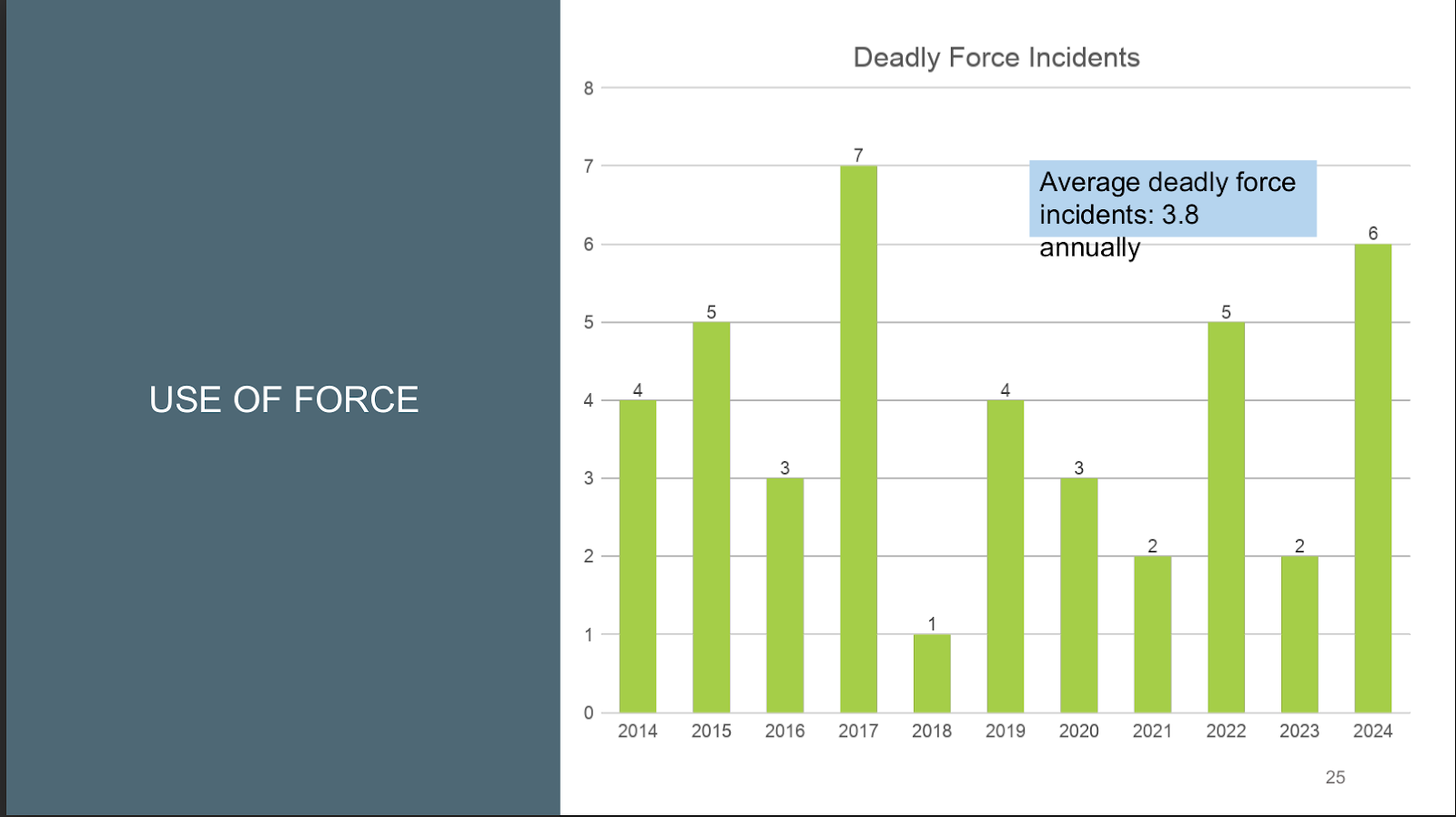
Though it turned out Novak was unarmed, Spokane County prosecutor Larry Haskell declined to prosecute Rankin, saying the shooting was justified — as he did with the killings of Manycolors and Hegel. In fact, in the decade since he took office as prosecutor, Haskell has never found a police shooting unjustified. During that time, Spokane police have killed 38 people, according to an SPD report presented to the Spokane City Council this week. Last year was the second-deadliest between 2015 and 2025, with six police killings.
Earlier this week, The Spokesman Review reported that the family of Kerry Jones-Hilburg, who was killed by police in 2023, had filed a $50 million suit, and the sister of Joshua Musselman, the most recent casualty of police use-of-force, had retained a well-known wrongful death attorney.
In interviews, Logue emphasizes that reform of review boards and police training would protect both civilians and police, and that less violence would alleviate a burden on taxpayers, who foot the bill for the settlements.
Jones-Hillburg’s killing was “many shootings ago,” Logue said, citing the six people Spokane police killed in the year since Jones-Hillburg’s death. “We can’t afford not to get better, not to refine ourselves.”
“It’s better for the police and for our community,” he said.
Debbie Novak, David Novak’s mother, who worked as a police dispatcher and often patrolled with SPD in the 1990s, became a vocal advocate for state-level police reforms after her son's death. Part of that includes the monthly protests to help bring him justice.
Tuesday’s protest was the 72nd, Novak told RANGE.
She advocates for state-level reform because she feels conversations around police brutality are too focused on the concerns of police. “It's police, police, police,” she said in an interview.
“Everything's about the police. When is it our turn?” Novak asked. “When is it gonna be about the people? When are they gonna hear our voices and not just the police?”
Editor's note: We changed one sentence in this piece that said "murdered by police" to "killed by police." Murder is a criminal charge that is only established legally after a conviction.


