

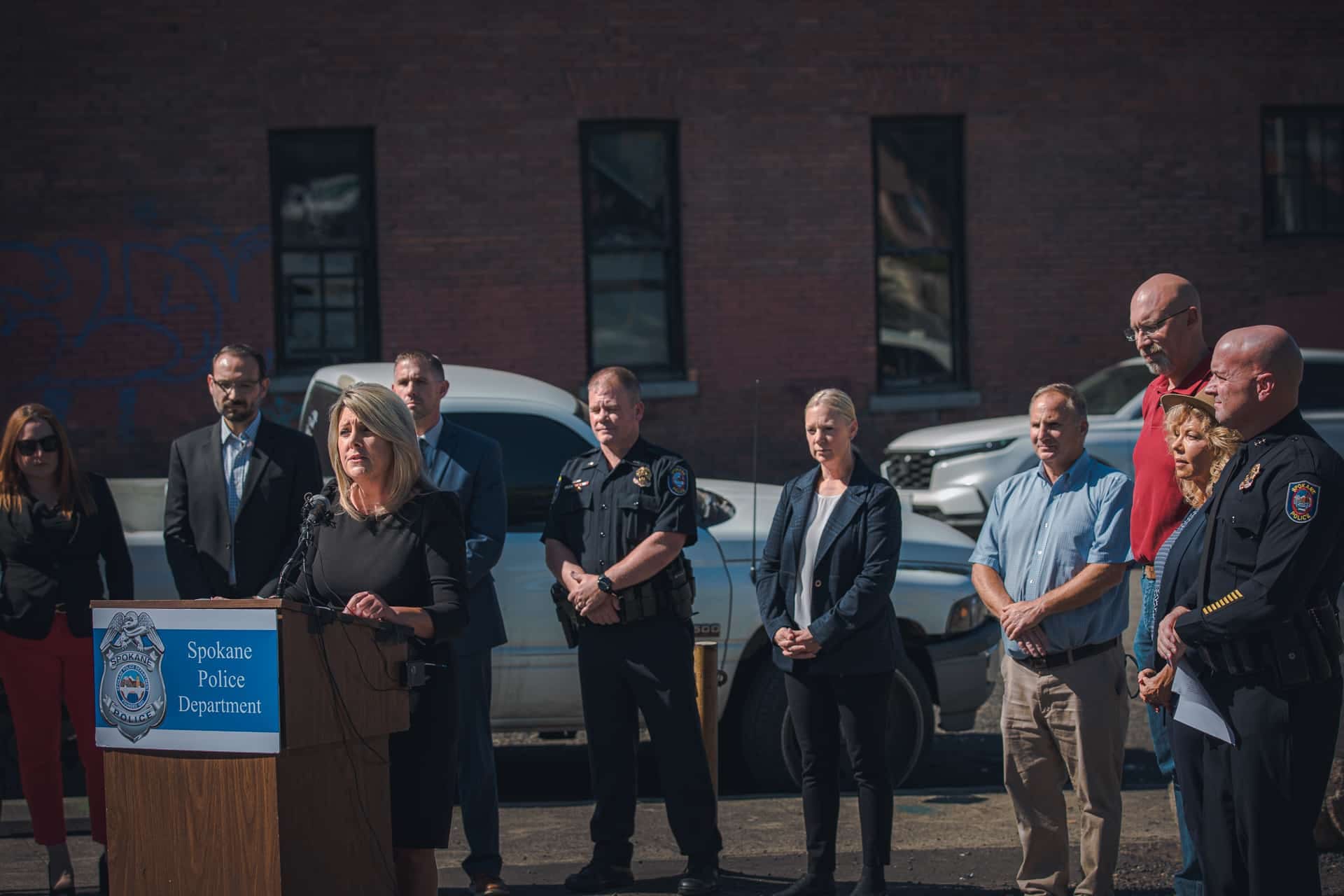
In a parking lot west of the controversial 2nd and Division intersection, with Catholic Charities’ Fr. Bach Haven apartment building cutting a dramatic figure in the background, Mayor Nadine Woodward hosted a press conference this afternoon on her plans to reduce crime, and what Police Chief Craig Meidl referred to as “blight.” Despite the wide-ranging possible solutions that were discussed at a city council meeting two weeks ago, bringing street preachers in to annoy homeless people into leaving wasn’t among today’s proposed solutions.
Surrounded by members of the Spokane Police Department, business owners from the Downtown Spokane Partnership, Spokane Club members, and Councilman Michael Cathcart, Woodward spoke with the tone of a concerned parent, stating multiple times that the city was working to “reset community expectations,” and “add back accountability.” According to Woodward, accountability looks like around-the-clock police coverage and increased carceral punishment to prevent the “fentanyl foils, feces, tons and tons of garbage,” that folks are seeing as a result of “failed policy.”
After Camp Hope’s closure earlier this year, the intersection of Second and Division has become the latest rallying point for politicians, the police and business owners to call for change, from cleaning up this specific intersection to building a new jail. The intersection, chosen for the amount of visibly unhoused people that congregate there regularly, is a central hub for resources, including Compassionate Addiction Treatment (CAT), Providence’s Community Clinic and Jewels Helping Hands. In addition to Bach Haven, Catholic Charities operates several other service-enriched apartment buildings nearby, along with House of Charity.
The site has already seen increased police presence in the last week, enforcement of the city’s revised sit-and-lie ordinance and a recent public drug use law, all of which Woodward lauded as things to be proud of in pursuit of the goal she called, “Make Crime Illegal Again.”
Now, it will see 24/7 police coverage, requiring an indeterminate number of overtime hours from officers, coming out of a budget that is already in the red. When asked about how the administration would fund the additional overtime hours, Woodward acknowledged the budget concerns, but said, “public safety is a priority. We will find a way to be able to pay for the overtime that we are accumulating to be able to concentrate public safety efforts in this area.”
Questions about how long the increased presence would be necessary were similarly met with vague answers about prioritizing public safety and figuring the rest out later.
The event was for press only, and SPD Communications Manager Julie Humphreys actively prevented community members from asking questions. Because of the location, though, many care providers showed up to listen, and gave their thoughts to RANGE afterward.
Hallie Burchinal, Executive Director of CAT, seemed on the verge of tears as she watched from behind the row of reporters.
“They did this in our parking lot. My heart was hurting so bad I thought I might need to be seen [by a doctor],” Burchinal said. “It makes it seem like we’re supporting this. [Mayor Woodward] has never spoken with us.”
She wasn’t the only one frustrated.
“There's no resources, so we're gonna put all the money into criminalizing it?” said Sarah Love, a counselor trainee at CAT. “Why don't we put some money into trying to provide mental health services and create a lasting, sustainable change? I'm not really sure how sustainable this is.”
At the end of the question and answer period (which also saw Woodward declining to take questions on City Council’s proposed censure), Robert Lippman, co-chair of the Spokane Homeless Coalition and Community Clinic Behavioral Health and Operations Manager for Providence raised his hand and attempted to ask a question. Woodward shut him down immediately.
“Robert, Robert, Robert, Robert, Robert, Robert. This is for media members. You're not a media member.”
Humphreys ended the meeting directly after.
Service providers have been at odds with the city for months over the proposed Spokane Regional Homeless Authority and tensions were still high, with the lack of communication between administration, police and service providers.
“Why don't they come and talk to us? Why aren't we collaborating, working together?” Love asked. “We all want the same thing. I mean, at least broadly.”


