
Two proposed policies — one of which copies Trump, Texas & Georgia — seem designed to challenge Washington laws and education policy
The Mead School District Board will have its first reading of two separate policy proposals aimed at censorship on Monday night. One is designed to prohibit any literature or materials referencing “gender identity, gender fluidity … or gender-neutral ideology in any form in Elementary libraries.” The other would prohibit, among other things, the compulsory teaching of “‘Critical Race Theory’ curricula or ideology” in civics education. (While CRT in schools is a huge topic on the right, most public school officials and teachers — including at Mead — deny this graduate-level academic concept is being taught at all.)
The policy concerning critical race theory (CRT) is a newly proposed policy concerning “Civics Education.” The LGBTQ+ prohibitions would be added to the District’s existing Library Media Center policy.
The CRT policy tries to do a lot of things in two and a half pages, including requiring teaching “diverse and contending perspectives without giving deference to any one perspective,” prohibiting grades, course credit or extra credit for political activism and lobbying, and prohibiting the punishment of students for voicing unpopular opinions.
The library policy revision is remarkably straightforward: If a book or piece of media has anything that paints outside of a strict gender binary “in any form,” it cannot be kept in Mead elementary collections. If such books are already in those collections, they must be removed. The policy revision does not specify changes for middle and high school collections.
Both the new Civics Education policy and the revision to the library policy were written by Board Director Michael Cannon and will be presented by him at the meeting tonight. The civics policy specifically has deep roots in the national anti-CRT movement and draws heavily — sometimes verbatim — from an executive order signed by Trump in late 2020 and a state law passed in Texas last year.
It’s not clear yet how the other four members of the board feel about these policy revisions, though four of the five currently sitting members were on the board in 2020 when they unanimously sent a letter to Governor Jay Inslee asking him to not to sign the 2020 sex education bill. That bill mandated comprehensive sex education in Washington schools and forbids abstinence-only curricula. Opponents of the bill challenged it with a 2020 referendum that was defeated by more than 15% points statewide.
The only current member who wasn’t on the board back then, BrieAnne Gray, ran to the right of her opponent, opposing not just comprehensive sex ed, but also COVID mask mandates, and the teaching of critical race theory.
Given that board composition, these policies may be likely to pass. What’s less clear, though, is whether they can withstand Washington State’s anti-discrimination laws and a specific recent focus on creating gender-inclusive schools. It almost seems as though Cannon’s policies were written to force a confrontation with the state.
Writing Gender Out of Library Policy
Mead’s current Library Media Center policy is a brief, three-page document that sets general guidelines for developing a collection that meets “the unique needs of each school,” including media selection criteria, a gift/donation policy, and guidelines for “de-selection” — the routine process of culling outdated, damaged or duplicate materials.
Over one quarter of the policy deals with resolving complaints from community members, and begins by telling library staff to “consider both the citizen’s right to express an opinion and the principles of intellectual freedom.”
Wide latitude is given to library staff to make choices that are appropriate for their specific school. No categories or topics are specifically prohibited, though staff are asked to consider de-selection of materials that “perpetuate cultural, ethnic or sexual stereotypes.”
Cannon’s draft keeps much of that latitude, with one big exception: the new policy explicitly prohibits any expressions of gender fluidity “in any form” in elementary libraries.
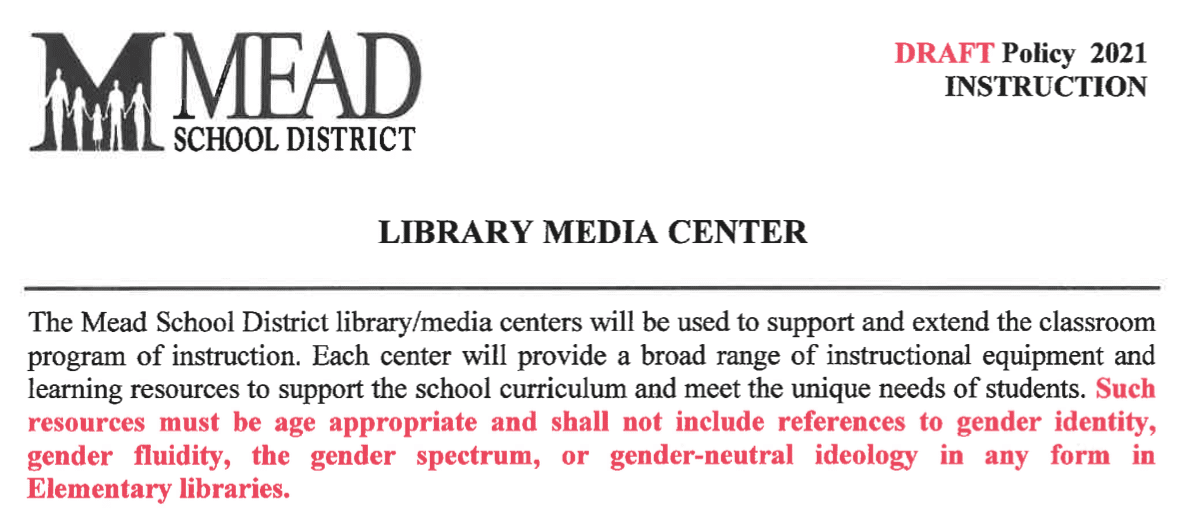
For books already in elementary collections, Cannon’s policy revisions mandate their removal.
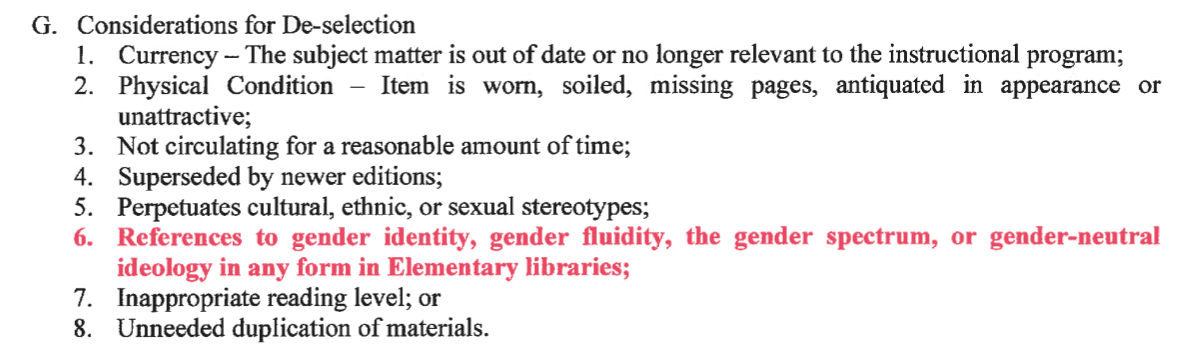
We haven’t yet seen any legal guidance on whether this policy would violate Washington State’s anti-discrimination laws, but gender expression and gender identity are protected classes in Washington. It’s also worth noting that the language of this proposal appears to ban references to gender identity in general, which could mean any book with people defined by gender would be subject to removal: Goodbye Hardy Boys, so-long Little Women.
The state law that prohibits discrimination in schools, 28A.642, specifically directs schools to adopt “at a minimum, all the elements of the model transgender student policy and procedure.” The law states definitively that the model policy is intended “to eliminate discrimination in Washington public schools on the basis of gender identity and expression; address the unique challenges and needs faced by transgender students in public schools; and describe the application of the model policy and procedure prohibiting harassment, intimidation, and bullying, required under RCW 28A.600.477, to transgender students.”
The law explicitly gives enforcement authority to the Office of the Superintendent of Public Instruction (OSPI), and OSPI, for its part, makes no distinction between kindergarten-aged kids and high schoolers when it comes to gender-inclusive education: “Civil rights laws prohibit discrimination and discriminatory harassment on the basis of gender expression and gender identity in Washington public schools. All [emphasis theirs] students have the right to be treated consistent with their gender identity at school.”
That doesn’t mean that every grade in Washington public schools will be taught about sexual activity — as fearmongers have claimed. For grades K-3, Washington’s sexual education curricula is focused on social-emotional learning, which “provides skills to do things like cope with feelings, set goals, and get along with others.”
The OSPI guidance on gender-inclusive schools does not explicitly discuss libraries or book prohibitions, but their language and guidance for things like using preferred names, pronouns, restrooms and locker rooms is unequivocal.
Given all that, it’s hard to see how a blanket prohibition on books with any treatment of gender fluidity wouldn’t be considered discriminatory.
The enforcement authority given to OSPI allows for significant penalties, including termination of the offending programs, “termination of all or part of state apportionment or categorical moneys to the offending school district … and the placement of the offending school district on probation with appropriate sanctions until compliance is achieved.”
Civics Education to Combat Feeling Bad
In a short preamble, Cannon calls his draft civics policy “a policy relating to the exclusion of Critical Race Theory [CRT] and the protection of quality civics education and academic discourse,” and writes that it is in specific response to advocates who want to “‘destabilize’ and ‘tear down’ institutional racism as it exists in the state’s basic education system,” while using the system to advance “Critical Race Theory and ‘social justice’ in terms of prescribed outcomes.”
This policy, which is aimed at grades K-12, is much more difficult to parse than the library policy and strains to combat CRT without really defining what CRT is, beyond a few specific books and projects and the feeling that, whatever it is, it makes white kids feel bad.
After the preamble, Cannon starts by outlining four broad prohibitions:
a) Teachers, administrators, employees or contractors cannot be “compelled” to discuss “writings derived from or related to such resources as The 1619 Project, ‘Critical Race Theory’ curricula or ideology, ‘How to be an AntiRacist’, or ‘Caste’.”
b) If they do choose to teach one of those topics, they should “explore the topic from diverse and contending perspectives without giving deference to any one perspective.”
c) Educators can’t require political activism or lobbying, and can’t award grades, course credit or extra credit if students do take part — essentially prohibiting civics educators from having kids actively participate in civics.
d) Educators can’t enforce any rules of the student code that would result in the punishment of a student for discussing any of these topics.
The idea in b) of not “giving deference” to any perspective could cause some real issues. Are civics teachers expected to give equal moral weight to abolitionists and slaveholders? How about the Holocaust? Secondly, given the context of the document, d) seems to be an attempt to ensure kids don’t get in trouble for questioning social justice orthodoxies, but the wording here is vague enough to cover any student engaging in debate.
The next section is where the anti-CRT language really ramps up, and it’s such a mouthful we’re just going to paste the whole thing:
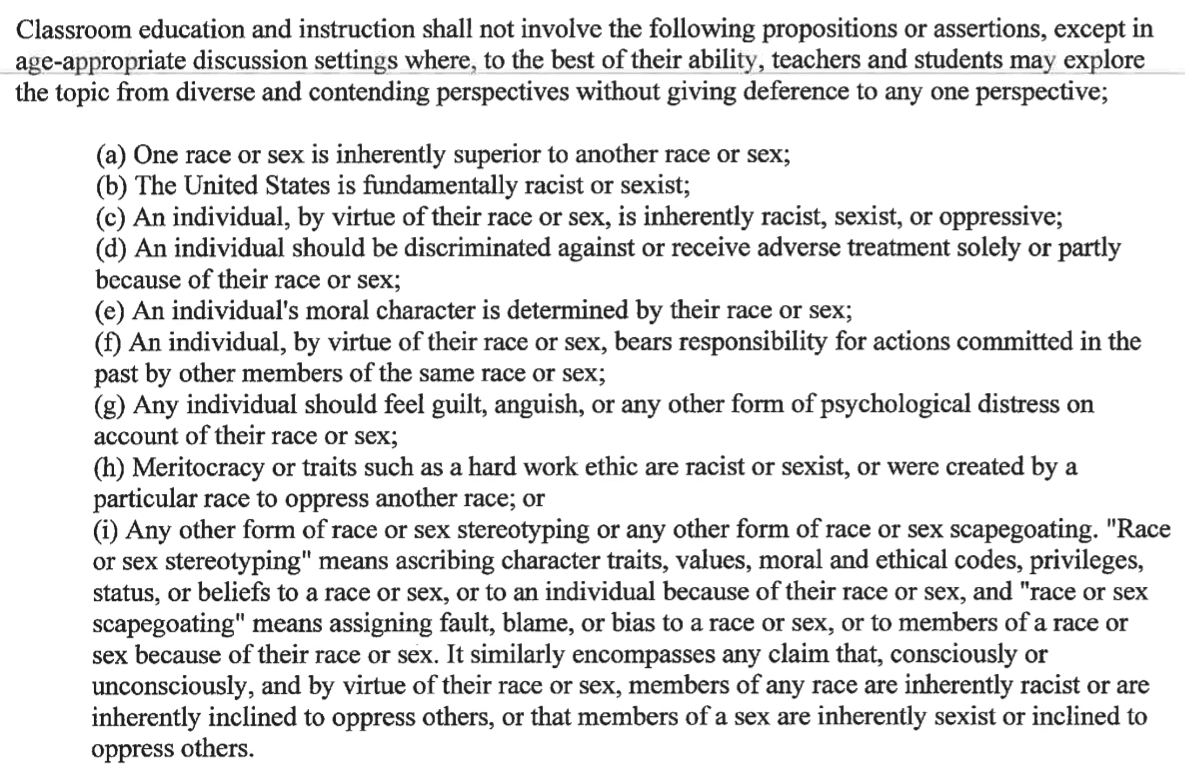
As above, while the intent to marginalize critical race theory is explicit in the document, this policy as written could cause some real headaches for educators.
Let’s cut and paste some pieces to see where we get: “Classroom instruction shall not involve” propositions that “a) one race or sex is inherently superior to another race or sex” “except in age-appropriate discussion” “without giving deference to any one perspective.”
Again: imagine this in the context of slavery. “Well kids, you see one side wanted their basic freedom to live a life free of bondage and ownership by other people. The other side wanted to imprison people and forcibly remove them from their homeland in order to keep them as property to build wealth from their labor. Now, let's pick sides and argue the pros and cons of each.”
Also problematic is g): “classroom education shall not [make] any individual should feel guilt, anguish or any other form of psychological distress on account of their race or sex.”
We have mandatory study of our indigenous culture as part of the Washington State History curriculum. Any discussion of westward expansion that doesn’t include a hard look at the forced displacement of natives onto reservations whitewashes a key element of how all of our civic and economic institutions — including sovereign tribal governments — rose out of the systemic displacement and genocide of native people.
Talking about the real and brutal oppression of those tribes might make a white kid feel bad. Ignoring it would surely make a native classmate feel completely erased.
So which kid’s feelings should this policy give preference to?
The Intellectual Lineage of Trump & Beyond
Writing model legislation to be remixed to fit the needs of state legislatures, city councils and even school boards is a core tactic for the conservative American Legislative Exchange Council (ALEC). For more on the influence of ALEC checkout this 2019 investigation. Increasingly, conservative organizations and lawmakers are taking a crowd-sourced approach to culture war, meaning parents and teacher groups who want to oppose these changes aren’t just going up against a specific local group, they’re going up against a national network that has stress-tested both legislative language and political tactics all over the United States.
Cannon’s civics policy draws — often verbatim — on Trump and a recent law that passed the Texas legislature. Of the nine bullet points in Cannon’s second section, eight are directly lifted from the text of that order:
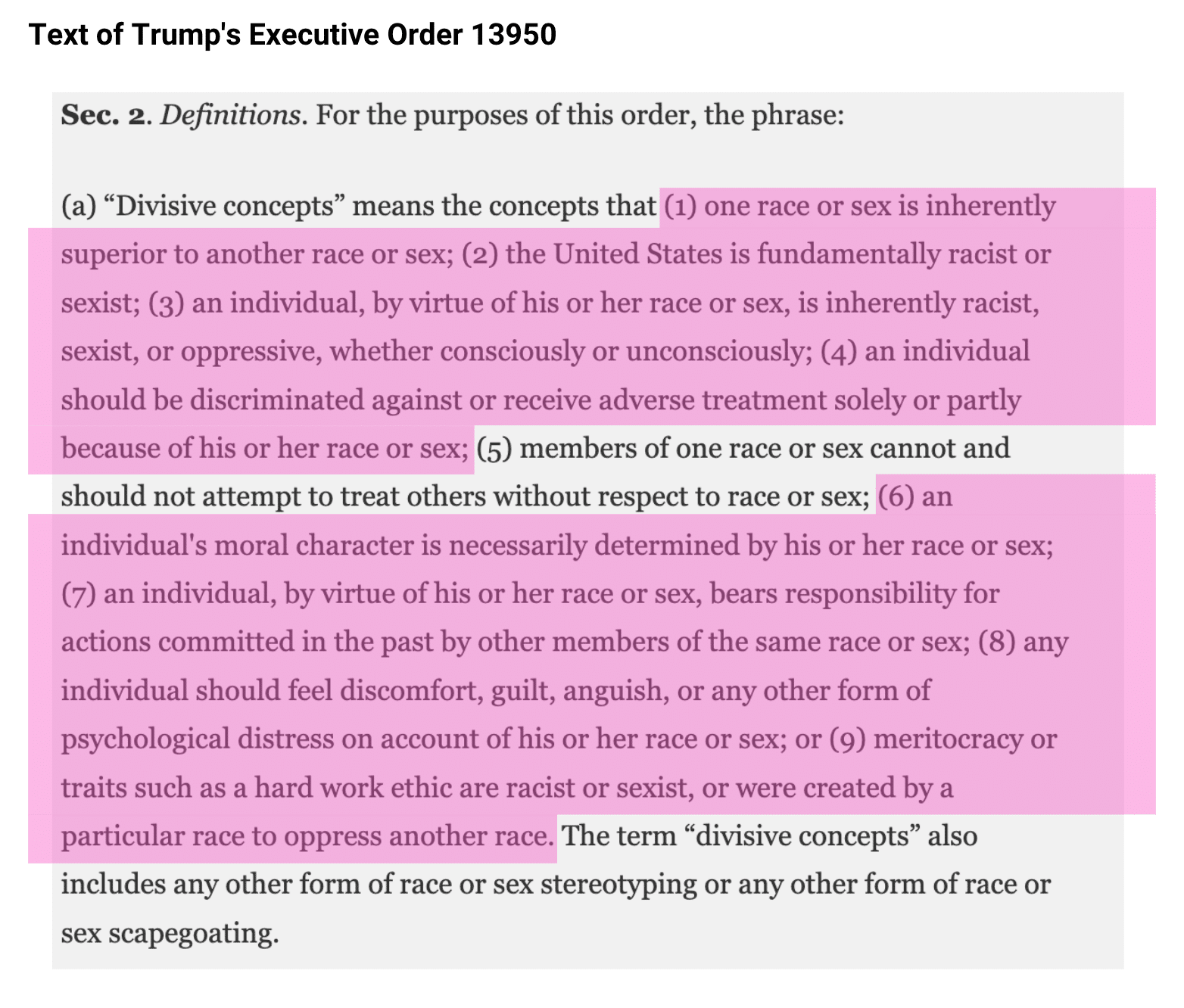
Biden revoked Trump’s order just 5 days after taking office in January 2021, but the concepts have stuck nationally.
A July 2021 investigation by Sarah Schwartz of Education Week traced the lineage of much of the anti-Critical Race Theory legislation across the country to this exact order, signed by Trump in September 2020. From there, similar or verbatim “divisive concepts” language was spread by anti-CRT pundits like Christopher Rufo, who essentially created the anti-CRT panic in part because he believed CRT was “the perfect villain.” Conservative organizations like The Heritage Foundation, America First Policy Institute and the Idaho Freedom Foundation have made fighting this so-called villain a majority battlefront in the culture war. The Idaho Freedom Foundation is a member of the State Policy Network, which, like ALEC, connects state-level conservative think tanks to each other to share policies and advocacy tactics. IFF recently fought against equity-focused school curriculum in Coeur d’Alene.
Idaho passed a “nondiscrimination” bill with nearly identical language to Trump’s as part of a marathon legislative session in April 2021. Six weeks later, the Georgia Board of Education passed an anti-CRT resolution using the same language. Tonight, this language will get a hearing in Mead.
Cannon’s third section, while not as direct a copy and paste as the second, still lifts several lines wholesale and is otherwise indebted to the structure of Chapter 28 of Texas’ Public Education Code, specifically section H, an anti-CRT section that was added by the legislature in Sept 2021:
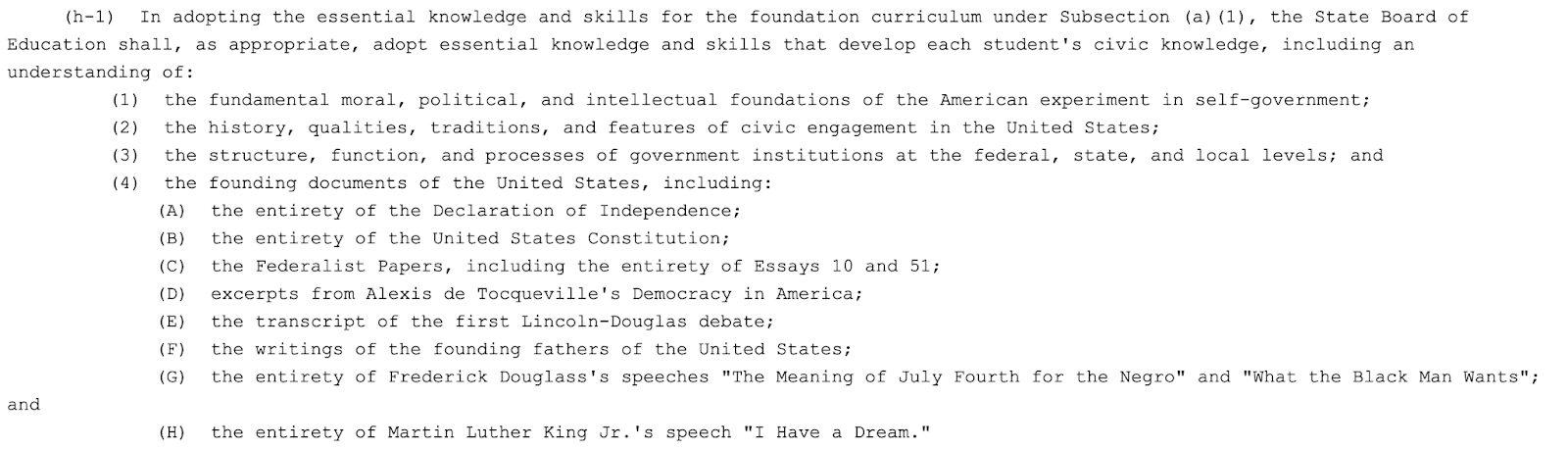
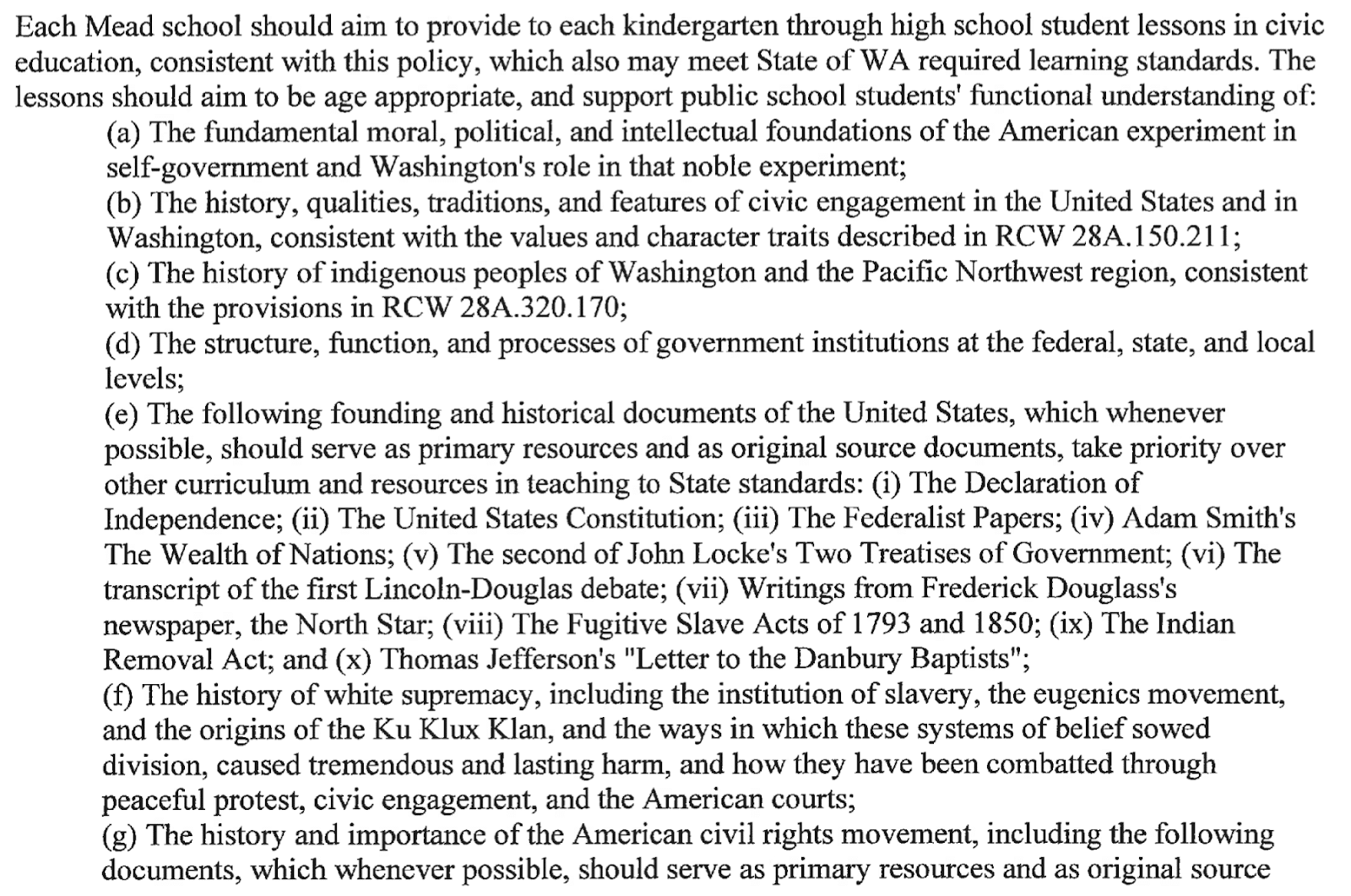
The actual works recommended vary a lot from legislation to legislation, but in all cases there is an attempt to focus on primary sources — the Constitution, the Federalist Papers, Martin Luther King Jr.’s “Letter from Birmingham Jail” — and away from any modern-day interpretations or scholarship.
One fascinating note on these selections is that it contains “Letter from Birmingham Jail” where King spends a lot of time railing against the “white moderate” who continually tells Black people to be patient in their search for rights — clear evidence of the antagonism, but leaves out King’s statement announcing the Poor People’s Campaign, where his rhetoric definitively shifted from white vs black to rich vs poor:

Even among the acceptable thinkers on Cannon’s list, there is so much glossed over, and what is there — both the positive legacy of King and the negative legacy of groups like the Ku Klux Klan are framed as historical artifacts, with no connection to the present day. This couldn’t be further from the truth.
King’s shift in tone toward a multi-ethnic coalition of the working class — including white people — inspired Jesse Jackson’s Rainbow Coalition of the ‘80s, which built a national platform and briefly earned Jackson front-runner status for the Democratic nomination for President in 1988. It was the explicit inspiration for Reverend William Barber’s current Poor People’s Campaign, which seeks to carry on King’s legacy.
The first section and concluding paragraph of the civics policy is also indebted to the Texas law, the Texas Public Policy Foundation and Stanley Kurtz, a fellow at the Ethics and Public Policy Center (an organization: "dedicated to applying the Judeo-Christian moral tradition to critical issues of public policy"). EdWeek identifies these sections as a prohibition on what Kurtz calls “action civics,” which has two main conditions, according to Schwartz, “1) a teacher cannot be compelled to discuss a particular current event or controversial issue, and that if a teacher chooses to do so, they must ‘strive to explore the topic from diverse and contending perspectives,’ and 2) schools can’t make engaging in political activism or advocacy part of their courses.”
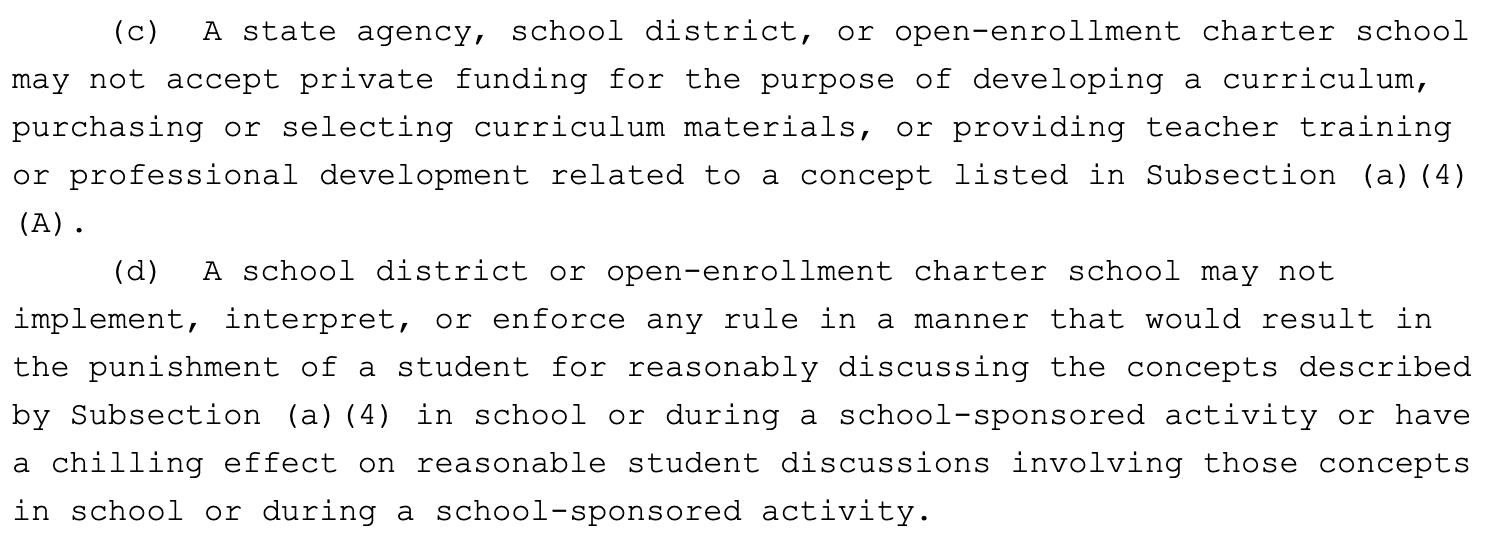
While section 28.0022 8 (d) (pictured below) of the Texas Education Code is very similar to point d) in the first section of Cannon’s policy, language similar to Texas’ (c), prohibiting private funding for CRT curriculum, appears at the end of Cannon’s document.
Battle Lines for a Culture War
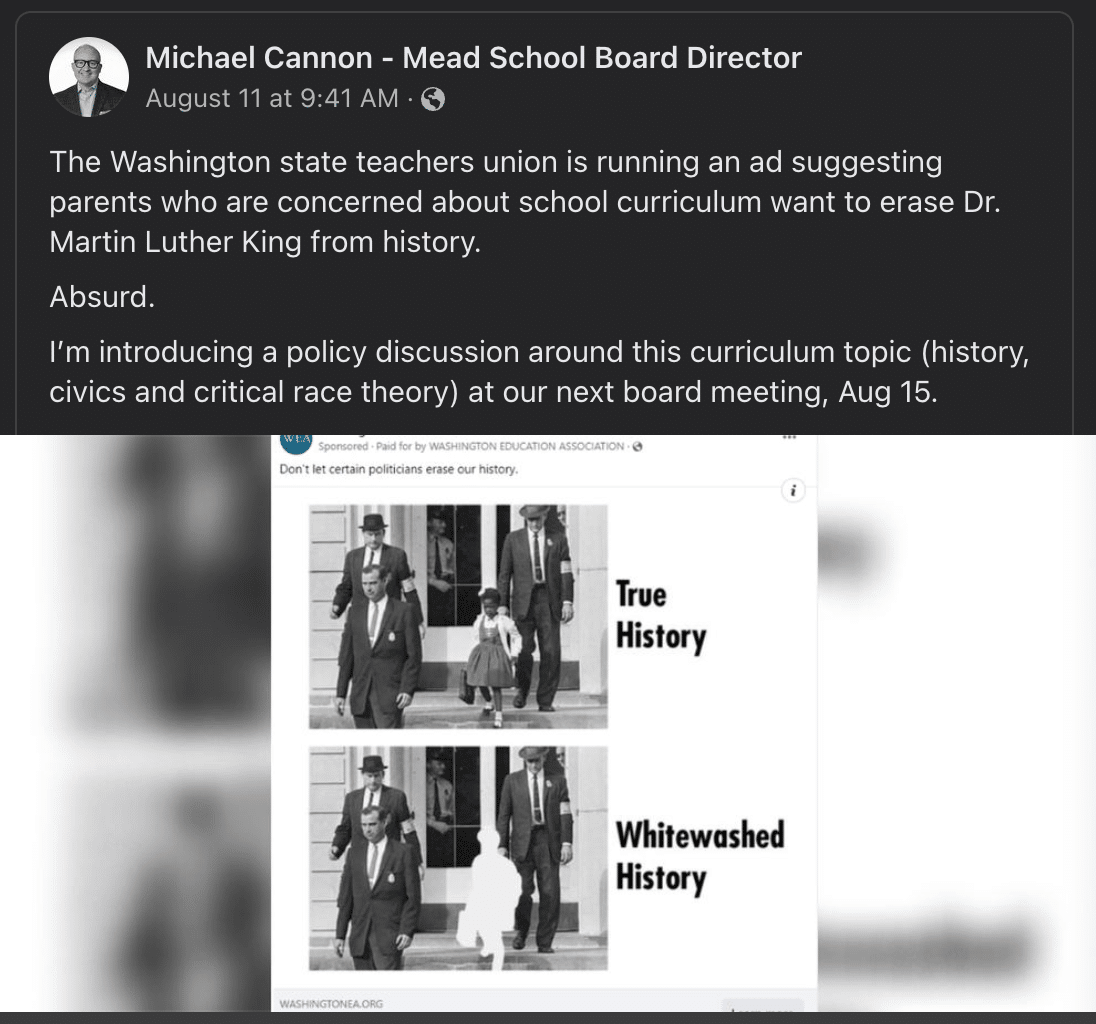
Cannon signaled his intent to introduce these policies on Facebook last Thursday, in a post calling out the Washington Education Association — the state’s largest union for public school employees.
By Sunday, a group of progressive advocates were organizing via Facebook Messenger to turn people out to speak at Monday night’s meeting.
The group chat was almost immediately infiltrated by members of the Facebook group Mead for CHOICE — a group that began as a protest against mask mandates and has since expanded to vaccine skepticism, gender essentialism and anti-CRT activism — and screenshots were posted to the group.
“There is a group of activists in our community and in Midway Elementary who are working to subvert the District’s will to keep our elementary aged students free from the woke ideology of trans activism,” wrote Krista Hanson, the woman who posted the screen grabs. “I pray that those of you who have the influence and the will to fight this cancer, will take immediate action.”
School Board Meeting Information
When: Monday, August 15 at 6 p.m.
Where: Northwood Middle School at 12908 N. Pittsburg St., Spokane, WA 99208.
To view online, go to the webinar link here or call 669-900-6833 and use Webinar ID 873 2269 0122.
Public Comment is slated toward the beginning of the meeting, after the approval of the agenda and minutes. Each speaker gets 3 minutes to talk. Here is the board’s full public comment policy and here is tonight’s agenda.


