


Since his abrupt (and potentially illegal) termination as regional health officer by the Spokane Regional Health District (SRHD) in October of 2020, Dr. Bob Lutz has been the face of an ongoing argument about the politicization of public health in Spokane County.
From repeated attempts to draw attention to inhospitable conditions at the Trent Shelter that have led to multiple disease outbreaks, to recent efforts to educate public officials and service providers on the real data behind the opioid crisis in the county, Lutz has been something of a Sisyphean character questing for data-driven, compassionate public health — often to the detriment of his own career.
The most recent development in Lutz’s saga happened on March 11, when he resigned his position as Regional Medical Officer at the State Department of Health (DOH).
RANGE obtained an email from Tao Kwan-Gett, the Chief Science Officer at DOH via public records request that showed that Lutz’ resignation came without warning and went into effect immediately. State Medical Epidemiologist Dr. Scott Lindquist immediately took over Lutz’s duties. It also happened just one week after Lutz presented opioid overdose data to the Spokane City Council.
Lutz declined to comment on his resignation from DOH and whether the timing of his resignation had anything to do with his presentation at city council.
Spokane City Council Member Paul Dillon, who — in his capacity as Public Health and Safety Committee chair — invited Lutz to speak to council, feared that the two events may be connected. Dillon told RANGE that just after Lutz’s presentation, he learned that Dr. Francisco Velazquez, the current regional health officer for SRHD was “not happy about it.”
Dillon said he got an email from a source at the Spokane Homeless Coalition, a group of service providers that Lutz had also presented data to, claiming that Lutz was being retaliated against for speaking out about data that SRHD had declined to make public or share with city government officials.
Telling the state
Other emails RANGE obtained in our records request showed that one day after Lutz presented to city council, Velazquez emailed Umair Shah, the Secretary of Health at DOH, notifying him that Lutz had presented data with specific statistics for Spokane County.
“During the presentation statements were made relative to declaring a public health emergency in the community, and the availability of resources to support said efforts. The statements have generated a significant level of media attention and inquiries as to the Spokane Regional Health District's intentions or lack thereof to declare said emergency,” Velazquez wrote on March 5.
“I am reaching out to you to better understand if declaring a public health emergency is an expectation from the Washington State Department of Health and if so, what are the resources to support this effort. In addition, it would be important for us to understand the rationale and intent of this presentation and why SRHD was not included in the conversation. I know that you value transparency and open communication and this email is in the spirit of maintaining the good relationship that our organizations enjoy.”
He also sent Shah a link to the recording of the presentation posted on the city’s youtube page.
Shah responded at 9:32 pm that evening, stating that it was the first he was learning of the presentation and “any potential impacts,” it may have, and that Kwan-Gett would be calling Velazquez to discuss further.
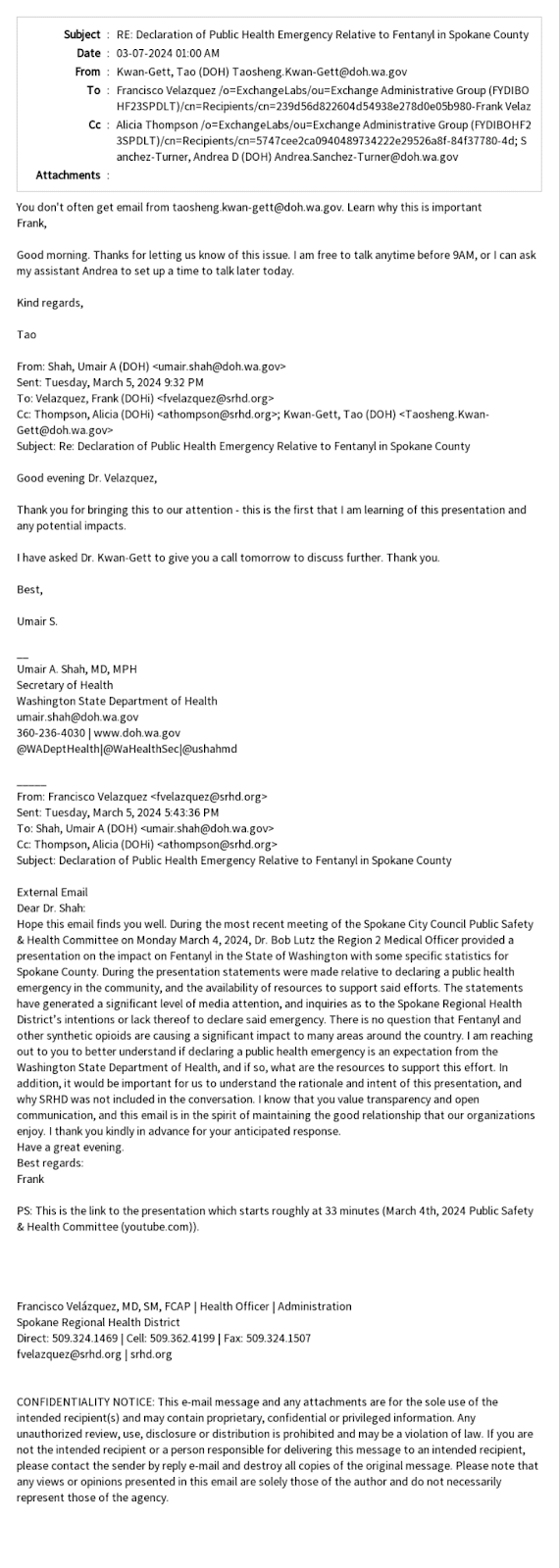
There was also a short email exchange between Velazquez and Kwan-Gett on Thursday, March 7, two days after the initial presentation, where Velazquez sent Kwan-Gett a link to a story from KREM 2 news citing data from Lutz’s presentation in relation to the council’s consideration of a resolution asking Governor Jay Inslee to declare a state of emergency (a resolution which ultimately passed.)
Kwan-Gett thanked Velazquez for sending the information and said he hadn’t been aware of it. Velazquez responded, “Thanks (it’s) part of the issue we discussed.”
Just a few days later, on March 11, Lutz had resigned. Media representatives for DOH declined to comment.
Dillon and other city officials had a subsequent meeting with Velazquez and Alicia Thompson, SRHD’s administrative officer, to discuss that resolution.
“I've never seen two people more nervous about a resolution,” Dillon said. He also mentioned repeated frustrations he and other council members have had in their attempts to get up-to-date data from SRHD. “The lack of transparency and the lack of public information was really frustrating, so it felt like we had to go to Dr. Lutz and his expertise to get answers.”
Dillon said he felt like Velazquez and Thompson interpreted his request of data from Lutz as a threat to them. So, at the end of the meeting about the resolution, he asked them point blank: “did you reach out to the state [department] of health to complain about Dr. Lutz?”
According to Dillon, Thompson told him they could not answer that question because it was “a legal matter.” Kelli Hawkins, Public Information & Government Affairs, could not provide comment relating to Lutz due to ongoing litigation, but said she wouldn't characterize Velazquez' email as a "complaint," and sent over a copy of his initial email to Shah.
Lutz does have an ongoing unlawful termination lawsuit against SRHD, which he also declined to comment on, but his attorney Robert J. Carlson provided the following statement to The Inlander in 2022:
“The primary basis for Dr. Lutz’s complaint is the Wrongful Termination of Dr. Lutz from his position as Health Officer of SRHD. The Claim for Wrongful Termination has numerous bases, including violations of statutory protections under Washington law, violations of internal SRHD bylaws, lack of just cause, and violations of public policy and State and Federal Constitutional protections. As included in the complaint, Dr. Lutz is seeking reinstatement to his position as Local Health Officer, damages resulting from the SRHD’s and Ms. Clark’s actions, and costs and attorney fees."
Shortly after Dillon’s meeting with Velazquez and Thompson — right around the beginning of April— Dillon said he received a subpoena request for all his communications with Lutz.
“It felt to me like it was hyper-defensive, afraid,” Dillon said. “All I was really doing was looking for the truth and for answers.”
Since the resolution passed on March 25 (and after Spokane’s IT department sent over his records), Dillon said he has had no further communications with or from SRHD — not even to provide the requested up-to-date data on overdoses.
Hawkins said that’s not an accurate characterization of SRHD's relationship with the city government, and that they’ve been open and communicative with both city council officials and the mayor's administration about all actions SRHD is taking. She also pointed to their dashboard, which now reflects preliminary overdose death data for both 2023 and 2024.
"The idea that we’re sitting on data," Hawkins said, "That’s not accurate."


