

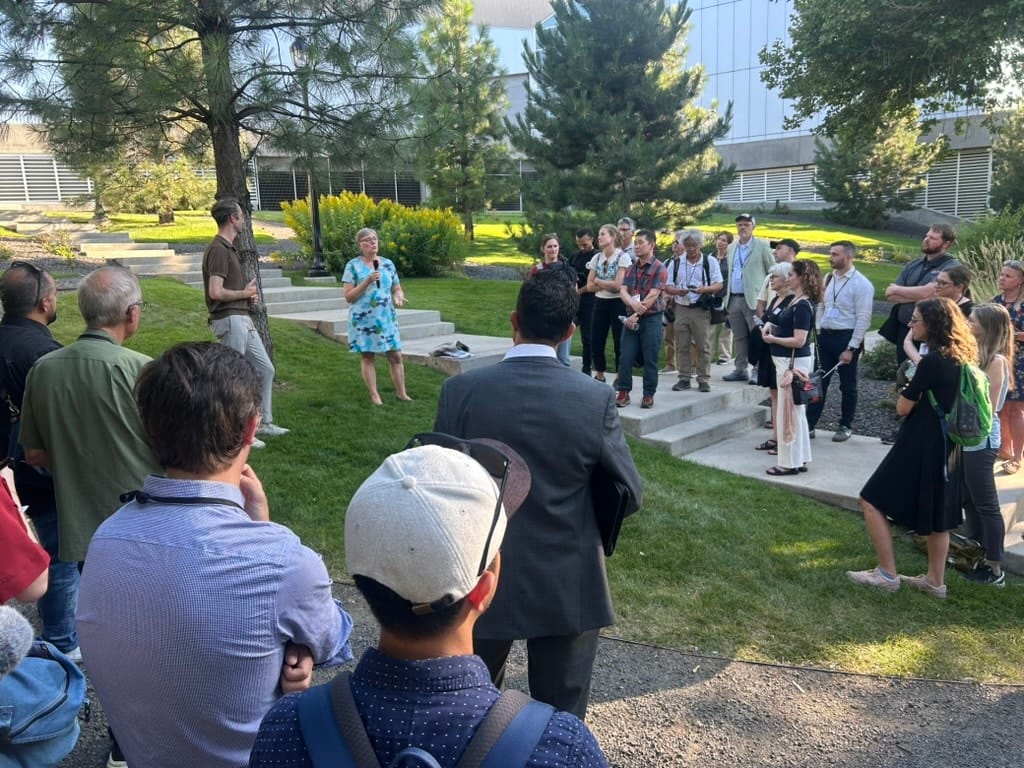
Transportation Choices Coalition (TCC), a statewide advocacy and lobbying nonprofit, was in Spokane last week for the Washington Traffic Safety Summit and hosted a Walk & Talk event that featured local and regional speakers to discuss the current and future states of Division Street.
74 attendees from across the state walked together along the south end of the corridor to observe for themselves the difficulties present today for those walking, cycling and taking transit.
Division Street is a state-owned highway, but it runs through the city, serving dual and sometimes conflicting roles as both a long-distance route and a local-access route.
That combination is deadly: 47% of pedestrian and cyclist fatalities occur on roads managed by the state, many of which are state highways running through towns and cities.
According to the Spokane Regional Transportation Council’s Division Connects study, “bicycle and pedestrian related crashes accounted for just 5% of total crashes, but 64% of severe and fatal crashes involved nonmotorized users.”
TCC’s Executive Director Kirk Hovenkotter counts Division Street among the Washington streets most in need of rehab.
“Division is a dangerous, state-owned street that doesn't work well for anyone on it, whether you are driving, walking, or rolling,” he said in a statement to RANGE. “That's especially true for the bus riders who make it the busiest transit street in the city. It lacks accessible sidewalks. There are football field sized distances between crosswalks. There's sparse shade, and no place for seniors to wait if they can't cross the street in time. Wide lanes encourage drivers to speed, crashes are frequent, and there are few appealing alternatives to being stuck in your car. There is no safe bike lane, and no bus lane to get the 25 around traffic.”
Walking the corridor with Hovenkotter and TCC, attendees saw firsthand evidence of Hovenkotter’s assessment: shade was scarce and sidewalks were narrow and positioned next to very loud traffic with no buffer. Even with a microphone and an amplifier, Walk & Talk speakers could not be heard over the din of traffic — even “regular” traffic noise was deafening, and attendees cringed at each louder-than-average truck or motorcycle.
Erik Lowe, Co-Executive Director of local advocacy group Spokane Reimagined, said he wants Division Street to be reshaped to serve everyone, not just those passing through in cars.
“Division is geared primarily for those who want to drive highway speeds within the city limits. During the walk and talk, I’m not sure if we were passed by a single vehicle going the posted 30 mph speed limit,” Lowe said. “It is an imposing hurdle for anyone not in a motor vehicle.”
The city of Spokane, the Washington State Department of Transportation (WSDOT), and Spokane Transit Authority (STA) are planning quite the makeover: Dan Wells, STA’s Deputy Director of Capital Development, described for attendees how STA plans to upgrade its existing service on the corridor into a Bus Rapid Transit line, featuring spacious, comfortable, amenity-filled stops, 15-minute headways and modern electric five-door buses. People who use the City Line — STA’s first bus rapid transit line — know what to expect: frequent, on-time, consistent service. Even better, coaches on Division Street will skip traffic in reserved lanes (which will also allow for right turns by those traveling in cars).
STA and the city are also collaborating on 30 active transportation projects in the area, most designed to ensure people can safely walk and cycle to and from BRT stops.
Farther north, WSDOT is planning to revamp Division Street from The Y at Country Homes Boulevard to Wandermere to adhere to Complete Streets laws. The agency plans on reducing speed limits, adding cycling infrastructure and adding more crossings for pedestrians.
Hovenkotter and TCC spend their days advocating for statewide legislation to address the Division Streets of other cities and towns — those state-owned highways cutting through urban areas. They hope the state will fund a “Megaproject for Safety,” a $1.5 billion fund spread over 10 years for revamping these dangerous and polluting corridors found in every crook and cranny of Washington. The state is familiar with transportation projects that size — the North Spokane Corridor will end up costing around the same amount.
During the Walk & Talk, Barb Chamberlain, Director of WSDOT’s Active Transportation Division and former bicycling activist in Spokane, encouraged attendees (many of whom work in transportation elsewhere) to dream big when considering how wide rights-of-way can be transformed to serve those walking, cycling and taking transit.
“We can make our streets work for everyone,” Chamberlain said.


