

Housing and homelessness. Policing and public safety. Traffic calming and transit.
In interviews for a forthcoming special section, most of the Spokane City Council members told RANGE these were their top priorities for the first quarter of 2024. Community members we interviewed got even more granular, expressing hopes that their elected officials would move quickly on creating pedestrian-focused infrastructure; flexible, innovative child care infrastructure; and preventative solutions to the housing crisis.
Yet, as the first month of the year comes to close, of the eight hours and 32 minutes council has been in regular Monday night City Council meetings, two hours — almost ¼ of their time — has been spent discussing, enforcing and hearing public comment on the new council rules, passed on January 22. After a protest against the rules from Spokane Community Against Racism (SCAR) on January 29 led to multiple council recesses and two temporary rules suspension with no clear conclusion, it’s likely that the conversation will continue to eat up time the city could be using to do city business.
That’s something council members in favor of the new rules and community activists both agree on: the conflict is wasting valuable time. But with an apparent deadlock, it’s unclear if either side will budge, leaving everyone to wonder just how much time at these meetings will be spent fighting about the rules.
For activists, peaceful protest is a way for people to silently voice their dissent or support, without having to scramble for an Open Forum slot, share their name publicly or research legislative items. And, activists say, someone standing in the room shouldn’t prevent council members from doing city business.
“Our participation is not a problem,” Justice Forral, a member of SCAR, said during Open Form at the January 8 city council meeting. “Your reaction to our participation is."
For council members, these protests represent an intimidation tactic and pose concerns for other community members who they say may be too scared to come speak at council meetings because of the protestors.
“When a group of 10 to 30 people stand up and turn their backs to you, there's a visceral reaction in people. Your heart starts racing. You get nervous and afraid to speak and you start fumbling what you're saying, you can't speak clearly,” Zappone said. “We have communicated that to the group of activists about this and they don't seem to be respecting other people.”
Every January, the city council votes on the rules of procedure that will govern the body for the rest of the year. The 38-page document gives clarification on everything from the place and time of meetings to the flow of legislation out of committees, but most of the changes criticized by community activists like SCAR, the Party for Socialism and Liberation (PSL) and Peace, Justice and Action League of Spokane (PJALS) lay in the sections defining council chamber decorum and the structure of the treasured Open Forum, the time set aside for the public to bring up issues to council members that aren’t listed on the agenda.
The rule changes, proposed by new Council President Betsy Wilkerson, have been controversial since their inception at the beginning of January. The first draft included a pitch to move Open Forum from the beginning of every meeting to a longer, once-a-month affair, which drew quick criticism.
Though the move to monthly forums was dropped early on, the replacement idea — shifting Open Forum to the end of the meeting instead of the beginning — seemed to be equally unpopular. Prior to the vote, freshman Council Member Paul Dillon told RANGE he’d received over 100 emails from constituents, all advocating against the rule changes.
Adding fuel to the fire, the rule changes also included a ban on standing in the chambers, a prohibition against video recording and removing the option to use visual aids and presentations during Open Forum or legislative testimony. Activists like Forral from SCAR and Zach McGuckin from PSL argued this was a direct response to the flood of civic engagement and protests the council had seen after passing a pro-Israel resolution just two days after the October 7, 2023 attack by Hamas, with no advance notice or public commentary, and abruptly ending a meeting after Forral read a transcript of a city council meeting in early November.
Public and council comment on the pro-Israel resolution, the drafting of a replacement resolution and the situation in the Middle East as a whole frequently took up all 15 of the Open Forum slots at the beginning of the meeting in the final months of 2023, and the trend continued into 2024, with testimony on this topic accounting for another 15.64% of all council time on the dais in 2024.
The rule change agenda item drew nearly an hour of public comment on January 22 — the day of its approval by a 4-2 margin — with Council Members Dillon and Michael Cathcart voting in opposition.
If the council had hoped to close the chapter on rules changes and move quietly on to items with more legislative importance, they were sorely disappointed.
Three hours before the scheduled 6 pm start of the January 29 Spokane City Council meeting, when the new rules would take effect, Mayor Lisa Brown and the council received a letter contending that the decorum rules prohibiting videography and standing in the chambers violated the state’s Open Public Meeting Act (OPMA). The letter was sent by Natasha Hill, a Spokane attorney and editor-in-chief of the recently relaunched The Black Lens newspaper, on behalf of SCAR.
“Because the SCAR members will cause no disruption, removing them for videorecording outside a designated area will violate their rights under the OPMA and the First Amendment to the United States Constitution," the letter read. “Please know that SCAR will bring legal action in the event the Spokane City Council violates the OPMA. SCAR will also bring action on behalf of any of its members, whose constitutional rights or rights under OPMA are violated.”
At the top of the meeting, Wilkerson read out the new council rules to the chamber. She clarified that the line about filming from “designated areas” would not limit people from recording with their cell phones while seated — one of the rules referenced by SCAR’s letter — but the standing rule remained.
Defiant or disruptive?
At first, all was quiet.
But, almost exactly 20 minutes after this Monday’s meeting began, Sam Lee, a member of both SCAR and PSL, stood, sliding silently from their seat to lean against the wall of the Council Chambers. It took nearly a full minute for any of the council members to notice, but once Council Member Jonathan Bingle did, he quickly called “point of order,” a term used to identify violations of the rules or correct misinformation.
Wilkerson requested that Lee sit. Instead, they responded, “I’m within my rights to stand,” a sentiment they repeated multiple times over the course of the evening. And so, 24 minutes and 36 seconds into the meeting, Wilkerson called the first five-minute recess.
Council members milled about the chambers. Wilkerson, Dillon and freshly appointed Council Member Lili Navarrete huddled with Chris Wright, the council’s policy adviser, before Dillon moved to chat with the protesters.
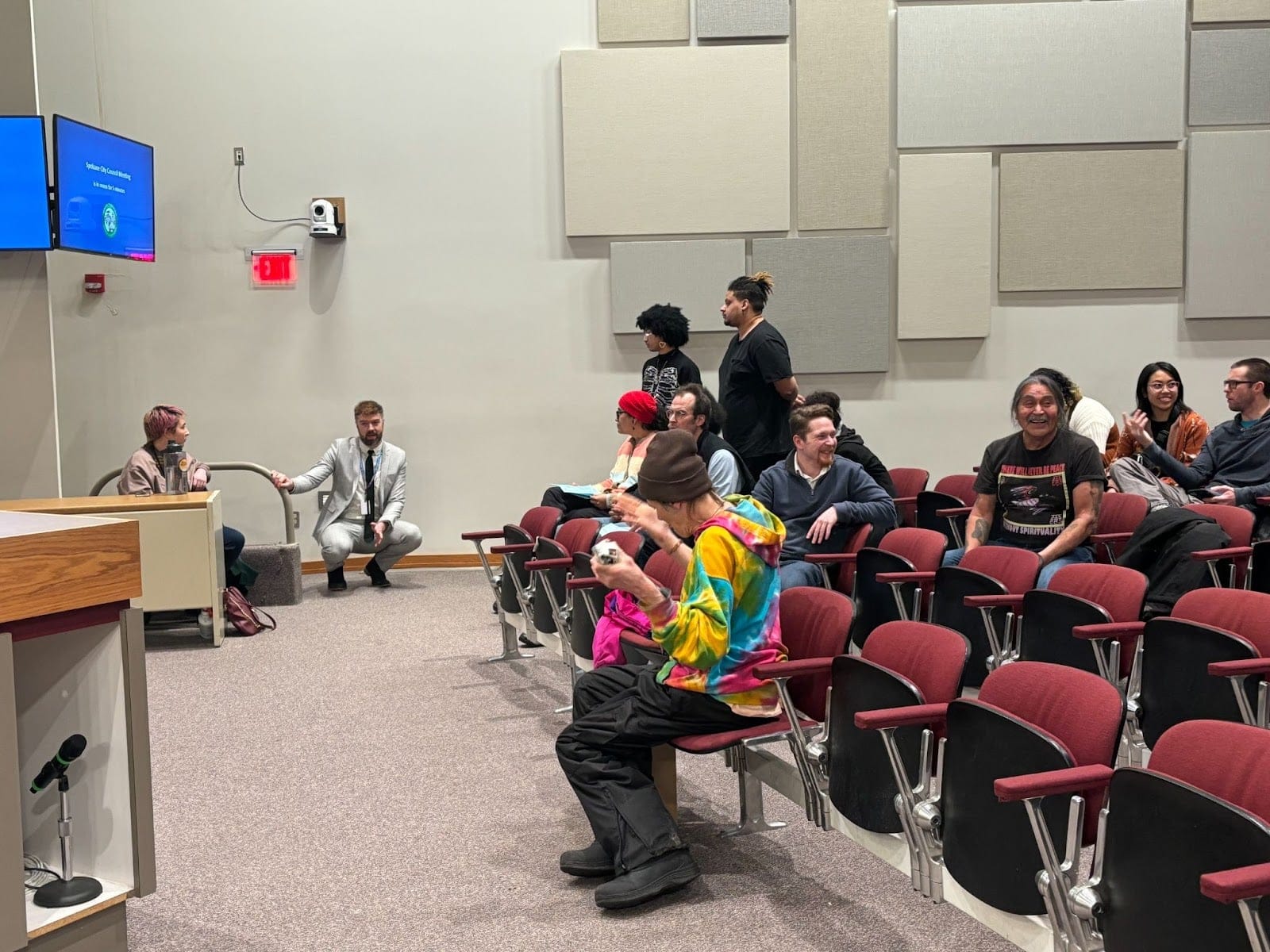
Sam Lee, Paul Dillon and members of SCAR and PSL talk during a recess. (Photo by Erin Sellers.)
After the five minute recess, council resumed their proceedings with no mention of the rules violations and continued city business — taking legislative commentary on an agenda item supporting the South Logan Transit-Oriented Development (TOD) Plan — but, within two minutes, Bingle again called a point of order as Lee again stood in the corner of the room near the dais, with a few fellow SCAR and PSL members joining them on their feet.
Though Dillon asked for a temporary rules suspension to allow standing, the council’s new president pro tempore, Zack Zappone, instead moved for another five minute recess, which was then extended by another three minutes.
In the eight-minute break, council members again wandered around. Bingle and Cathcart retired to the Briefing Chambers. Wilkerson and Zappone talked to the protesters. Some council members engaged in quiet conversations as they paced the dais.
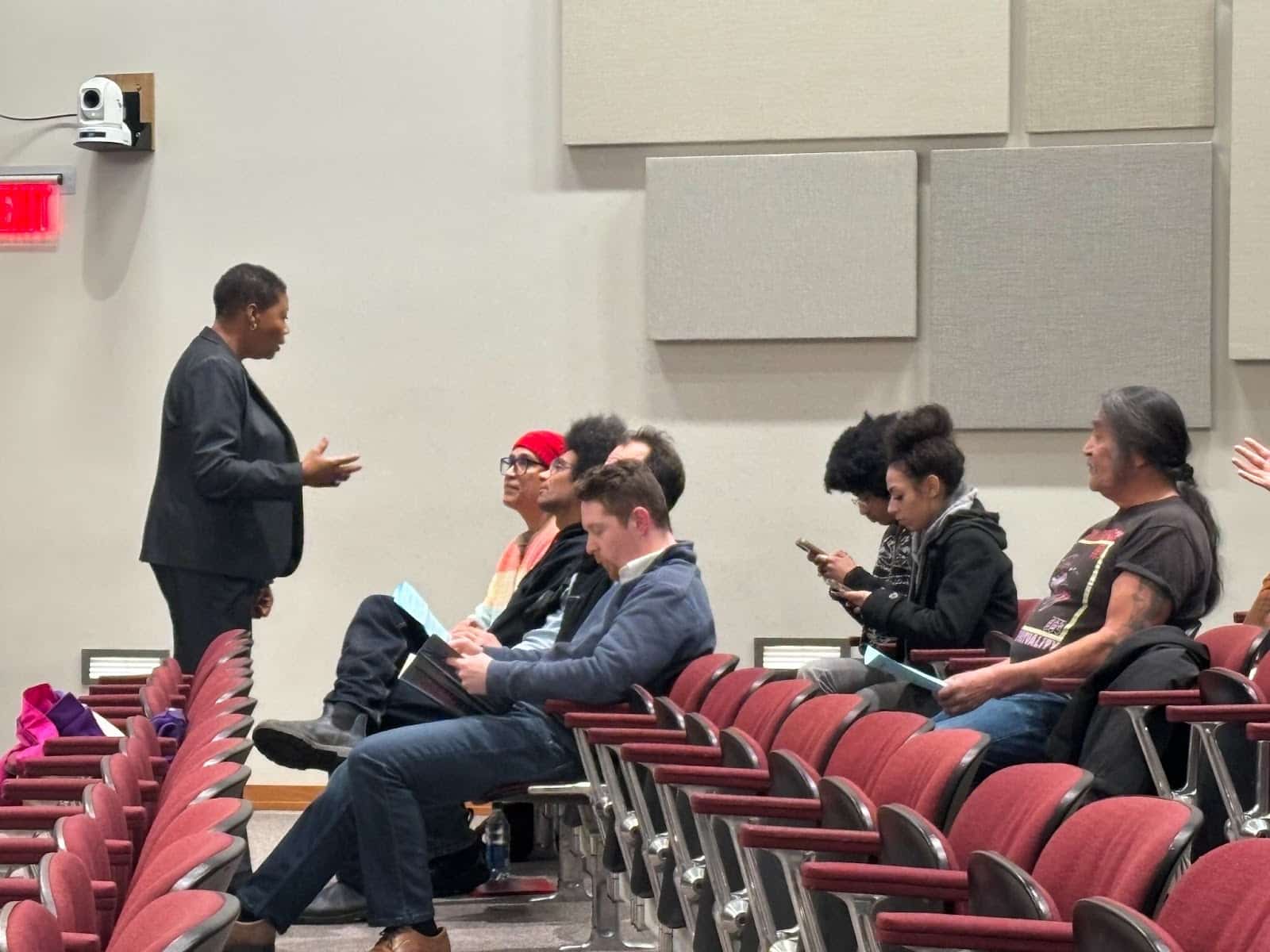
Council President Wilkerson talking with SCAR members during one of the recesses. (Photo by Erin Sellers.)
As they came back from recess, Wilkerson moved the council straight into business, taking testimony on the TOD plan and calling for a vote. Just after the resolution passed, for the third time of the night, Bingle leaned into his microphone.
“Point of order.”
Lee was standing again.
This time, Zappone immediately moved to suspend the rules — a somewhat complicated procedural move that first required council to vote to suspend the rules, then required additional votes on which specific rules they’re going to amend. The council ultimately voted to suspend the rules on standing just for that meeting — a victory for the protesters.
“For the purposes of tonight, to get through tonight’s meeting and make sure city business can continue, it’ll be more productive for us to not enforce the rules tonight,” Zappone said.
But Zappone wasn’t finished, immediately handing protesters a defeat, as council members unanimously voted to suspend the Open Forum scheduled for the end of the meeting.
“We all believe in free speech and the importance of having the voice of everyone heard up here, and we want to make sure that it’s a safe environment for everyone to be here, for every individual,” Zappone said. He went on to point out that the protesters were standing, with their backs turned, in the front row, “very close to the dais,” and said that he’d personally heard from community members who felt unsafe to come down to city council meetings and speak.
Cathcart seconded that sentiment, stating, “I will not have my wife and my child come down in this environment.”
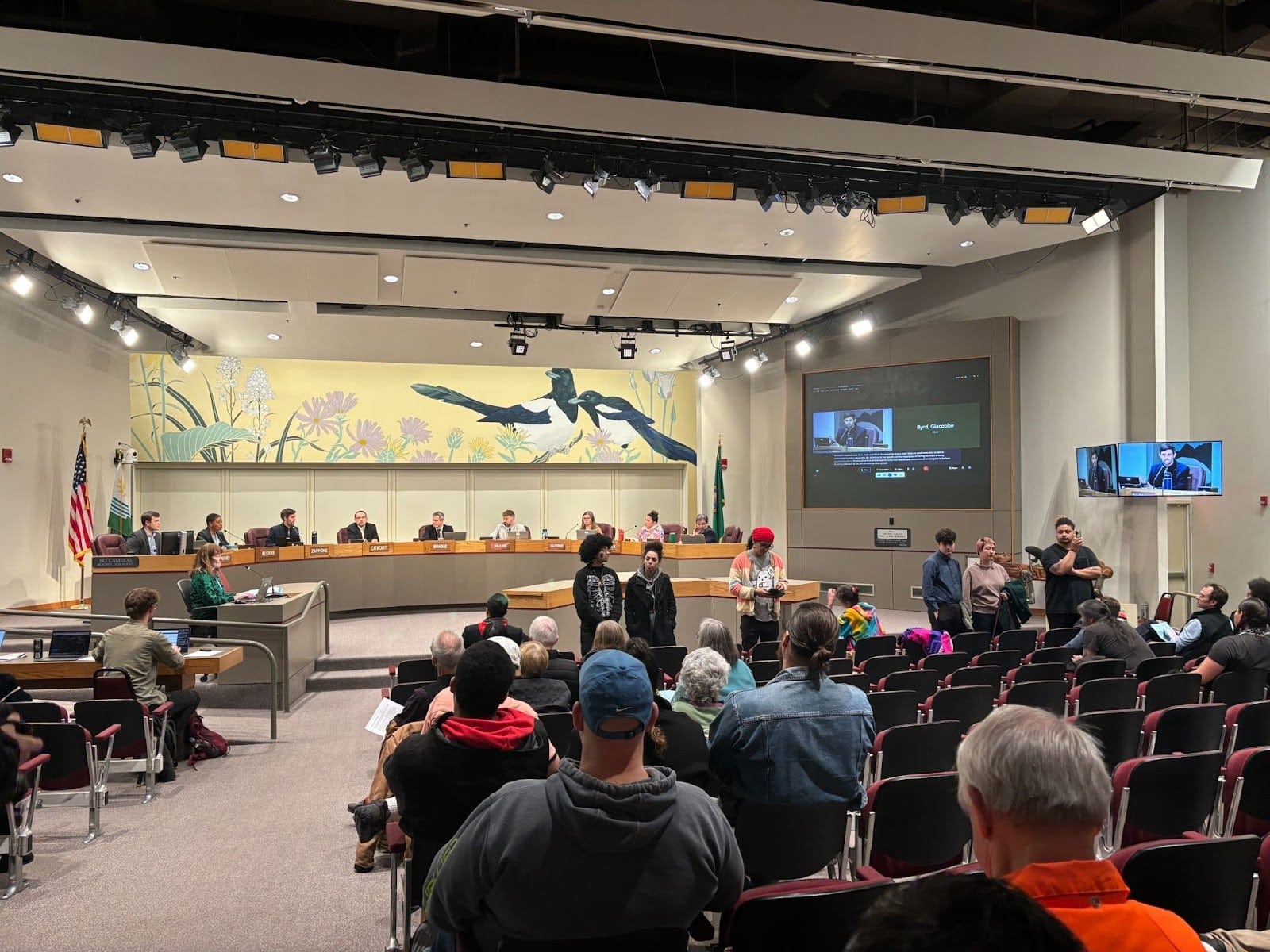
Protesters standing “very close to the dais,” according to Zappone. (Photo by Erin Sellers)
The rest of the meeting continued mostly with business as usual, except for legislative testimony from SCAR activist Forral, who wove in as much of their frustration with the council’s actions into commentary about the specific agenda items as they could get away with while still being considered on-topic.
Then, it ended abruptly, with no Open Forum to close it out.
It’s unclear what will happen at next week’s meeting if protesters continue to break rules, though Zappone said on the dais that the council hoped to have conversations with the activists before the next meeting.
“There seems to be this belief that people can say whatever they want whenever they want and do whatever they want,” Zappone told RANGE in an interview this week.
He said the Spokane City Council already goes above and beyond what is required by state OPMA laws by having an Open Forum and in-person legislative testimony at all, and reiterated that allowing coordinated activist groups to use standing as a means of dissent is “intimidating” for people who don’t belong to that group or who have opinions the group disagrees with.
“Every single member of council has stated over and over, we want to hear from you,” Zappone said. “But we have to do that in a way that allows everybody to speak their truth.”
After the meeting, RANGE spoke with Forral, who was visibly frustrated with the council’s decisions that evening.
“We did something they didn't like, what did they do? They punished us by removing Open Forum,” Forral said. “That’s insanity.”
Forral agreed that the city had important business to focus on — they’ve been a frequent testifier on issues like housing and homelessness, renters’ rights and police accountability — but from their perspective, city council members have gotten in their own way.
“If they just let that person stand who was being peaceful, who was completely silent, not being disruptive, and literally in the corner of the room doing absolutely nothing,” Forral said, it wouldn’t have prevented the city from conducting its business.
“Most people would say that was not a disruption and city council went out of the way to say it was,” Forral finished.
“They don't like our defiance, especially as indigenous people,” added Warbear, one of the protesters, as security guards informed attendees Council Chambers were closing. “They've never liked our defiance.”


