

Editor’s note: The article discusses sexual assault. “Guarded by Predators” is a new investigative series exposing rape and abuse by Idaho’s prison guards and the system that shields them. Find the entire series at investigatewest.org/guarded-by-predators.
In a small courthouse in southeast Idaho, a woman incarcerated at the nearby prison had just finished testifying that a male guard came into the bathroom on her cellblock and kissed her on at least five different occasions.
She also told the court that one day, around Easter in 2012, the guard, Kim Rogers, had followed her into a janitor’s closet at Pocatello Women’s Correctional Center, reached under her shirt and grabbed her breasts. A week later, in the same closet, Rogers put his hand down her panties and touched her before she yanked his arm away, she testified.
That may have been a crime according to Idaho state law, which deems genital contact between prison staff and a prisoner — but not groping or kissing — illegal. Rogers had even confessed to a detective that he touched her “vagina.” But his defense attorney still argued that it was not necessarily an admission to a crime.
Rogers’ attorney, Justin Oleson, challenged the detective who took the stand next, asking why he didn’t ensure Rogers understood the word “vagina.”
“I assumed that due to his age and experience, and the fact that he was in law enforcement and had training with proper contact with inmates, and what he should and should not do, that that had already been covered during that training,” Detective Tony Busch replied.
For the next five minutes, the woman listened as four men — a prosecutor, defense attorney, judge and police detective — debated what, exactly, Rogers meant by vagina.
“Where did he touch her vagina at?”
“I don’t know. I didn’t ask. Anywhere is a violation of the law, whether it’s the front, back, side, it doesn’t matter.”
“Did you ask him how he knew that he touched her vagina and not just her pubic hair?”
“I don’t recall if I asked him that or not.”
“Do you think he…”
“He understood what I was asking, yes.”
“And you know that because he defined those areas for you?”
“No, he looked at the ground, put his head down and said, ‘I know what I did was wrong. I made a mistake.’”
Oleson, the defense attorney, eventually arrived at his point.
“As I think somebody told me when I was a little kid, boys have outies and girls have innies,” Oleson said. “So, it’s pretty easy to determine whether you’ve touched a male’s genitals. He touched, according to the officer, her vagina, but what does that mean? I believe the state has a burden to prove what the genitals are. They haven’t.”
Judge Paul Laggis, exasperated with the defense’s argument, conceded that Idaho state law does not clearly define a woman’s genitals. Bannock County prosecutor Vic Pearson later offered Rogers a plea deal for a lesser charge of attempted sexual contact and a penalty of eight years’ probation. Rogers accepted it. He served no prison time for the abuse. His probation was dismissed after serving less than five years and the charge was removed from his record.
The case against Rogers highlights how difficult it can be for prosecutors to hold correction officers accountable for sexual abuse, even when a guard seemingly confesses to the crime.
Idaho, like many states, limits its definition of sexual assault when the victim is an inmate. Even though federal standards say all inappropriate touching by prison workers and even suggestive comments or voyeurism are illegal, Idaho’s law protects inmates from abuse only when staff touch the victim’s genitals or they’re made to touch the genitals of staff.
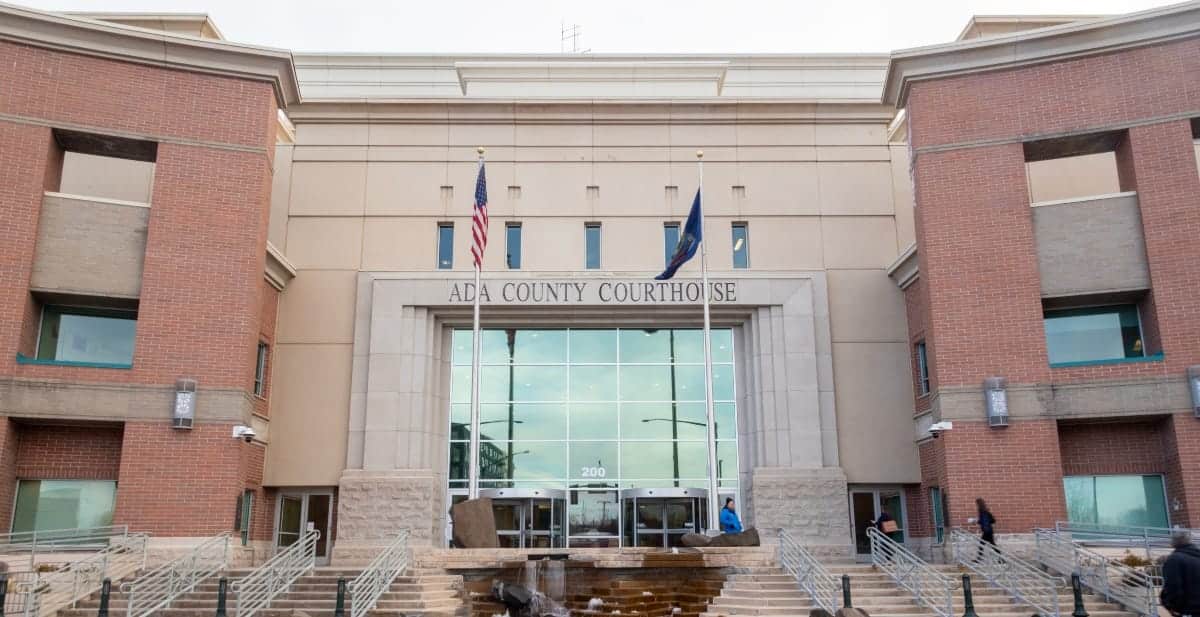
The exterior of the Ada County Courthouse in Boise, Idaho. (Kyle Green/InvestigateWest)
It’s still illegal in Idaho to touch the groin, inner thighs, buttocks, breasts or genital area of any person, including an inmate, without their consent. Guards can be charged with felony or misdemeanor sexual battery for abusing an inmate. But that rarely happens.
Incarcerated victims often go along or reluctantly agree to sexual requests from guards because they’re afraid of what will happen if they say no. For that reason, inmates cannot consent under federal and state laws written specifically to protect prisoners from abusive workers, requiring only proof that the sexual contact occurred. Idaho’s sexual battery laws, however, don’t recognize the power that prison staff hold over the people in their custody and, therefore, require prosecutors to prove that the victim did not consent. Prosecutors say that is especially challenging when the victim is an inmate, who is often perceived as untrustworthy.
The result: Idaho guards harass and assault inmates with impunity and little fear of criminal consequences. In the rare cases that they are charged, accused guards are typically offered a plea deal that requires no prison time, while their victims spend years incarcerated for drug offenses, DUIs and parole violations.
InvestigateWest interviewed dozens of women who described, in detail, sexual harassment and assaults they experienced from prison workers. But few of their abusers were ever charged with any crimes.
In the last decade, 11 Idaho prison staff at men’s and women’s facilities have been prosecuted for sexually assaulting an inmate. Only two were sentenced to a prison term — but instead of serving their yearslong sentences, they served fewer than 10 months in a treatment program where participants are housed separately from the general prison population.
Prosecutors and investigators are trained to be skeptical of people in custody, longtime federal prosecutor Fara Gold acknowledged in a 2018 report to federal prosecutors. And inmates who struggle with addiction or have lengthy criminal histories are even less likely to be believed, according to the report, which offered guidance on prosecuting law enforcement sexual misconduct. And that’s likely why their abusers choose them, she said.
“The challenge in prosecuting any sort of law enforcement misconduct, but certainly law enforcement sexual misconduct, whether it’s police officers or jailers, is that they choose victims who no one is going to believe,” Gold said. “They are targeted, these victims, because the perpetrators bank on the fact that no one’s going to believe them.”
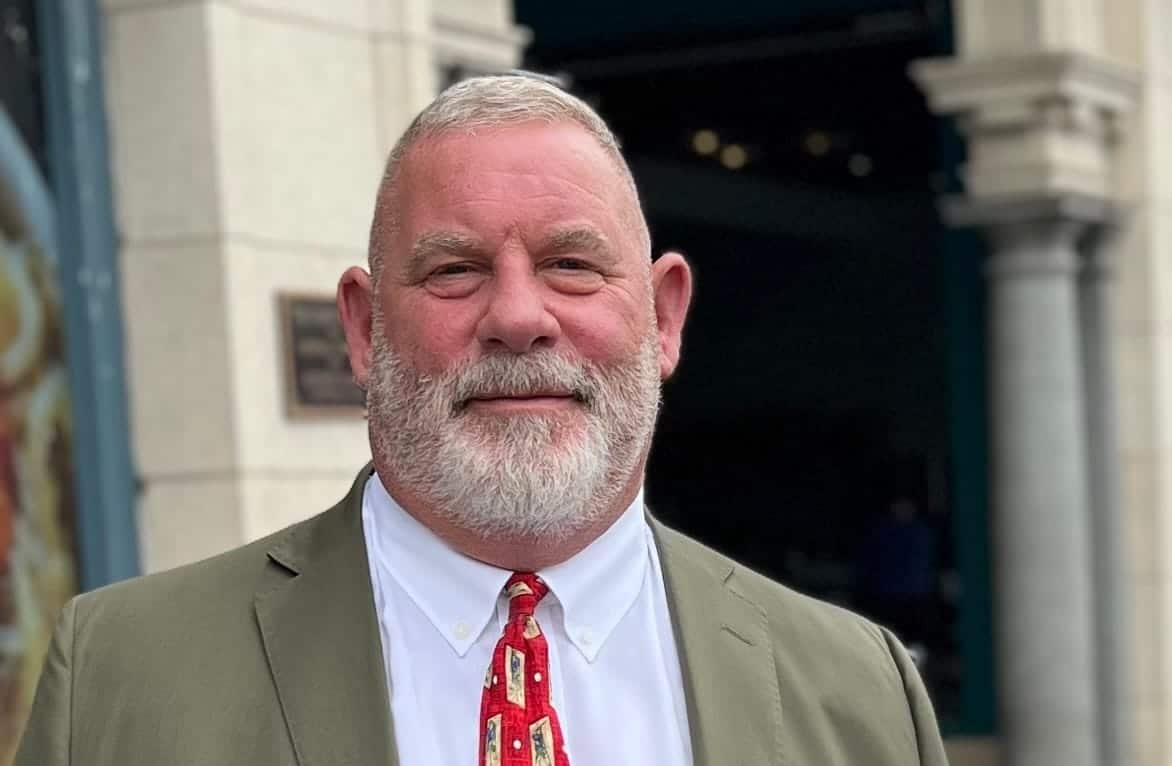
Attorney Joseph Filicetti, shown here outside his office in Boise, Idaho, authored and lobbied for the Idaho state law that criminalizes sexual contact between corrections staff and prisoners. But even Filicetti says the law, which only protects inmates from assaults that involve contact with a person’s genitals or anus, doesn’t do enough to protect people in custody. (Photo courtesy of Joseph Filicetti)
Control and consent
Idaho made it a felony for corrections officers to have sexual contact with inmates in 1993, long before the U.S. Department of Justice developed its standards.
The law, written by a former Ada County deputy prosecutor, carries a maximum sentence of life imprisonment but lacks a mandatory minimum sentence, leaving penalties up to a judge. That allows most offenders to avoid prison time altogether.
Meanwhile, Idaho incarcerates more women per capita than any other state, driven largely by harsh drug charges, many of which have mandatory minimum sentences. Early this year, state lawmakers imposed a fine of at least $300 for possession of up to 3 ounces of marijuana. Quantities over 1 pound carry minimum sentences of at least one year in prison and a $5,000 fine. And last year, lawmakers sharpened penalties for fentanyl users and distributors by adding mandatory minimum prison sentences.
window.addEventListener("message",function(a){if(void 0!==a.data["datawrapper-height"]){var e=document.querySelectorAll("iframe");for(var t in a.data["datawrapper-height"])for(var r,i=0;r=e[i];i++)if(r.contentWindow===a.source){var d=a.data["datawrapper-height"][t]+"px";r.style.height=d}}});
State legislators later expanded the sexual contact law, applying it to all contract workers and employees of the Idaho Department of Correction and juvenile corrections. But critics say the state’s definition of sexual contact falls short of other states and federal mandates, leaving Idaho inmates even more vulnerable.
Even the attorney who authored and lobbied for the law at the Idaho Legislature, Joseph Filicetti, said it doesn’t do enough to protect people in custody from sexual assault.
From 1987 to 1996, Filicetti prosecuted sexual abuse and other crimes committed in prisons located in Ada County. But it was difficult to prove the level of control that a Department of Correction worker had over a victim, Filicetti told InvestigateWest. So he wrote the 1993 law that was passed by lawmakers as a bright-line rule.
“You’re in control of these people, so they’re off-limits,” Filicetti said.
But the law only covers assaults that involve at least one person’s genitals or anus, leaving prosecutors with the same hurdle for abuse that doesn’t meet that threshold.
For those situations, “you can file a sexual battery” charge, Filicetti said. But in his nine years as a prosecutor, he never did. When asked if a prison worker had ever been charged with sexual battery in Ada County, a spokesperson for the prosecutor’s office said they do not track that information.
In 2015, Idaho officials agreed to comply with the federal Prison Rape Elimination Act, which prohibits staff from engaging in a broad range of sexual misconduct: kissing an inmate; touching their breasts or buttocks even over clothing; coercing or requesting sexual favors; gawking at inmates while they undress; and making derogatory or suggestive comments. But Idaho has failed to update its state law to reflect those guidelines. And federal prosecutors typically don’t enforce the standard unless there is a pattern of abuse, leaving it up to Idaho prosecutors to enforce the much weaker state law, attorney Brenda Smith said.

Brenda Smith is the director of the Project on Addressing Prison Rape at American University in Washington, D.C., and has studied the federal standards and state laws designed to protect inmates from sexual abuse. She says Idaho’s law is ”very narrow” compared to other states and could leave the state liable. (Provided by American University Washington College of Law)
Smith is the director of the Project on Addressing Prison Rape at American University in Washington, D.C., and has studied the federal standards and state laws designed to protect inmates from sexual abuse. She said Idaho’s law focused on genital contact is “very narrow” and could leave the state liable.
“The notion that those parts of a person’s body, for no legitimate reason and clearly intended for sexual gratification, are not a part of that statute is problematic and is actually out of line with where many jurisdictions are,” Smith said. “And I would say that Idaho proceeds at its peril.
“Your dignity doesn’t end and your privacy doesn’t end in custody,” she said.
Andrea Weiskircher has studied the federal standard closely since last summer when she filed a complaint against five prison workers she said abused her while she was incarcerated on a grand theft charge. She knows that the federal guidelines allow zero tolerance for harassment or assault behind bars. And that the Idaho Department of Correction has said it complies with those rules.
“The guards can manipulate us and use us. That’s what I feel like they’re saying,” Weiskircher said. “That you can put your hands on my breast. You can kiss me. You can scare me. You can keep me in my cell and keep me from being released on parole. You can make me have to pretend to love you so I can get out of prison, so I can have things, so I can have a job. That doesn’t seem fair.
“How come they get to do that to us?” she said.
Nationwide, only 5% of substantiated cases of sexual misconduct by prison staff against inmates in 2019 and 2020 led to a conviction of any kind, according to the most recent U.S. Department of Justice data.
While most states have adopted laws to prevent guards and other prison staff from taking advantage of inmates under their control, few go as far to protect prisoners as the federal standard, an analysis by InvestigateWest found.
Two states that closely mimic the federal standards are Arizona and Nevada, which allow prosecutors to charge guards and other correction workers for rape, sexual assault, coercion and harassment. Oregon’s felony custodial sexual misconduct law requires a threshold of physical contact similar to Idaho’s, while a second misdemeanor law expands the opportunity for prosecutors to charge guards who commit less severe sexual misconduct.
Washington increased penalties for jail and prison staff who sexually abuse inmates in 2022 after a woman who was sexually harassed by a guard committed suicide in her jail cell. The guard was convicted of sexually assaulting four other women at the Forks city jail. Similar to Oregon, Washington has first-degree and second-degree violations for sexual abuse of people in custody. “Kimberly Bender’s Law,” named for the woman who died, now requires offenders convicted of first-degree custodial assault to register as a sex offender.
Idaho law requires those convicted of sexual contact with a prisoner to register as a sex offender, too, limiting where they can live and work and requiring treatment and more frequent check-ins while on probation or parole. But when striking a plea deal, prosecutors often agree to remove that stipulation. Ricardo Quiroz, who was convicted of raping an inmate after he drove her to a medical procedure, is the only person charged with the crime in the past five years who has had to register as a sex offender.
Lesser charges like sexual battery and burglary have been applied by Idaho prosecutors offering plea deals.
Former Boise prison guard Roberto Guiller Escobedo pleaded guilty to two misdemeanor counts of unnecessary assault by an officer in 2013 after three male inmates accused the guard of groping them and one claimed that Escobedo performed oral sex on him and he was made to perform oral sex on Escobedo. Escobedo was sentenced to probation.
“What are you condoning in Idaho?” Weiskircher said. “You don’t care if inmates are raped and molested.”
‘Quote, unquote victim’
In Idaho, leniency toward Department of Correction workers accused of sexually abusing an inmate is typical — even when it happens under the director’s nose.
Morgan Cruz was an administrative assistant to Department of Correction Director Josh Tewalt early in 2022 when she was assigned to supervise a crew of inmate workers who were cleaning and remodeling the department’s central offices. For nearly two years, Cruz had answered phones, kept calendars and wrote reports for Tewalt and other department administrators. She had never worked with inmates or attended the necessary training to do so, she told InvestigateWest.
That summer, the department’s chief of staff, Christine Starr, and then-deputy director Bree Derrick, who’s now department director, told Cruz they had received a report that she was too close with one of the male workers and needed to maintain professional boundaries, Cruz said. She told them nothing inappropriate had happened. But that changed a few weeks later, she said.
Cruz told an investigator that she gave the inmate oral sex at the department’s central office, where the offices of the director and other administrative staff are housed. She later recanted.
Cruz said she knew it was wrong but she couldn’t deny their “storybook love.” And that’s how her attorney presented it in court, as a “consensual adult relationship,” even though under federal and state law, prisoners cannot consent.
“Because they’re inmates, they’re treated almost like children,” said Erin Tognetti, who prosecuted child and inmate sex assaults while working for Bannock County. “Like, even if they act like it’s completely voluntary, well, nothing’s really voluntary because of the power disparity.”
Cruz was sentenced to four years probation after pleading guilty to burglary — a broadly defined, nonviolent felony that caps prison time at 10 years and does not require sex offender registration. Idaho law defines burglary as anyone who enters a room with intent to commit a felony — in Cruz’s case, sexual contact with a prisoner. At least three other Idaho prison workers accused of sexually assaulting an inmate have accepted offers to plead to the lesser burglary charge, a search of court records revealed.
From 2021 to 2024, Tognetti prosecuted sexual abuse cases at the women’s prison in Pocatello. Only two ever crossed her desk. She filed charges against both men. One guard died by suicide after being charged.
Tognetti said that while Idaho’s law is clear that inmates cannot consent to sexual activity with prison staff, an inmate’s willingness, or at least the prosecutor’s perception of it, does influence the case.
When Tognetti charged Alveris Tomassini with sexual contact with a prisoner, the law was on her side. He had touched an inmate’s genitals at Pocatello women’s prison where he had worked as a guard for only a couple of weeks. And evidence wasn’t a problem, either, Tognetti said. There was video of Tomassini’s arm reaching through a slot in the woman’s cell door and of him giving her a thumbs-up as he exited the unit.
But Tognetti offered him a deal. Tomassini pleaded guilty to aggravated battery and was sentenced to probation. He wasn’t required to serve time in prison or register as a sex offender.
“He got a good deal,” Tognetti said.
The woman who Tomassini assaulted told investigators that she initiated the relationship. She said she flirted with guards at the prison. She liked the attention. She had been incarcerated for four years, and she missed being touched. A jury probably wouldn’t be sympathetic to a victim like that, Tognetti said.
And, frankly, neither was Tognetti.
“It was very much kind of a game to my — quote, unquote — victim,” Tognetti said. “She kind of saw it as a sport trying to get him to interact with her. She was actively pursuing him. She was flirting. She was flashing him. She was slipping him notes.
“She was the one starting it so who knows how many guards have crossed the line with her. We have no idea.”
InvestigateWest (investigatewest.org) is an independent news nonprofit dedicated to investigative journalism in the Pacific Northwest. This reporting was supported by the Fund for Investigative Journalism and the Pulitzer Center.


